|
Those days where my head swells just a tad, I need only to
be reminded of my arch nemesis of the sports world: bowling. I couldn't explain
why I'm so terrible; I've even had dates where my female partner out-bowled me
(though, I may have let her win on occasion too.) I spent more than a few nights rolling balls
down at Spare Gotham and I never seem to improve.
 There
may be hope for me yet. Turns out the recent success of bowling professionals
is less about skill than it is the quality of the ball. These balls use
legitimate physical advantages to gain the competitive edge. If there is
anything possible to help my bowling game, this dude will abide. There
may be hope for me yet. Turns out the recent success of bowling professionals
is less about skill than it is the quality of the ball. These balls use
legitimate physical advantages to gain the competitive edge. If there is
anything possible to help my bowling game, this dude will abide.
...via Seattle Times
Breaking Balls
Bowling balls can be boiled down to two components that
directly correlate to the rolling behavior of a bowling ball, the core and the
shell. In the early 1990s, balls with new shell and core configurations allowed
the most humble of bowlers to achieve 200+ point games. These balls are known
as "cheaters" in bowling lexicon.
While typical balls are covered in a slick, urethane or
plastic shell, these balls are made of resin and feature a pored surface. 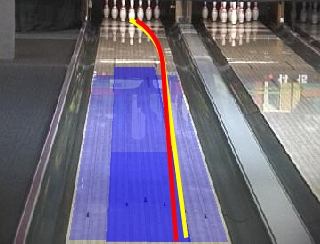 The
first 40 feet of a bowling lane is called the "heads," and is covered in
mineral oil to help reduce ball damage to the wooden lane. Slick balls
literally glide through this section completing just a few rotations and losing
critical energy, while pored balls are able to absorb some of the oil and
maintain more of the throwing force applied by the bowler. Once the ball exits
the heads, the pores also help traction on the non-oiled "back-end" of the
lane. The effect is a ball that rolls through the heads faster and curves on
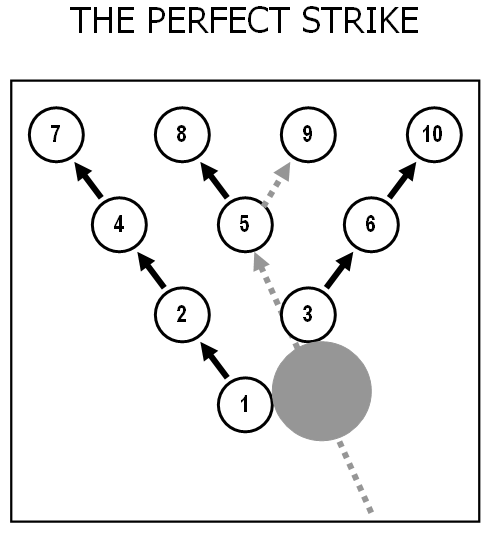
the backend at a higher angle. A strike is executed by a ball that assaults the
pin "pocket," which is the small area between the first row of pins and the
second row. The
first 40 feet of a bowling lane is called the "heads," and is covered in
mineral oil to help reduce ball damage to the wooden lane. Slick balls
literally glide through this section completing just a few rotations and losing
critical energy, while pored balls are able to absorb some of the oil and
maintain more of the throwing force applied by the bowler. Once the ball exits
the heads, the pores also help traction on the non-oiled "back-end" of the
lane. The effect is a ball that rolls through the heads faster and curves on
the backend at a higher angle. A strike is executed by a ball that assaults the
pin "pocket," which is the small area between the first row of pins and the
second row.
...via ABC 2 Bowling
While the resin shells help with lane traction, the core is
what can give the bowler an accurate measure of the ball's curve since a lane's
oil pattern changes even within the same game. Balls are of either two-piece or
three-piece design. Three-piece balls feature the shell, a ceramic inner core,
and an additional weight to compensate for weight lost during drilling.
Two-piece balls do not include this additional compensation.
The purpose of this inner core is to reduce the ball's
radius of gyration, which dictates how the ball's mass and density will be
distributed while rolling. Varying core designs are available, with cores that
place more mass toward the edges of the ball curving later on the lane than balls with
centralized mass. A faster bowl usually requires more mass toward the center of
the ball.
 ... via Wikimedia ... via Wikimedia
The
Science Channel's "How it's Made" featured bowling ball cores on a recent episode. After watching that, my career aspirations have changed considerably.
Ball Fun
Of course, having these physical advantages means nothing if
you don't know how to use them, right?
Generically, bowlers fall into one of two categories: the
"cranker" and the "stroker."

Crankers (pictured right) are the type of bowler who use their wh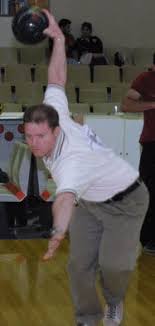 ole bodies
to roll the ball at optimum speed, with less finesse and better concentration
on overpowering pins. The leg stance provides leverage, and the cupped wrist
provides a side grip on the ball so the player can apply "English" to the ball,
making it spin at high rate across the Z and Y axis, which gains traction after
exiting the heads. ole bodies
to roll the ball at optimum speed, with less finesse and better concentration
on overpowering pins. The leg stance provides leverage, and the cupped wrist
provides a side grip on the ball so the player can apply "English" to the ball,
making it spin at high rate across the Z and Y axis, which gains traction after
exiting the heads.
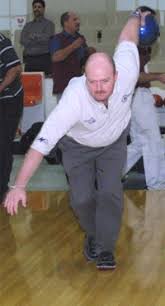 Strokers (pictured left) are a type of bowler who rely on accuracy and form
to maintain a reliable shot that consistently strikes the pocket. This type of
bowler keeps their shoulders straight to the pin, and slides with their last
step on delivery. A lighter ball is typically used, but maintains the same
hooked path as a heavier ball, but with less rotation around the Z-Y axis. This
is again due to the core. Manufacturers are able to calculate bowling balls to
hook to the same angle, despite different masses being used. Strokers (pictured left) are a type of bowler who rely on accuracy and form
to maintain a reliable shot that consistently strikes the pocket. This type of
bowler keeps their shoulders straight to the pin, and slides with their last
step on delivery. A lighter ball is typically used, but maintains the same
hooked path as a heavier ball, but with less rotation around the Z-Y axis. This
is again due to the core. Manufacturers are able to calculate bowling balls to
hook to the same angle, despite different masses being used.
...via Ten Pin Bowling
You would think that in order to be a cranker, you have to
be a large person; someone tall enough with long enough arms to generate a big
backswing and follow-through. That's not the case. Notable PBA pro Chris Warren
stands at 5-foot-4, yet can throw the ball at 118* mph. And 6-foot-2 bowler
Walter Ray Williams Jr. uses a light stroke, toppling pins with his resin ball
that would have remained had he used a urethane ball.
The Better Bowler
As with everything--like Jeremy Lin's jumper--practice makes
perfect.
However, armed with the knowledge of how bowling balls
curve, and at which angle to attack the pocket, you too can become Ernie McCracken.
 As for me, I'd like to think that I'm one of those
individuals who know to quit when ahead. So, rather than risk being "munsoned," you can expect to find me in the alley bar with a Sam Adams playing
billiards. As for me, I'd like to think that I'm one of those
individuals who know to quit when ahead. So, rather than risk being "munsoned," you can expect to find me in the alley bar with a Sam Adams playing
billiards.
* Ed. Note: This fact seems hyperbolized, despite its propensity from Popular Mechanics. A more a reasonable speed of 18 mph suggest a typo, but the article author refuses to comment or explain. BIG stick tap to Doorman.
Resources
Wikipedia - Bowling Ball
Bowling Ball - Bowling Ball Core Designs
Bowler's Paradise
Vizard, Frank, and Robert Lipsyte. Why a Curveball Curves. ; The Incredible Science of Sports. 2009. Print.
| 


 Re: A Bowler's Balls is All That Counts


