|
 In the early years of passenger aviation, things were how
you say…different. In the early years of passenger aviation, things were how
you say…different.
Passengers would dress up in their Sunday best. You could
smoke in the cabin. Airlines would make special (non-microwaved) meals for
passengers with dietary needs. No one frisked or viewed you naked before you
boarded the plane, and sexually harassing the stewardess (not flight attendant)
was an unfortunate given.
There are a few things that likely contributed to this
"laissez-airfare" [Pats self on back]. September 11 and the underwear/shoe
bombers hadn't happened yet, and the biggest threat to Western prosperity was
communism. Airlines respected the business and comfort of their passengers as
they realized they still faced significant competition from railroads and
automobiles. Likewise, passengers felt privileged to travel via airplane; it
was novel and it was glamorous.
Would an innovative, fast, marketable, and inherently safe
method of transport usher in a new era of travel? One built on customer service
with a low risk of terrorist meddling? It may not bring back the suits or the
smoking lounge, but it could provide the airline industry with some much needed
competition.
Meet the Ground
Effect Vehicle (GEV)
 By 1934, the U.S. National Advisory Committee for
Aeronautics had issued a reference manual based on the work of Frenchman
Maurice Le Sueur. He had simply documented what pilots already knew: planes
operated most efficiently when flying just dozens of feet above the earth. By 1934, the U.S. National Advisory Committee for
Aeronautics had issued a reference manual based on the work of Frenchman
Maurice Le Sueur. He had simply documented what pilots already knew: planes
operated most efficiently when flying just dozens of feet above the earth.
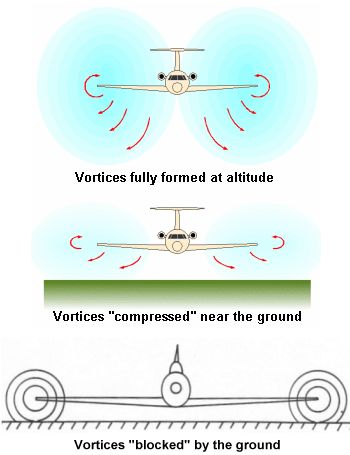
When an aircraft is flying at an altitude equidistant or
below the length of its wingspan, it experiences a significant reduction of
induced drag. The basic principal of lift is accomplished by higher air
pressure under the wing and lower air pressure above the wing. 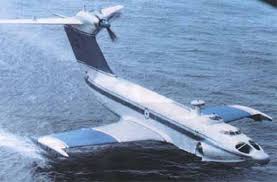 The air flows
from below the wing to the edge and upwards in a circular fashion creating
vortices at the wingtips. This reduces the efficiency of the wing's angle of
attack. By flying close to a surface, vortices are interrupted. Witness wingtip vortices
depicted by smoke. The air flows
from below the wing to the edge and upwards in a circular fashion creating
vortices at the wingtips. This reduces the efficiency of the wing's angle of
attack. By flying close to a surface, vortices are interrupted. Witness wingtip vortices
depicted by smoke.
Flying very close to the ground also improves the air
'cushion' generated by the wing underside, and also improves the aircraft
lift-to-drag ration. This creates a floating effect, where the plane can
maintain velocity while reducing thrust.
Watch
the Universal Hoverwing GEV.
GEV Applications
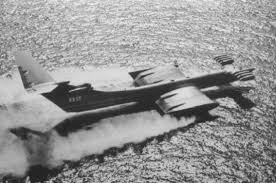 While GEVs are most efficient over land, they rarely have
the landscape to be useful. Using GEVs over water is most practical. The Soviet Union was a forerunner of GEV
technology, and subsequently militarized some designs. At 240 feet long,
the U.S-dubbed "Caspian Sea Monster" was an enormous GEV. It reached speeds of
350 mph at a height of 66 feet. They later produced five odd-looking but
successful GEVs for logistical support in the Caspian and Black Seas. In 2010, Iran
became the only other nation to use GEVs as military vehicles. Boeing has
proposed a large-transport GEV for Western military use, but it remains a concept at
the date of this publication. While GEVs are most efficient over land, they rarely have
the landscape to be useful. Using GEVs over water is most practical. The Soviet Union was a forerunner of GEV
technology, and subsequently militarized some designs. At 240 feet long,
the U.S-dubbed "Caspian Sea Monster" was an enormous GEV. It reached speeds of
350 mph at a height of 66 feet. They later produced five odd-looking but
successful GEVs for logistical support in the Caspian and Black Seas. In 2010, Iran
became the only other nation to use GEVs as military vehicles. Boeing has
proposed a large-transport GEV for Western military use, but it remains a concept at
the date of this publication.
 Instead, civilian use for ferrying or tourism remains the
GEV's primary niche. One could envision a GEV that provides passage across the
oceans in roughly the same amount of time as a plane. It would in theory be a
cheaper form of travel, since it would require less fuel than other aircraft.
It would also appeal to individuals who are afraid of flying due to heights or
crashing. GEVs remain relatively close to the water surface-close enough that a
mechanical failure would be unlikely to destroy the cabin of the vehicle. Since
GEVs would be restricted to open water and coastlines, it would also be less
likely to become the medium of terrorists--landlocked cities would be out of
reach and GEV land-access points could be closely monitored. Instead, civilian use for ferrying or tourism remains the
GEV's primary niche. One could envision a GEV that provides passage across the
oceans in roughly the same amount of time as a plane. It would in theory be a
cheaper form of travel, since it would require less fuel than other aircraft.
It would also appeal to individuals who are afraid of flying due to heights or
crashing. GEVs remain relatively close to the water surface-close enough that a
mechanical failure would be unlikely to destroy the cabin of the vehicle. Since
GEVs would be restricted to open water and coastlines, it would also be less
likely to become the medium of terrorists--landlocked cities would be out of
reach and GEV land-access points could be closely monitored.
So, can you envision a trans-Atlantic crossing that has the speed
of air travel, the safety of boat travel, and energy-efficient propulsion? It
sounds too good to be true. Finally, at least one company has explored the feasibility of ground effect trains, but it seems silly.
 And what about the travel etiquette I rambled about earlier?
It would probably be more akin to a cruise ship. Similar to how women were
required to a dress or skirt to board a plane, men would now be required to
wear a cabana shirts and boat shoes! And what about the travel etiquette I rambled about earlier?
It would probably be more akin to a cruise ship. Similar to how women were
required to a dress or skirt to board a plane, men would now be required to
wear a cabana shirts and boat shoes!
Resources
Image credits, in order: Vintage Ad Browser; Aerospace Web; G Static; David S. Zondy; Buzzle
Wikipedia - Ground Effect Vehicle; A-90 Orlyonok; Wingtip vortices
| 


 Re: Ground Effect Vehicles As Alternate Transportation


"Almost" Good Answers: