|
It's long been said that surprise is one of the best weapons
on the battlefield. The Ancient Chinese essay the "Thirty-Six Stratagems,"
often attributed to Sun Tzu, outlines its effectiveness: "In any battle the
element of surprise can provide an overwhelming advantage."
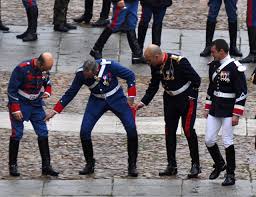
This has been the prevailing logic of warfare
since prehistoric raiding parties , but until the 19th Century one area of battle technique was glaringly
surprise-deficient: uniforms. The French wore scarlet tunics, the British wore
'redcoats', and those Yankee rebels wore blue. These aren't exactly the most subtle colors for marching through
forests and fields, are they?
The reasoning is that before
rifles, firearms were too inaccurate at distances where camouflage would be
effective. Pretty much you're going to identify soldiers 100 yards away no
matter what color or outfit they wear.
As guerilla warfare dwindled British troop numbers during the American
Revolution, and the development of rifling led to a significant increase in
longarm performance in the 1800s, officers realized that colorful uniforms with
shiny buttons not only felt really silly but also got you killed. By the turn
of the 20th Century most major armies had adopted colors associated with their
theaters. Notable camouflage designs have been developed since, sometimes to
the chagrin of the personnel it's meant to protect.
 Julius Caesar is credited with the first recorded use of
camouflage for a battlefield advantage. He ordered reconnaissance boats off the
coast of Britain painted Venetian blue during the Gallic Wars. Unfortunately,
camouflage techniques for ships were ignored until World War I, when the use of
U-boats and airplanes required concealment from enemies at distances. This gave
birth to the infamous dazzle camouflage in U.S. and U.K. warships, where the
intention was not to hide but rather confuse. (This type of camo also seems really silly.) Military leaders
admitted that it would be difficult to hide the outline of ship, but that it
was possible to baffle observers as to the direction, speed, type and size of
the ship. This relied on the use of visual rangefinders for targeting and its
effectiveness has been debated. It was used to lesser extent in World War II,
where radar and sonar deemed such patterns obsolete. Julius Caesar is credited with the first recorded use of
camouflage for a battlefield advantage. He ordered reconnaissance boats off the
coast of Britain painted Venetian blue during the Gallic Wars. Unfortunately,
camouflage techniques for ships were ignored until World War I, when the use of
U-boats and airplanes required concealment from enemies at distances. This gave
birth to the infamous dazzle camouflage in U.S. and U.K. warships, where the
intention was not to hide but rather confuse. (This type of camo also seems really silly.) Military leaders
admitted that it would be difficult to hide the outline of ship, but that it
was possible to baffle observers as to the direction, speed, type and size of
the ship. This relied on the use of visual rangefinders for targeting and its
effectiveness has been debated. It was used to lesser extent in World War II,
where radar and sonar deemed such patterns obsolete.
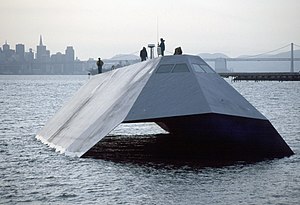  Flash forward to 1984, where Lockheed engineers design the
Sea Shadow (pictured left), an experimental U.S. warship to test innovations in ship control,
structures, automation, seakeeping, and signature control. The Sea Shadow's designs
proved to be invalid for a variety of reasons, and it is currently being
dismantled in Suisun Bay,
Calif. However, Sweden has produced some radar-evasive ships with its
launch of the Visby-class corvettes (at right) in 2000. Five naval vessels have composite
construction and angular designs, eliminating its radar detectability and heat
signature by 99%. Flash forward to 1984, where Lockheed engineers design the
Sea Shadow (pictured left), an experimental U.S. warship to test innovations in ship control,
structures, automation, seakeeping, and signature control. The Sea Shadow's designs
proved to be invalid for a variety of reasons, and it is currently being
dismantled in Suisun Bay,
Calif. However, Sweden has produced some radar-evasive ships with its
launch of the Visby-class corvettes (at right) in 2000. Five naval vessels have composite
construction and angular designs, eliminating its radar detectability and heat
signature by 99%.
Of course, intriguing camo designs are not limited to naval
forces. The woodland pattern soon became the go-to troop pattern for NATO
countries in the 1980s, and a desert variation was later adapted as well. These
patterns were rather aesthetically appeasing--at least in comparison to what
replaced it. In 1996 Canadian Forces introduced a digital camouflage design
that was intended to simulate the pale boundaries of textures from a distance. With
colors blending seamlessly, the CADPAT (Canadian Pattern) was 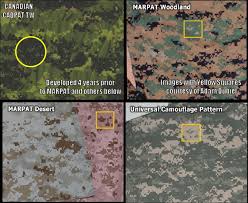 determined to be
extremely more effective at concealing troops. The U.S. Marines were quick to
adopt their own variation of digital camouflage in 2001, while praising its
updated and unique look. determined to be
extremely more effective at concealing troops. The U.S. Marines were quick to
adopt their own variation of digital camouflage in 2001, while praising its
updated and unique look.
There has been some harsh criticism of digital camouflage
however, especially as branches have
tried to develop a be-all, end-all camouflage design. Since 2004, the U.S. Army
has spent $5 billion on a digitized design that has "failed in every
environment." In an attempt to outfit expensive gear in a single, neutral camo
pattern the army developed Universal Camouflage. However, the design clashes
with every other pattern in service and testing has determined the pattern
actually makes soldiers more visible when overused. The army outfitted
servicemen and women with this design before testing even concluded. 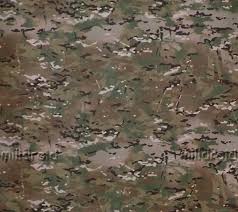 This
demonstrates the delicate nature of camouflage pattern design: patterns must be
exclusive enough to avoid recognition, but diverse enough to operate in
multiple environments. Today the U.S. Army is implementing Multi-Cam, a
well-regarded pattern in use in several other nations. This
demonstrates the delicate nature of camouflage pattern design: patterns must be
exclusive enough to avoid recognition, but diverse enough to operate in
multiple environments. Today the U.S. Army is implementing Multi-Cam, a
well-regarded pattern in use in several other nations.
What does the future of camouflage design hold? For the best
answer, we need to look at the past.
Allegedly, military interest in invisibility has existed
since at least 1943. According to some reports, the U.S. Navy conducted an
experiment based on Albert Einstein's Unified Field Theory--that was designed
to make physical matter invisible. Docked in the Philadelphia Naval Yards in
1943, the U.S.S. Eldridge was supplied with peculiar equipment.  In the first
experiment the ship vanished into a cloud of greenish fog; in the second
experiment the Eldridge teleported from its mooring and appeared off the coast
of Norfolk, only to reappear in Philadelphia moments later. In both experiments
the ship's crew members are reputed to have gotten extremely sick. Some
suffered from mental illness or nausea, while others found body parts
atomically-fused to the ship's metallic superstructure. These events were
undertaken as part of Project Rainbow, a known program to reduce radar cross
sections in the 1950s. However, The Philadelphia Experiment is largely
considered to be a hoax. In the first
experiment the ship vanished into a cloud of greenish fog; in the second
experiment the Eldridge teleported from its mooring and appeared off the coast
of Norfolk, only to reappear in Philadelphia moments later. In both experiments
the ship's crew members are reputed to have gotten extremely sick. Some
suffered from mental illness or nausea, while others found body parts
atomically-fused to the ship's metallic superstructure. These events were
undertaken as part of Project Rainbow, a known program to reduce radar cross
sections in the 1950s. However, The Philadelphia Experiment is largely
considered to be a hoax.
Active camouflage is an area of
heavy interest and it, in a sense, actually makes items invisible. The idea is
that cameras identify an item's surroundings and a cloaking device mimics what
an observer would expect to see. Active camouflage exists as a  proof-of-concept
and new technologies are promising a holographic cloak. For now, active
camouflage exists to conceal tanks and vehicles when viewed by infrared. Dubbed
Adaptiv, hexagon panels are attached to the vehicle and hide the object's heat
signature. These panels emit a new outline of a nonthreatening object such as a
car or large rock. The manufacturer claims that it can conceal vehicles at less
than 500 meters. proof-of-concept
and new technologies are promising a holographic cloak. For now, active
camouflage exists to conceal tanks and vehicles when viewed by infrared. Dubbed
Adaptiv, hexagon panels are attached to the vehicle and hide the object's heat
signature. These panels emit a new outline of a nonthreatening object such as a
car or large rock. The manufacturer claims that it can conceal vehicles at less
than 500 meters.
Camouflage is a relatively recent battlefield invention and
its effective lifespan will be just a few hundred years. Eventually wars will
be fought at distances where visual identification will no longer be required. As we enter an age of smart bombs and bullets, making items invisible to targeting
systems has become much more essential. There may even be a day were people
completely abstain from the front lines. We're not there yet though, and
safeguarding the world's freedom fighters is not a mistake worth making-even if
the U.S. Army's $5 billion may detract.
As we enter an age of smart bombs and bullets, making items invisible to targeting
systems has become much more essential. There may even be a day were people
completely abstain from the front lines. We're not there yet though, and
safeguarding the world's freedom fighters is not a mistake worth making-even if
the U.S. Army's $5 billion may detract.
Now if you'll excuse me, I'm going to put on my ghillie
suit and hang out in the bushes for a few hours.
Resources:
Image credits: Wired; Twisted Sifter; Wikimedia; Paisley and Patterns; Milidroid; Alem da Imaginacao; Army Surplus World
Wikipedia - Military Camouflage; Philadelphia Experiment; Active camouflage; Adaptiv; Sea Shadow; MARPAT
Popular Mechanics - The Evolution of Camouflage; The Pentagon's Convoluted Search for Better Camouflage
Gizmodo - U.S. Army's Pixellated Camo Uniform is a $5 Billion Failure
| 


 Re: Camouflage Comprehensive


