|
Is humankind a naturally peaceful, accepting and tranquil species, or are we prone to aggression, isolation and war? While there isn't really an answer to such a  question--and I'm not intending to invoke philosophical debate-- this dichotic inquiry has led to many engineering innovations in our world. question--and I'm not intending to invoke philosophical debate-- this dichotic inquiry has led to many engineering innovations in our world.
Bridges bring people together; fences keep them apart. Weapons manufacturers build the most lethal, high-tech, precision cluster bombs ever in existence, but military planes are as likely to deliver food and care packages as they are death from above. Historians refer to global security post-World War II as 'The Long Peace' due to the relative apprehension of countries to engage in all-out wars. In his upcoming book The Better Nature of Our Angels, psychologist Steven Pinker asserts that humanity is likely to eradicate war one day, perhaps sooner than we expect.
But when the designs of weapon engineers lie stagnant and dangerous on the battlefield, as is the case with landmines, it becomes the job of another engineer to  clear these implements once the battles have ceased. And while there are no academic qualifications, combat engineering units are relied upon to build bridges, roads and fortifications; implement camouflage and communication networks; and in the following instance, ensure that leftover ordinance doesn't maim a young child as he retrieves a far-flung soccer ball. clear these implements once the battles have ceased. And while there are no academic qualifications, combat engineering units are relied upon to build bridges, roads and fortifications; implement camouflage and communication networks; and in the following instance, ensure that leftover ordinance doesn't maim a young child as he retrieves a far-flung soccer ball.
According to the UN, landmines kill 15,000 to 20,000 people each year, of which almost 80% are civilian since accurately mapping war-torn regions is an imperfect science. While militaries will lay mines and remove a portion of the enemy's mines, once the fighting ends so do their demining operations. The burden falls on communities to deal with unexploded and indiscriminate mines. Though 161 parties have signed the 1997 Ottawa Treaty to ban mine warfare, over 110 million mines remain planted in 70 countries around the world. A large number of these mines reside in third-world and rural areas, threatening the lives of millions who do not have access to mine-clearing equipment. Previously, their best method of mine detection was letting the livestock graze someplace new for the day. Fortunately, humanitarian organizations and scientific communities have done their best to provide unique and cost effective demining methods.
 While metal detectors have been the status quo of the Little Green Plastic Army, they are deficient when mines are plastic in construction and they also yield 1,000 false positives for every mine. As such, mechanical methods of demining usually involve exploding the mine with the use of heavy-duty machinery. While metal detectors have been the status quo of the Little Green Plastic Army, they are deficient when mines are plastic in construction and they also yield 1,000 false positives for every mine. As such, mechanical methods of demining usually involve exploding the mine with the use of heavy-duty machinery.
Flails and tillers are mounted on high-capacity tractors which are remote controlled or even operator-driven. Just like the garden equipment, they churn the top layer of soil and detonate the mine. They have hardened tools to keep the equipment from sustaining serious damage during an explosion, and cab and motor compartments are well armored. When the machine finds a landmine the result is a large explosion that is concentrated towards the front of the machine, and they are epically cool to watch. In similar fashion, many robots have been developed which use ground penetrating radar, metal detection, stereo vision cameras, or other methods to identify landmines. Robots do not usually explode the mine but instead mark it with spray paint.
Other, less mechanical means of demining are typically very accurate, but also require human intervention. Dogs are well-regarded in their sense of smell, and with this sense they can detect explosives buried beneath the Earth's surface. However, a dog's enthusiasm varies by day, and they can become exhausted and ineffective, in hot climates like Africa and Asia. So while a dog is heavy enough to trigger a landmine, a rat is not, and has become the favored animal for working in minefields.
 "Rats are intelligent, and they like to learn new things," Jared Mkumbo told a Time reporter in 2008. Mkumbo, a Tanzanian rat trainer, praised the African giant pouched rats for their loyalty and sense of smell. Not only are the rats accustomed to the climate, but they are inexpensive to procure, train, raise and transport. The rats work for food, so they can be given to different handlers. Finally, the rats are light enough so that they do not accidentally detonate a mine, and even scratch over the mine to indicate its presence. The Dutch news program Humanwire did a report on Hero Rats. "Rats are intelligent, and they like to learn new things," Jared Mkumbo told a Time reporter in 2008. Mkumbo, a Tanzanian rat trainer, praised the African giant pouched rats for their loyalty and sense of smell. Not only are the rats accustomed to the climate, but they are inexpensive to procure, train, raise and transport. The rats work for food, so they can be given to different handlers. Finally, the rats are light enough so that they do not accidentally detonate a mine, and even scratch over the mine to indicate its presence. The Dutch news program Humanwire did a report on Hero Rats.
The future of detecting landmines with the biological gifts of a species seems even more far-fetched than using rats. The bodies of the honey bee absorb chemicals that 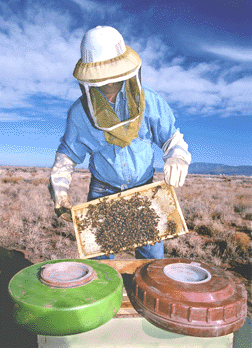 it has been in recent contact with, and a sensor inside a hive can determine if TNT is one of those chemicals. Researchers train bees to associate the smell of TNT by placing food nearby. Once they've learned that TNT smells like food, each bee is outfitted with an RFID tag. By tracing the bee's flight path, researchers can estimate landmine locations. The mustard plant Arabidopsis thaliana turns red under harsh conditions, and a Danish biotech company has genetically engineered the plant to only change color when in the presence of the NO that leaks from landmines and IEDs. Finally, using bioengineered bacteria has proven to be a viable way searching hundreds of acres in just a few hours. The bacterium fluoresces under UV light when near TNT. it has been in recent contact with, and a sensor inside a hive can determine if TNT is one of those chemicals. Researchers train bees to associate the smell of TNT by placing food nearby. Once they've learned that TNT smells like food, each bee is outfitted with an RFID tag. By tracing the bee's flight path, researchers can estimate landmine locations. The mustard plant Arabidopsis thaliana turns red under harsh conditions, and a Danish biotech company has genetically engineered the plant to only change color when in the presence of the NO that leaks from landmines and IEDs. Finally, using bioengineered bacteria has proven to be a viable way searching hundreds of acres in just a few hours. The bacterium fluoresces under UV light when near TNT.
While researchers take the time to improve other demining methods, such as nuclear reactions and acoustic measurement, the people of Cambodia wonder every time they leave their home for a walk if they'll return. It's a speculation Aki Ra, a child soldier-turned-blue collar mine deactivator. Aki Ra's disassembly process is harrowing, to say the least (no really, watch the video I just linked).
 While the world has noticed how reckless and dangerous landmines can be, they will continue to pervade the goodwill established by the Ottawa Treaty as long as the world's largest military powers continue to stockpile them. Of the 10 largest militaries in the world (China, USA, India, North Korea, Turkey, South Korea, Pakistan, Iran, Egypt, Vietnam), none of them have signed the treaty. While most of these countries concern themselves with nuclear weapons, one of the world's most deadly weapons remains unaddressed. While the world has noticed how reckless and dangerous landmines can be, they will continue to pervade the goodwill established by the Ottawa Treaty as long as the world's largest military powers continue to stockpile them. Of the 10 largest militaries in the world (China, USA, India, North Korea, Turkey, South Korea, Pakistan, Iran, Egypt, Vietnam), none of them have signed the treaty. While most of these countries concern themselves with nuclear weapons, one of the world's most deadly weapons remains unaddressed.
Resources
(Image credits: White Oliphaunt; Handicap Int.; Spider Pic; Armed Forces Int.; Giant Hamster; Sandia; ICRC)
Time - The Landmine-Sniffing Rats of Mozambique
Wikipedia - Demining; Ottawa Treaty
UN - Demining
Armed Forces Press - Researchers Abuzz About Bees...
| 


 Re: Operation Eliminate Landmines


