|
 Tipperary Hill is a Syracuse, N.Y., neighborhood with a
heavily Irish heritage, and the Celtic pride of its residents has led to an
85-year-old traffic anomaly. In the 1920's, locals took offence that the new
traffic light that placed the 'British' red over the 'Irish' green, so they
took a very Irish approach: they broke it. The city obliged the neighborhood's
attitude until the state government demanded the light be hung red-side up. For
three more years the locals hurled stones at the light, until finally the city
relented and hung the light green-over-red. Today, the light remains this way
and it appears to be the only example of a green-on-top red light. Tipperary Hill is a Syracuse, N.Y., neighborhood with a
heavily Irish heritage, and the Celtic pride of its residents has led to an
85-year-old traffic anomaly. In the 1920's, locals took offence that the new
traffic light that placed the 'British' red over the 'Irish' green, so they
took a very Irish approach: they broke it. The city obliged the neighborhood's
attitude until the state government demanded the light be hung red-side up. For
three more years the locals hurled stones at the light, until finally the city
relented and hung the light green-over-red. Today, the light remains this way
and it appears to be the only example of a green-on-top red light.
No matter how a traffic light is oriented--and no matter the
local identity--red is universally seen as "stop" in motorized countries. As
annoying as they are, red lights are imperative in creating a right of way for
drivers. And traffic lights have become commonplace on canals, in bike lanes, and
for public transport systems.
While many drivers dream about a
device that always gives
them the green light, other places are integrating computer analysis into
traffic signals. And as the traffic light is set to face its sesquicentennial
in 2018, some engineers are imaging are new, more efficient means of traffic
regulation.
The Past
 The first traffic light was installed outside London's
parliament in 1868. The design was based upon a train yard signal and included
semaphore arms with integral red and green gas lanterns. The signal could be
manually rotated, and though the main advantage was increased safety for the
operator, a gas explosion maimed the police officer who ran it just a month
after it was installed. Until electric designs were invented, the traffic light
was considered too dangerous. In 1914, Cleveland, Ohio, installed the first
electric traffic light, and over the next decade many light designs
proliferated in North America. Early models were commonly mounted on pillars
within intersections. These 'dummy lights' required drivers to swerve around
them, and only exist in historic preservation instances today. Eventually,
lights began to be hung; they gained switches so a signal operator could
control multiple light sets (Salt Lake City, 1917); and lights became automated
(1922, Houston) or computerized (1968, Toronto). Excepting when countdown
timers began to appear in the 1990s, traffic light representation has been
largely unchanged. The first traffic light was installed outside London's
parliament in 1868. The design was based upon a train yard signal and included
semaphore arms with integral red and green gas lanterns. The signal could be
manually rotated, and though the main advantage was increased safety for the
operator, a gas explosion maimed the police officer who ran it just a month
after it was installed. Until electric designs were invented, the traffic light
was considered too dangerous. In 1914, Cleveland, Ohio, installed the first
electric traffic light, and over the next decade many light designs
proliferated in North America. Early models were commonly mounted on pillars
within intersections. These 'dummy lights' required drivers to swerve around
them, and only exist in historic preservation instances today. Eventually,
lights began to be hung; they gained switches so a signal operator could
control multiple light sets (Salt Lake City, 1917); and lights became automated
(1922, Houston) or computerized (1968, Toronto). Excepting when countdown
timers began to appear in the 1990s, traffic light representation has been
largely unchanged.
There
is an innumerable amount of configurations for traffic lights worldwide, but
red is 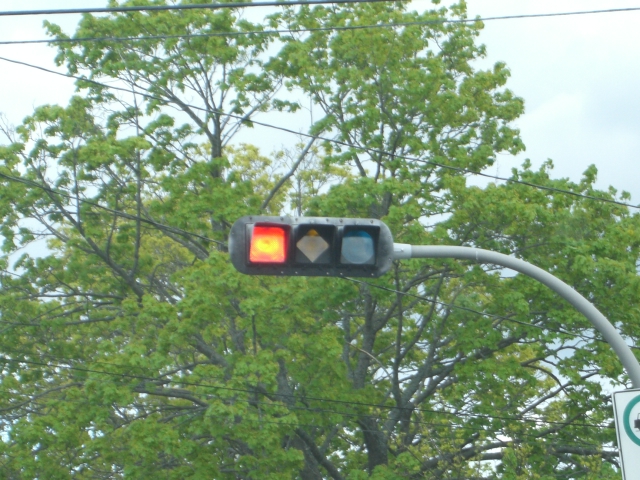 comprehensively seen as 'stop' in contrast to green's 'go'. The U.S.
states of California and Texas sometimes place two red lights on top of each
other, if only to gain visibility. Blustery regions of the southern U.S also
frequently use horizontal traffic lights to reduce wind resistance. Canadian
provinces commonly use horizontal designs as well, but some incorporate shapes
into the designs to aid color blind drivers. Red signals are represented by a
square; yellow by a diamond; and green by a circle. There are other unique
instances of horizontally-oriented traffic lights. Some Chinese cities utilize
a horizontal LED bar light which displays in patterned red, blinking yellow, or
shrinking green. Other Chinese states use simple red/green arrows, which can be
confusing to unfamiliar drivers. comprehensively seen as 'stop' in contrast to green's 'go'. The U.S.
states of California and Texas sometimes place two red lights on top of each
other, if only to gain visibility. Blustery regions of the southern U.S also
frequently use horizontal traffic lights to reduce wind resistance. Canadian
provinces commonly use horizontal designs as well, but some incorporate shapes
into the designs to aid color blind drivers. Red signals are represented by a
square; yellow by a diamond; and green by a circle. There are other unique
instances of horizontally-oriented traffic lights. Some Chinese cities utilize
a horizontal LED bar light which displays in patterned red, blinking yellow, or
shrinking green. Other Chinese states use simple red/green arrows, which can be
confusing to unfamiliar drivers. Perhaps the most random type of traffic signal
can be found in the Netherlands, which sparingly uses a nine dot grid to
represent traffic commands (at right). Perhaps the most random type of traffic signal
can be found in the Netherlands, which sparingly uses a nine dot grid to
represent traffic commands (at right).
The Present
 Even though the methodology of the traffic light has been
stagnant for years, new concepts are beginning to invigorate this old mechanism.
Recently, Los Angeles became the first city in the world to synchronize every single
one of its traffic lights; that's 4,500 lights across 469 square miles. Los
Angeles has the second worst traffic congestion in the U.S., only behind
Washington D.C. As a result, L.A. has spent 30 years and $400 million to build
a system of magnetic sensors, traffic cameras, and computers to analyze and
predict traffic patterns in the metro area. The result is a 16% increase in
traffic speed, and a 12% decrease in delays at traffic lights. This was done in
large part to be more environmentally and economically friendly-one report
estimates fuel and time savings to be up to $1.3 billion. Even though the methodology of the traffic light has been
stagnant for years, new concepts are beginning to invigorate this old mechanism.
Recently, Los Angeles became the first city in the world to synchronize every single
one of its traffic lights; that's 4,500 lights across 469 square miles. Los
Angeles has the second worst traffic congestion in the U.S., only behind
Washington D.C. As a result, L.A. has spent 30 years and $400 million to build
a system of magnetic sensors, traffic cameras, and computers to analyze and
predict traffic patterns in the metro area. The result is a 16% increase in
traffic speed, and a 12% decrease in delays at traffic lights. This was done in
large part to be more environmentally and economically friendly-one report
estimates fuel and time savings to be up to $1.3 billion.
The Future
As far as the future of traffic control is concerned, there
are two very different camps. In one, a visual redesign of traffic lights to
modernize them; the second, a future with no traffic lights at all.
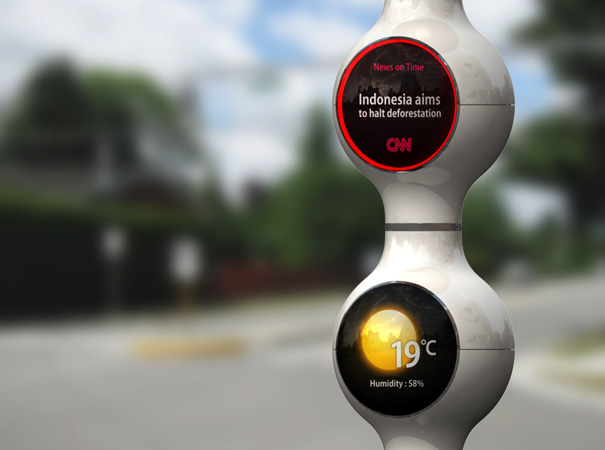 The droplet traffic light (seen right) is an invention of a Korean
company. The idea is simple: a solar powered light operates normally, directing
vehicles in shades of red, yellow, and green. But when the light is red, it
rotates to display the news, weather, and traffic info. Before the light is up,
it rotates back to the standard color indicators and then finally lets vehicles
pass. On the other hand, residents of the Dutch town of Drachten have been
guinea pigs for an experiment in which their traffic lights have been removed
altogether. The idea, says the engineer behind the project, is to make the
roads more dangerous, thereby encouraging
people to be more wary of their decisions. Remarkably, major traffic collisions
have been exchanged for minor impacts, and traffic deaths have decreased as
well. The droplet traffic light (seen right) is an invention of a Korean
company. The idea is simple: a solar powered light operates normally, directing
vehicles in shades of red, yellow, and green. But when the light is red, it
rotates to display the news, weather, and traffic info. Before the light is up,
it rotates back to the standard color indicators and then finally lets vehicles
pass. On the other hand, residents of the Dutch town of Drachten have been
guinea pigs for an experiment in which their traffic lights have been removed
altogether. The idea, says the engineer behind the project, is to make the
roads more dangerous, thereby encouraging
people to be more wary of their decisions. Remarkably, major traffic collisions
have been exchanged for minor impacts, and traffic deaths have decreased as
well.
Personally, I don't see either of the aforementioned ideas
coming into wide acceptance. While solar powered traffic lights are definitely
smart, I don't think many municipalities are going to install small LCD
displays in their traffic lights, which will only further distract drivers. As
far as removing traffic lights altogether, that seems far-fetched as well.
Russians, in a nation with poor traffic laws but over 30 million cars, have a
dash cam in nearly every vehicle to protect personal rights. The result has
been such dash cam gold as mirror
fight; armor crossing;
and jet buzz.
What say you? What does the future of traffic control look like?
Resources
(Image credits: Roadtrippers; My Internet Security; Wikimedia; UC Davis; Yanko Design)
Wikipedia - Traffic light; Tipperary Hill
Telegraph - Is this the end for traffic lights?
NY Times - To fight gridlock, LA...
Design Boom - Psychic Factory: Droplet Traffic Light
Wired - Why almost everyone in Russia...
| 


 Re: Rethinking Traffic Lights


