|
Waterproofing sprays are nothing new. You may have used them to waterproof your tent or tarp fabric, a rain jacket, or perhaps some work gloves or work boots. Over the past few years however, a number of so-called hydrophobic or superhydrophobic coatings have gained a notable amount of attention. This isn't surprising considering the eye-catching, magic-like product demonstration videos that Rust-O-Leum's NeverWet™ and Ultra-tech's Ultra-Ever Dry™ have pushed to consumers [check out the videos here and here]. Cool stuff!

NeverWet™ in action - Via CNET
Just what are hydrophobic coatings exactly? - Well, I'm glad you asked!

Hydrophobic literally means "water fearing", and sheds light on the purpose of hydrophobic coatings, which is to repel water. Hydrophobic materials cause the hydrophobic effect - a phenomenon where nonpolar molecules (molecules with an overall balanced charge distribution) repel or minimize their contact with water molecules (which are polar). This is due to the water molecule's tendency to form hydrogen bond with itself: nonpolar molecules interfere with this network of bonds more than other polar molecules. Thus, when water comes in contact with a nonpolar substance, the two materials naturally move in order to minimize contact. The common example of this is oil in water.
Water molecule (right) - Via brooklyn.cuny.edu
When a hydrophobic coating is applied to a surface, it encourages minimal contact between itself and water, causing water to ball up into very spherical droplets and/or slide off a surface as if it's friction was reduced.
Why are they called superhydrophobic coatings?
Superhydrophobic means what is sounds like - very hydrophobic. By definition, a superhydrophobic material causes the contact angle of water droplets that touch it to exceed 150 degrees and the roll-off angle to be less than 10 degrees. This definition is based off of the effects exhibited by the lotus plant, which has superhydrophobic leaves which help protect the plant from pathogens and increases its overall exposure to sunlight. Superhydrophobic coatings are extremely water-repellant, and cause the effects seen in the demonstration videos where the liquid seems to fall right off.
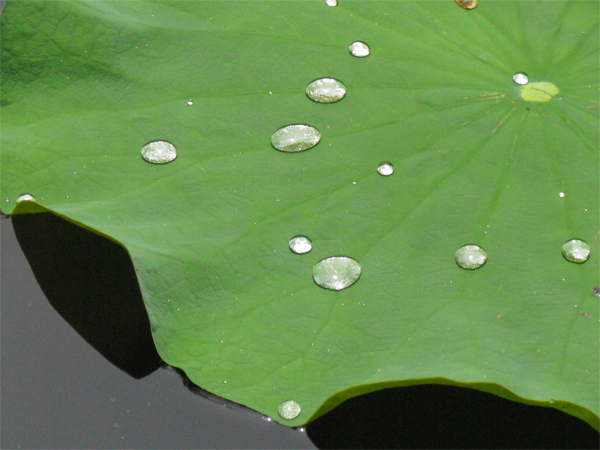
Lotus plant leaf - Via sunipix.com
So what's the catch?
There a few catches of course. This isn't magic in a can after all… it's actually magic in two cans! By this I mean that most of these new water-repellant coatings require the application of two separate materials - a base layer and a top coat. Product life before reapplication will depend on the surface use, exposure to sunlight, temperature, abrasion, etc.
The products are also limited to certain applications. Consumer versions (in spray cans, etc.) are going to create coatings that are microns (vs. nanometers) thick. This means the coatings will cause both visible (discoloration) and textural (waxy feeling) changes to the applied surface. Also, most of these coatings cannot be safely applied
What about industry?to clothing, certain fabrics, or anything that will touch food. Some consumer reviews have stated that the coating "destroys" certain materials/surfaces, which probably means think twice about what you're coating before you spray. To that end, I imagine trying to waterproof your skin would also not be such a good idea. Don't do that…
The advantage of hydrophobic coatings in industry is the ability to apply much thinner layers. This makes applications to electronics feasible without affecting their thermal properties (i.e. no danger of overheating). Industrial coating processes also have the ability to apply material evenly across a surface to avoid clumping.

One application where hydrophobic coatings would be particularly useful is in steam condensers in power plants that utilize steam turbines. Having hydrophobic surfaces helps to remove condensed water to be reused in the steam generator or boiler, improving efficiency. Unfortunately, most coatings have very limited durability in these harsh environments. Recently, MIT researchers say they have solved this problemby developing a new covalent-bonding process that is significantly more stable than previous coatings. According to their tests, metal surfaces coated using the team's process stood up well even after exposure to 100 degrees Celsius, well above the 40 degrees Celsius temperature in power-plant condensers.
Condenser droplets (right) - Via MIT news
What about you?
The effects of superhydrophobic coatings are definitely neat to watch, and it will be interesting to see how they develop from here. I've used a few waterproofing materials for my tent and for my leather boots, but I haven't had the need to try my luck with anything more "advanced". What about you?
| 


 Re: Hydrophobic Coatings


