Previous in Forum: Electrical Equipment Damaged by Lightning Strike   Next in Forum: Arcing Under Magnetic Field
Close
Close
Close
Page 2 of 2: « First < Prev 1 2 Last »
Rate Comments: Nested
Anonymous Poster

DC Incandescent Bulb

03/16/2010 2:16 AM

A simple question:Can I use ordinary incandescent bulb rated 230V AC,60w in 220V DC?Is there any problem?These bulbs are actully used in the emergency lighting fed from DC charger.There are hardly available DC bulbs in the market.Pls have your opinions/experiences here...........thank you.

Reply
Interested in this topic? By joining CR4 you can "subscribe" to
this discussion and receive notification when new comments are added.

Good Answers:

These comments received enough positive votes to make them "good answers".

"Almost" Good Answers:

Check out these comments that don't yet have enough votes to be "official" good answers and, if you agree with them, vote them!
Guru

Join Date: Oct 2009
Location: sometimes Wales,UK.. was Libya, now Oman!
Posts: 1715
Good Answers: 117
#89

Re: DC Incandescent Bulb

03/18/2010 5:43 PM

I've just got it!

No, not STD's, why some any posts are way off, there's no light on at the end of the tunnel, so it's the blind leading the blind.

For Christ sakes someone invent a lamp/light bulb that works, or i'll never see to pee straight again.

__________________
The square root of nothing is what you make it!
Reply
Guru
Hobbies - DIY Welding - New Member

Join Date: Feb 2007
Location: Next to the Prime Merridian (51°29'34.50"N 0°13'32.85"W)
Posts: 780
Good Answers: 1
#99

Re: DC Incandescent Bulb

03/22/2010 9:24 AM

Since the filament is purely resistive and its resistance for all practical purposes will be the same (884.6 ohms) regardless AC or DC current used.

The only thing is at 220V it'll only give @55W instead of 60W that in your case won't make much of a difference, will it?

__________________
Making mistake is part of learning.
Reply
Guru
Engineering Fields - Mechanical Engineering - New Member

Join Date: May 2008
Location: CHENNAI, TAMIL NADU, INDIA.
Posts: 1851
Good Answers: 65
#103

Re: DC Incandescent Bulb

01/27/2013 12:53 AM

Dear Friend,

Yes. You can use 230 Volts 60 W bulb in 220 Volts DC. Ordinary Incandescent Bulb emits light on acccount of HEATING EFFECT of the filament.

DHAYANANDHAN.S

Reply
Guru
Popular Science - Weaponology - New Member Safety - ESD - New Member Hobbies - Fishing - New Member

Join Date: Sep 2006
Location: Near Frankfurt am Main, Germany. 50.390866N, 8.884827E
Posts: 17996
Good Answers: 200
#104

Re: DC Incandescent Bulb

01/27/2013 4:40 AM

To remind all, the value of AC voltage measured with a reasonable meter reflects the "work" that a DC voltage of that same value can do.

If we take the example of a light bulb marked as being 230 Volts, it can have either 230 Volts AC or DC applied to it and will be of exactly the same brightness with either - no difference whatsoever......

The measured AC voltage is called the RMS value, 0.707 of the peak value.

The OP can read up on this here:-

http://en.wikipedia.org/wiki/Alternating_current#Mathematics_of_AC_voltages

But whereas the DC voltage will (should) be of a constant value, the AC voltage varies at the "speed" of the frequency. Usually 50 or 60 Hz..

Therefore when it is at a low value, or even passing through the zero line, no work is being done, though the speed at which a light bulb filament can cool down is relatively so slow that it is not even noticeable.

A LED can switch on and off at the low frequencies used and some people can actually see it or even be affected by it......Especially some bad PC/TV screens can effect people badly who are sensitive.....

In the light bulb, it "averages" out the power dissipation, maintaining for the average human eye a fairly constant value of illumination....

In the link you can find this:-

Power and root mean square

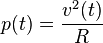
The relationship between voltage and the power delivered is

where represents a load resistance.

Rather than using instantaneous power, , it is more practical to use a time averaged power (where the averaging is performed over any integer number of cycles). Therefore, AC voltage is often expressed as a root mean square (RMS) value, written as , because

For a sinusoidal voltage:

The factor is called the crest factor, which varies for different waveforms.

__________________
"What others say about you reveals more about them, than it does you." Anon.
Reply
Reply to Forum Thread Page 2 of 2: « First < Prev 1 2 Last »

Good Answers:

These comments received enough positive votes to make them "good answers".

"Almost" Good Answers:

Check out these comments that don't yet have enough votes to be "official" good answers and, if you agree with them, vote them!
Copy to Clipboard

Users who posted comments:

Andy Germany (16); Anonymous Poster (19); bhankiii (2); brich (9); capblanc (2); Carl Pugh (1); dhayanandhan (1); Doorman (1); DreadZontar (2); dvmdsc (9); Electroman (1); Erajib (1); ffej (1); giri (1); GW (5); Haajee (3); Isti80 (3); jack of all trades (1); jvrj (1); lyn (2); madness (1); old salt (4); pwr2thepeople (1); PWSlack (1); Randall (2); ronseto (4); Rorschach (2); tcmtech (1); Tornado (6); TVP45 (1)

Previous in Forum: Electrical Equipment Damaged by Lightning Strike   Next in Forum: Arcing Under Magnetic Field

Advertisement