Previous in Forum: Oil Purificaiton System   Next in Forum: Stainless Steel Trim Rams Pitting
Close
Close
Close
61 comments
Rate Comments: Nested
Guru
Technical Fields - Technical Writing - New Member Engineering Fields - Marine Engineering - New Member

Join Date: Sep 2008
Location: Vancleave, Ms about 30 miles inland from Biloxi and the coast
Posts: 3197
Good Answers: 106

Terminal Velocity Vs. Initial Velocity

07/04/2010 12:05 PM

This is not a homework question. I haven't been near a school for 30+ years. My mind sometimes fails me.

If I shoot a bullet straight up in the air, the bullet will leave the barrel at a muzzle velocity (initial velocity), ascend until it reaches zero and then gravity takes over and the bullet descends until it reaches the ground (terminal velocity). The terminal velocity will be much less than the initial velocity.

Can a bullet or object be projected skyward at such an initial velocity that the terminal velocity will be greater than the initial velocity? We are ignoring wind and start and finish elevation is the same.

__________________
Mr.Ron from South Ms.
Register to Reply
Interested in this topic? By joining CR4 you can "subscribe" to
this discussion and receive notification when new comments are added.

Good Answers:

These comments received enough positive votes to make them "good answers".

"Almost" Good Answers:

Check out these comments that don't yet have enough votes to be "official" good answers and, if you agree with them, vote them!
Guru

Join Date: Oct 2008
Posts: 42355
Good Answers: 1693
#1

Re: A question to pick your brain and mine also

07/04/2010 1:45 PM

First, lets agree on terms. Terminal velocity is the constant speed attained by a falling object considering gravity and drag. After that, the speed is constant. Impact velocity may, or may not equal terminal velocity.

You could adjust the initial velocity to equal the impact velocity, which could also be the terminal velocity.

But, you cannot get more energy out of the bullet than you impart when the bullet is fired, so I say the answer is no.

Some math whiz may be able to explain it with formulae.

When is was young AND stupid I did this with black powder pistol in the desert. Never could get one to come back down very close to the original position. Fortunately.

Register to Reply
Guru
Technical Fields - Technical Writing - New Member Engineering Fields - Marine Engineering - New Member

Join Date: Sep 2008
Location: Vancleave, Ms about 30 miles inland from Biloxi and the coast
Posts: 3197
Good Answers: 106
#2
In reply to #1

Re: A question to pick your brain and mine also

07/04/2010 2:18 PM

Since this is an experiment that would be conducted on earth, drag, friction and all other forces would have to be considered. In space, a bullet fired would just go off in a direction and continue forever along that path until deflected or stopped by another object. On earth, an object starting at zero and accelerating by gravity would attain a terminal (impact) velocity. Here is where I'm not sure what happens. Can an object accelerate by gravity alone, given enough space, to exceed the muzzle velocity?

__________________
Mr.Ron from South Ms.
Register to Reply
Guru
United States - Member - New Member

Join Date: Mar 2010
Location: In the pool because it is too hot.
Posts: 3054
Good Answers: 141
#3
In reply to #2

Re: A question to pick your brain and mine also

07/04/2010 2:28 PM

What happens if you fire a bullet from 10km up high towards the planet?

__________________
Plenty of room here
Register to Reply
Guru
Hobbies - Fishing - New Member

Join Date: Jun 2008
Location: Raleigh, NC USA
Posts: 13529
Good Answers: 468
#7
In reply to #3

Re: A question to pick your brain and mine also

07/04/2010 4:04 PM

Wouldn't drag eventually slow it to terminal velocity?

__________________
Those who would give up essential Liberty, to purchase a little temporary Safety, deserve neither Liberty nor Safety. Ben Franklin
Register to Reply
Guru

Join Date: Oct 2008
Posts: 42355
Good Answers: 1693
#5
In reply to #2

Re: A question to pick your brain and mine also

07/04/2010 2:42 PM

For this discussion, we'll have to define some variables.

1. Muzzle velocity of projectile.

2. configuration of projectile. Ball or typical bullet configuration

3. Mass of projectile.

4. Air density. This will be the tricky one. Density varies with temperature and altitude. OK moisture content, too. Pilots understand this as density altitude.

5. One of the big brains might be willing to do the math for us. The last time I darkened the door of a university was 1970.

Register to Reply
Guru
Popular Science - Weaponology - New Member Safety - ESD - New Member Hobbies - Fishing - New Member

Join Date: Sep 2006
Location: Near Frankfurt am Main, Germany. 50.390866N, 8.884827E
Posts: 17996
Good Answers: 200
#28
In reply to #1

Re: A question to pick your brain and mine also

07/05/2010 4:03 AM

My ex brother in law did this with a crossbow near to his brother in law.

That one ran around like a beheaded chicken till the bolt finally landed about 30 yards away!!!!!

Boy was it funny to watch....

__________________
"What others say about you reveals more about them, than it does you." Anon.
Register to Reply
Anonymous Poster
#36
In reply to #1

Re: A question to pick your brain and mine also

07/05/2010 12:03 PM

When the bullet leaves the barrel it no longer has an energy boost like a jet. Gravity takes over and starts alowing the bullet down, and then once it reaches it max it will fall at 32.2 feet per second.

As far as impact velocity unless it hits something there really should not be an impact, but instead it will keep climbing until it looses its energy force, and like every in the world it will fall to the earth, but it will no fall straight down with the groves on the bullets put in by the barrel

This is my opinion, and of course it has been thrity years since I was in physics.

Register to Reply Score 1 for Off Topic
Guru

Join Date: Oct 2008
Posts: 42355
Good Answers: 1693
#37
In reply to #36

Re: A question to pick your brain and mine also

07/05/2010 12:08 PM

The impact to which I referred was the impact that occurs when the bullet hits earth on the way down.

Register to Reply
Anonymous Poster
#61
In reply to #36

Re: A question to pick your brain and mine also

11/16/2010 8:24 AM

yes.

Register to Reply Off Topic (Score 5)
Guru
Engineering Fields - Optical Engineering - Member Engineering Fields - Engineering Physics - Member Engineering Fields - Systems Engineering - Member

Join Date: Apr 2010
Location: Trantor
Posts: 5363
Good Answers: 647
#4

Re: A question to pick your brain and mine also

07/04/2010 2:38 PM

The last sentence rules out having an impact point lower than the initial launch point which would have been a possible scenario, maybe not for a bullet per se but for some other object launched with a low initial velocity.

Another possibility would be for an object that uses a propeller to slowly attain some given height, at which point the propeller is disabled/ejected/enclosed and the object then free-falls attaining a higher speed at impact than its launch speed.

By the way, you probably meant speed rather than velocity. 'Velocity' is a vector so it includes both magnitude and direction. Perhaps there is a situation where the speed is slower but the object is rapidly changing direction, yielding a net increase in velocity.

__________________
Whiskey, women -- and astrophysics. Because sometimes a problem can't be solved with just whiskey and women.
Register to Reply
Guru
Technical Fields - Technical Writing - New Member Engineering Fields - Piping Design Engineering - New Member

Join Date: May 2009
Location: Richland, WA, USA
Posts: 21017
Good Answers: 795
#6

Re: A question to pick your brain and mine also

07/04/2010 3:17 PM

If no atmosphere, and if the bullet is fired at less than escape velocity, as it comes down its speed at each altitude will be the same as it was going up. A graph of altitude vs. time would be a symmetrical parabola. With atmosphere, there is drag, which constantly slows the bullet compared to its speed in vacuum. Thus it will land slower than it took off. A graph would be roughly parabolic, but would be skewed to the left.

Hiya, classmate Lyn! (UW 1970 for me. On a good day I can even remember the secret ΦBK handshake.) (Re another thread, I would try to do a BYOB of that Gran Patron at Rancho de Chimayó.)

__________________
In vino veritas; in cervisia carmen; in aqua E. coli.
Register to Reply Score 1 for Good Answer
Guru

Join Date: Oct 2008
Posts: 42355
Good Answers: 1693
#11
In reply to #6

Re: A question to pick your brain and mine also

07/04/2010 4:31 PM

"Re another thread, I would try to do a BYOB of that Gran Patron at Rancho de Chimayó" Alas, there is nothing left but the bottle.

Oh, Happy 4th to you, ronseto and the rest of the US gang.

I wonder, do the Brits celebrate getting rid of us on this date???????????????????

Register to Reply
Guru
Technical Fields - Technical Writing - New Member Engineering Fields - Marine Engineering - New Member

Join Date: Sep 2008
Location: Vancleave, Ms about 30 miles inland from Biloxi and the coast
Posts: 3197
Good Answers: 106
#12
In reply to #11

Re: A question to pick your brain and mine also

07/04/2010 5:03 PM

Thanks for keeping me honest. Sometimes we/I think we know more than we really do. It's up to guys like you to set us straight. There are times when I've posted a question or a reply and regretted doing so. Usually it was too late to retract it.

__________________
Mr.Ron from South Ms.
Register to Reply
Guru
Technical Fields - Technical Writing - New Member Engineering Fields - Piping Design Engineering - New Member

Join Date: May 2009
Location: Richland, WA, USA
Posts: 21017
Good Answers: 795
#13
In reply to #12

Re: A question to pick your brain and mine also

07/04/2010 5:19 PM

Yep, if I don't get my foot out of my mouth within that 15-minute edit window, I just have to eat it.

__________________
In vino veritas; in cervisia carmen; in aqua E. coli.
Register to Reply
Guru
Technical Fields - Technical Writing - New Member Engineering Fields - Marine Engineering - New Member

Join Date: Sep 2008
Location: Vancleave, Ms about 30 miles inland from Biloxi and the coast
Posts: 3197
Good Answers: 106
#8

Re: A question to pick your brain and mine also

07/04/2010 4:14 PM

I think I have the answer. Impact(terminal) velocity/speed can never exceed the initial upward muzzle velocity. If I launch a bullet vertically at 3000 ft/sec, it will climb to a certain height until the velocity becomes zero and then start downward to where it started and end at a lesser velocity, due to drag. Whether the motion is up or down, gravity will be the controlling force. Increasing the upward velocity from 3000 to 4000 or more, will only change how high the bullet will travel. I'm sorry to waste your time with such a simple concept.

__________________
Mr.Ron from South Ms.
Register to Reply
Guru

Join Date: Oct 2008
Posts: 42355
Good Answers: 1693
#9
In reply to #8

Re: A question to pick your brain and mine also

07/04/2010 4:22 PM

This is important stuff. It's not a waste of time! Besides a little mental activity is good for us old codgers. Clears out the cobwebs brought on by alcohol consumption.

Register to Reply
Guru
Technical Fields - Technical Writing - New Member Engineering Fields - Marine Engineering - New Member

Join Date: Sep 2008
Location: Vancleave, Ms about 30 miles inland from Biloxi and the coast
Posts: 3197
Good Answers: 106
#10
In reply to #9

Re: A question to pick your brain and mine also

07/04/2010 4:28 PM

I'll drink to that and have a happy 4th.

__________________
Mr.Ron from South Ms.
Register to Reply
Guru
Hobbies - HAM Radio - New Member United Kingdom - Big Ben - New Member Fans of Old Computers - Altair 8800 - New Member Canada - Member - New Member

Join Date: Jun 2006
Location: Toronto
Posts: 3968
Good Answers: 120
#14
In reply to #10

Re: A question to pick your brain and mine also

07/04/2010 10:42 PM

It is not possible for a dense projectile to have a terminal velocity higher than its vertical initial velocity. As it rises it loses velocity to gravity as well as drag. It will not go as high as it would in an evacuated tube, due to drag. In time the velocity = zero and the descent begins. If it was infinitely dense or in that same evacuated tube it would fall back to the barrel with the same velocity if left with, again zero drag.

Thus it will not

__________________
Per Ardua Ad Astra
Register to Reply
Guru

Join Date: May 2010
Posts: 570
Good Answers: 55
#20
In reply to #8

Re: A question to pick your brain and mine also

07/05/2010 12:23 AM

Yes, I'd say you are right.

The classics textbook physics problems like this ignore drag. In that case, the start and end speeds are the same. But with drag, the terminal velocity must be lower -- there is no shape that is slicker than frictionless.

__________________
Si hoc signum legere potes, operis boni in rebus Latinis alacribus et fructuosis potiri potes!
Register to Reply
Commentator

Join Date: Dec 2009
Posts: 70
#15

Re: Terminal Velocity Vs. Initial Velocity

07/04/2010 10:45 PM

If it is on earth or remains within the gravity of earth I would suggest that it cannot. In theory it would be no different than firing a bullet horizontally. Gravity starts working on it instantly and the energy (powder) charge is the same. We also must assume the bullet will not fly due to its design. It will reach the gound at about the same time at any angle.above horizonal.

Register to Reply
Power-User

Join Date: Oct 2008
Location: Thousand Islands, Ontario, Canada
Posts: 187
Good Answers: 9
#16

Re: Terminal Velocity Vs. Initial Velocity

07/04/2010 10:51 PM

In short, no.

Interestingly, the guys on Mythbusters tackled this situation. Their question was whether the falling projectile would have sufficient energy/velocity to kill someone standing at "ground zero". The upshot was that atmospheric drag was so significant that a fatal injury was extremely unlikely.

Register to Reply Score 1 for Good Answer
2
Guru
United States - Member - Member in Good Standing

Join Date: May 2007
Location: Lafayette, CO
Posts: 652
Good Answers: 61
#17

Re: Terminal Velocity Vs. Initial Velocity

07/05/2010 12:09 AM

A couple of minor points. Bullets are gyroscopicly stabilized, so whether fired in atmosphere or in vacuum, they will not tumble. Second, atmospheric drag is what causes bullets to lose velocity yes, though the higher the ballistic coefficient of the bullet, the slower it loses velocity to drag. This is why target bullets are unusually long and heavy for their diameter.

So yes, if this experiment were performed here on Earth, the bullet would climb to whatever altitude it could until gravity and drag bled off all of it's energy, at which point it would begin to fall, accelerating until such point as the force of gravity was exactly equal to the atmospheric drag on the bullet, or terminal velocity, which would then equal impact velocity, all other things being equal, which they never are. We actually tackled this very problem in physics class at Penn State.

However, there is a special case. Assume that the experiment were performed on an airless body such as the moon. The astronaut points the gun (pistol, rifle?) straight up and fires. Once again, the bullet ascends, but this time without drag, reaches it's apogee, and then begins falling. Since it is not experiencing any drag, it will continue to accelerate, achieving muzzle velocity just as it passes the level of the muzzle and impacting just ever so slightly faster than muzzle velocity, since the muzzle will have been somewhat higher than the ground. Of course, if the weapon were pointed exactly straight up, it would be wise to step back a few feet.

__________________
DrMoose
Register to Reply Good Answer (Score 2)
Guru

Join Date: Oct 2008
Posts: 42355
Good Answers: 1693
#21
In reply to #17

Re: Terminal Velocity Vs. Initial Velocity

07/05/2010 12:34 AM

Another minor point. I won't debate ballistic design as it relates to drag, since it is not relevant. The OP defined the experiment and it did not include a vacuum. However, I'm not sure that the projectile will continue to spin in an atmosphere, due to drag.

If you refer to my earlier post, I can attest that bullets arriving back to earth after having been fired from a black powder pistol certainly sounded like they were tumbling.

Also, your point about moving, "if the weapon were pointed exactly straight up" is misguided, since the " Bullets are gyroscopicly stabilized" they would not arrive back at the same location, due to the effect of their previously mentioned spin.

Register to Reply
Guru
Hobbies - RC Aircraft - New Member Hobbies - Automotive Performance - New Member Hobbies - DIY Welding - New Member

Join Date: Jul 2007
Location: Fort Lauderdale Florida
Posts: 5708
Good Answers: 123
#18

Re: Terminal Velocity Vs. Initial Velocity

07/05/2010 12:13 AM

Are you working on an over-unity machine also?

If you attach electrical leads to the bullet, and charge it with a 12 volt battery, the moisture in the air will give off hydrogen in a sufficient quantity to recharge the battery on the upward travel. The hydrogen generated on the down ward travel would above the amount needed to recharge the battery. There you have it over-unity.

Happy 4th to all.

__________________
Bob
Register to Reply Score 1 for Off Topic
Guru

Join Date: Apr 2006
Location: Cincinnati, Ohio, USA
Posts: 662
Good Answers: 49
#19

Re: Terminal Velocity Vs. Initial Velocity

07/05/2010 12:22 AM

A couple of reflections on the laws of physics.

FIRST- Mass has nothing to do with how fast an object falls- Gallileo proved that a few hundred years ago in Pisa.

SECOND- If an object is launched at any angle above horizontal, it will take longer to reach the ground because it will have farther to travel from its point of no vertical motion or acceleration.

THIRD- Any object released will begin to accelerate downward at 32 ft per second-squared. If the initial velocity is 3000 FPM, disregarding drag (because this IS a bullet) it will travel vertically for about 9.685 seconds, when its velocity has been negated by gravity. So, if it goes from 3000 FPM to 0 FPM in 9.685 seconds, it will go about ((3000 - 0) / 2) X 9.685 / 60, or 242 feet vertically.

It will then CONTINUE to accelerate in a negative direction, so (using the equation V = SqRt of (2 x G x d)) it will be moving at SqRt (2 X 32 ft / sec2 X 242) or 124 FPM, and it will take 2.75 seconds to return. SO- yes,there will be SOME drag so the bullet will not get to 242 feet and definitely will be moving slower than 124 FPM when it hits, which- to answer the initial question- is a LOT less than the original muzzle velocity.

I have been doing a lot of work recently with pneumatic conveying, so "playing" with gravity acceleration has been part of the process.

__________________
NO MATTER HOW WELL YOU HAVE DONE SO FAR, ALWAYS TRY TO BE BETTER TOMORROW.
Register to Reply Score 1 for Off Topic
Power-User

Join Date: Oct 2008
Location: Thousand Islands, Ontario, Canada
Posts: 187
Good Answers: 9
#22
In reply to #19

Re: Terminal Velocity Vs. Initial Velocity

07/05/2010 12:35 AM

Only 242' upwards, with an initial velocity of 3000fps, (and that's a pretty high velocity weapon),,, best run those numbers again..

Register to Reply
Guru

Join Date: Oct 2009
Posts: 1460
Good Answers: 30
#31
In reply to #22

Re: Terminal Velocity Vs. Initial Velocity

07/05/2010 5:39 AM

Actually, the quoted figure was 3000 fpm, not fps. Not a high velocity weapon at all.

Register to Reply
Guru

Join Date: Oct 2008
Posts: 42355
Good Answers: 1693
#24
In reply to #19

Re: Terminal Velocity Vs. Initial Velocity

07/05/2010 12:45 AM

" Mass has nothing to do with how fast an object falls"

True, but drag does and you can't ignore it in either case, as you seem to have done. Bullets, or falling objects are indeed slowed by drag. We don't live in a vacuum.

Register to Reply
Participant

Join Date: Jul 2010
Location: Phoenix, Arizona
Posts: 3
#25
In reply to #24

Re: Terminal Velocity Vs. Initial Velocity

07/05/2010 1:07 AM

Conservation of energy states both velocities are the same. If you add air turbulence, ballistic movement, etc., you may affect final velocity since initial instantaneous velocity for bullet was not subject to anything but muzzle velocity.

I am not a ballistics person. I just recalled basic physics of energy conservation. Recall the projectile equations were set for ideal conditions, no air friction limiting the distance was usually included.

DC

Register to Reply
Guru

Join Date: Oct 2008
Posts: 42355
Good Answers: 1693
#26
In reply to #25

Re: Terminal Velocity Vs. Initial Velocity

07/05/2010 1:16 AM

I'm afraid I do not grasp what you are saying. We do not live in an ideal world.

Register to Reply
Guru
Engineering Fields - Control Engineering - Time to take control United States - Member - New Member Engineering Fields - Systems Engineering - New Member Engineering Fields - Mechanical Engineering - New Member

Join Date: Apr 2009
Location: Tampa, Florida, USA
Posts: 2129
Good Answers: 87
#46
In reply to #19

Re: Terminal Velocity Vs. Initial Velocity

07/06/2010 3:00 PM

energygod,

I think you may be mistaken.

The equation of motion for constant acceleration with an initial velocity is

x(t) = xo + vo*t + 0.5*a*t2

and t = (v-vo)/a

Acceleration 'a' for the case of projectile being straight up (opposite gravity) is -32.174 ft/s/s. The velocity 'v' of interest is when the velocity is zero and the bullet will be at its maximum height. The initial velocity, vo, for your example is 3000 fpm or 50 fps.

therefore

t = (0 ft/s -50 ft/s)/-32.174 ft/s/s = 1.554 s

Defining the initial position, xo, to be zero, then the bullet's highest altitude will be

x(1.554 s) = 0 ft + 50 ft/s *1.554 s + 0.5*(-32.174 ft/s/s)*(1.554 s)2 = 38.85 ft.

Likewise, once the bullet has ceased its ascent, it has zero velocity and now the same equation can be rearranged and used to determine its theoretical speed at any given altitude.

v(t) = vo + a*t = √(vo2+2*a*x(t)) where a is +32.174 ft/s/s and vo = 0 fps

This gives us √ ((0 ft/s) 2 +2*(32.174 ft/s/s)*(38.85 ft)) = 50 fps or 3000 fpm.

Of course if we don't ignore the affects of drag, then max height and the time to achieve it would be reduced as would the velocity upon return to the starting altitude.

Here is a site where you can plug in numbers to see. I did not use it to compute my answers I did, however, use it check my answers.

__________________
J B
Register to Reply
Guru
Engineering Fields - Control Engineering - Time to take control United States - Member - New Member Engineering Fields - Systems Engineering - New Member Engineering Fields - Mechanical Engineering - New Member

Join Date: Apr 2009
Location: Tampa, Florida, USA
Posts: 2129
Good Answers: 87
#48
In reply to #46

Re: Terminal Velocity Vs. Initial Velocity

07/06/2010 3:31 PM

I just realized I neglected to provide the link. Try this.

__________________
J B
Register to Reply
Guru

Join Date: May 2010
Location: in optimism
Posts: 4050
Good Answers: 130
#49
In reply to #48

Re: Terminal Velocity Vs. Initial Velocity

07/07/2010 6:23 AM

An excellent "knee jerk" "you are wrong" response to what was obviously a typo (and corrected later.)

Did you not think during that "38 feet" result - "people are remarkably safe from firearms if they just climb ladders".

May (insert Deity) help CR4

__________________
There is no sin except stupidity. (Oscar Wilde, Irish dramatist, novelist, & poet (1854 - 1900))
Register to Reply
Guru
Engineering Fields - Control Engineering - Time to take control United States - Member - New Member Engineering Fields - Systems Engineering - New Member Engineering Fields - Mechanical Engineering - New Member

Join Date: Apr 2009
Location: Tampa, Florida, USA
Posts: 2129
Good Answers: 87
#50
In reply to #49

Re: Terminal Velocity Vs. Initial Velocity

07/07/2010 8:15 AM

Excuse me, but how is that a "knee jerk" reaction? My post came more than 48 hours after post 19 which I was responding to. Granted I did not read the entire thread before responding, but I did read all comments (22, 24, 25, 26 and 31) which replied to post 19 to see if anyone else had recognized a mistake. None had. On threads that are 40+ comments long, I generally do not read the entire thread before posting as I may get distracted and neglect to go back...but I do follow to the end of the responses to a particular comment. I generally do not comment on the OP until I read all comments.

Why is 3000 fpm obviously a typo? Engerygod even converted from FPM to FPS within this equation (((3000 - 0) / 2) X 9.685 / 60) to get 242 feet. If it was a typo, why would he (she?) have done that?

I had no way of knowing whether the author of the 3000 fpm value just picked a number off the top of his head or whether he was using a value that is typical in regards to firearms as either example would have sufficed based on the question by posed for this thread.

You say "Did you not think during that "38 feet" result...". Of course I thought that 38 feet was unrealistic applied to the real world. I am no expert in fire arms and have no idea what a typical muzzle velocity would be of common guns and ammunition. My first calculation came up with 38 ft and I thought I may be in error which is why I provided equations and a link to an independent site which validates my result.

__________________
J B
Register to Reply
Guru
Hobbies - RC Aircraft - New Member Hobbies - Automotive Performance - New Member Hobbies - DIY Welding - New Member

Join Date: Jul 2007
Location: Fort Lauderdale Florida
Posts: 5708
Good Answers: 123
#51
In reply to #50

Re: Terminal Velocity Vs. Initial Velocity

07/07/2010 9:53 AM

On threads airline pilot's manuals that are 40+ comments long, I generally do not read the entire thread manual before posting as I may get distracted and neglect to go back...but I do follow to the end. And I think I am a good pilot.

I guess different rules for different people.

__________________
Bob
Register to Reply
Guru
Engineering Fields - Control Engineering - Time to take control United States - Member - New Member Engineering Fields - Systems Engineering - New Member Engineering Fields - Mechanical Engineering - New Member

Join Date: Apr 2009
Location: Tampa, Florida, USA
Posts: 2129
Good Answers: 87
#53
In reply to #51

Re: Terminal Velocity Vs. Initial Velocity

07/07/2010 10:28 AM

Since when are there comments on pilot's manuals?

__________________
J B
Register to Reply
Guru

Join Date: Apr 2006
Location: Cincinnati, Ohio, USA
Posts: 662
Good Answers: 49
#52
In reply to #50

Re: Terminal Velocity Vs. Initial Velocity

07/07/2010 10:03 AM

A lot of heartache could have been avoided if the CR4 system had recognized my original response as "written" when I first wrote it. For reasons only the DP Gods know, it did not so I had to wait a while to re-enter the conversation and, even then, had to post a new response vs. a "reply" to an earlier catch of my very infrequent late night brain fade.

Your response was right on the money- I missed it when I jumped in to correct my earlier sins, or I would have likely just tried to say- Thanks for the correction.

__________________
NO MATTER HOW WELL YOU HAVE DONE SO FAR, ALWAYS TRY TO BE BETTER TOMORROW.
Register to Reply
Guru
Engineering Fields - Control Engineering - Time to take control United States - Member - New Member Engineering Fields - Systems Engineering - New Member Engineering Fields - Mechanical Engineering - New Member

Join Date: Apr 2009
Location: Tampa, Florida, USA
Posts: 2129
Good Answers: 87
#54
In reply to #52

Re: Terminal Velocity Vs. Initial Velocity

07/07/2010 10:30 AM

No problem. I haven't really had too many problems with CR4's interaction, but every once in awhile I've seen something strange occur.

__________________
J B
Register to Reply
Guru

Join Date: May 2010
Location: in optimism
Posts: 4050
Good Answers: 130
#55
In reply to #52

Re: Terminal Velocity Vs. Initial Velocity

07/07/2010 11:56 AM

I wouldn't worry - I took it as illustrative.

For Mr "excuse me" above,

1000 m/s muzzle velocity is around the typical center-fire.

Using the supplied above link - for done in a vacuum, yields;

And you can see 51,000 meters is the peak height. (167,000 ft)

And if you go to Anti-Aircraft Artillery you will see few bullets can reach 20,000 m.

In terms of the OP, how high, is 'useless information', as clearly drag is huge effect.

The fun part is; what stupid answers the last two boxes can be made to give if you put a time in the box.

With web 'helpers' it also pays to check for anomalies.

In this one the "horizontal range" says to me "please explain"

Math, after all, is just a model of experience.

It's not a bad idea to compare the math answer to ones experience.

__________________
There is no sin except stupidity. (Oscar Wilde, Irish dramatist, novelist, & poet (1854 - 1900))
Register to Reply
2
Guru

Join Date: May 2010
Posts: 570
Good Answers: 55
#56
In reply to #55

Re: Terminal Velocity Vs. Initial Velocity

07/08/2010 12:26 AM

In this one the "horizontal range" says to me "please explain"

It has to do with frame of reference. The math model knows that if you shoot straight up, you'll get hit on your head. You move 1.2496 meters out of the way. From your perspective, it appears that the bullet hits 1.2496 meters down range.

__________________
Si hoc signum legere potes, operis boni in rebus Latinis alacribus et fructuosis potiri potes!
Register to Reply Good Answer (Score 2)
Guru

Join Date: May 2010
Location: in optimism
Posts: 4050
Good Answers: 130
#59
In reply to #56

Re: Terminal Velocity Vs. Initial Velocity

07/08/2010 2:46 AM

And there I was thinking the 'solver' had it locked into a parabolic equation - and all the while it was "relativity"

(GA)

__________________
There is no sin except stupidity. (Oscar Wilde, Irish dramatist, novelist, & poet (1854 - 1900))
Register to Reply
Participant

Join Date: Jul 2010
Location: Phoenix, Arizona
Posts: 3
#23

Re: Terminal Velocity Vs. Initial Velocity

07/05/2010 12:35 AM

I read all the comments you got and thought of sharing the conservation of energy principle which states that when the bullet is going up, E=mh (h=height) and when coming down, E=[m*(v squared)]/2.

In a vacuum, initial velocity = final velocity. Due to air drag, if initial velocity is too high, final velocity may be lower due to air friction.

regards, DC

Register to Reply
Participant

Join Date: Jul 2010
Posts: 4
#27

Re: Terminal Velocity Vs. Initial Velocity

07/05/2010 2:17 AM

Only if given some external source of power that kicks in on the way down. Think crashing rockets or fireworks that turn on themselves.

Register to Reply
Anonymous Poster
#29

Re: Terminal Velocity Vs. Initial Velocity

07/05/2010 4:13 AM

I know a guy that took a .30 Cal round that cleaned out the lower 6 teeth in the front. Came from a shot fired 3.5 miles away. Elevation of the shot must have been 1500 feet with the target at 15 feet. The intended Caribou target may still be walking around today. The bullet after all that traveling shattered his window prior to the dental work, but he looks pretty good today. I would think 3.5 miles of air friction would slow a bullet I but remember something about school that had to do with horizontal and vertical forces not being related.

Register to Reply
Participant

Join Date: Jul 2010
Posts: 4
#30
In reply to #29

Re: Terminal Velocity Vs. Initial Velocity

07/05/2010 4:35 AM

slow it down yes but considering the initial speed and the short time it takes to travel that distance (and the air has to do its braking work) he's lucky to still be around, still, driving past golf courses seems to be more dangerous.

Register to Reply
Anonymous Poster
#32

Re: Terminal Velocity Vs. Initial Velocity

07/05/2010 6:11 AM

You state that terminal velocity will be lower than initial velocity. Terminal velocity of a falling object will be limited by aerodynamics, and is in the area of 100-120 mph. Muzzle velocity and therefore initial velocity is well in excess of that, so a bullet could not be made to fall faster than initial velocity.

Objects can be made to fall in excess of that terminal speed, just look at the space shuttle upon landing. The shuttle has to reach escape velocity which is higher than the rockets initial velocity. In this case I am not sure of actual velocities, so cannot tell you if initial velocity is higher than terminal velocity, though this is the only case I can think of where it might.

As your problem is stated, the only way I can see for the object to reach a higher terminal velcity than initial velocity is to fall further than it was projected, and to fall in the same spinning manner rather than tumbling as a bullet will once it reaches maximum height and falls.

Register to Reply
Guru

Join Date: May 2010
Location: in optimism
Posts: 4050
Good Answers: 130
#33

Re: Terminal Velocity Vs. Initial Velocity

07/05/2010 6:16 AM

This;

is now, fairly well, the typical rifle ball design

The idea is the center of drag is coincident with the center of mass.

It typically leaves the barrel spinning between 100,000 and 300,000 rpm. So in the few seconds it takes to reach the maximum height in your scenario, it would still have some rpm.

Therefore; given all above, it will likely fall tail first.

Also, due to the less than optimal drag, and decaying spin, will tend to oscillate, or fall less efficiently than a rain drop.

Obviously its ½mg2 verses the presented area, is greater than water, but the falling terminal velocity (arrival velocity) is going to be in the low hundreds of fps, not the thousands of 'launch speed'.

But to answer;

"Can a bullet or object be projected skyward at such an initial velocity that the terminal velocity will be greater than the initial velocity? We are ignoring wind and start and finish elevation is the same."

you could consider a flechette design.

dropped from a (slowly) ascending balloon?

(can' beat - then cheat)

__________________
There is no sin except stupidity. (Oscar Wilde, Irish dramatist, novelist, & poet (1854 - 1900))
Register to Reply
Guru
Hobbies - HAM Radio - New Member United Kingdom - Big Ben - New Member Fans of Old Computers - Altair 8800 - New Member Canada - Member - New Member

Join Date: Jun 2006
Location: Toronto
Posts: 3968
Good Answers: 120
#34
In reply to #33

Re: Terminal Velocity Vs. Initial Velocity

07/05/2010 7:16 AM

people seems to be missing the point that the mass of a projectile is a cubic matter (double each dimension = 8 times the mass)whereas static drag is a frontal area, square law matter, (double the frontal dimensions = 4 times the area), so a sphere has an increasing terminal velocity as it gets larger.

Overlaid on this is the drag equation which has a velocity squared(double the speed = 4 times the drag).

Put this together and you see why we have a terminal velocity and that is why things entering from orbit at 17,000 MPH experience so much drag that the friction from that drag makes them hot enough to burn up.

Now the stefann boltzman law says that radiated energy has a t to the fourth power term. That means that a sphere of, say Platinum or Tungsten may not melt, but just be slowed and heated. Tungsten might lose mass by oxidation, platinum will not.

now I know why I get hot when I run fast

__________________
Per Ardua Ad Astra
Register to Reply
Anonymous Poster
#35

Re: Terminal Velocity Vs. Initial Velocity

07/05/2010 7:29 AM

There are certain materials that seem to defy the constant rate of accelleration due to gravity.Do your homework.It would be too easy to tell you.

Register to Reply
Guru
Technical Fields - Technical Writing - New Member Engineering Fields - Piping Design Engineering - New Member

Join Date: May 2009
Location: Richland, WA, USA
Posts: 21017
Good Answers: 795
#57
In reply to #35

Re: Terminal Velocity Vs. Initial Velocity

07/08/2010 1:09 AM

Such as a feather, no doubt. Have you ever seen a feather fall in high vacuum, though?

__________________
In vino veritas; in cervisia carmen; in aqua E. coli.
Register to Reply
Guru

Join Date: Apr 2006
Location: Cincinnati, Ohio, USA
Posts: 662
Good Answers: 49
#58
In reply to #35

Re: Terminal Velocity Vs. Initial Velocity

07/08/2010 2:26 AM

Keep in mind that gravity is only one force that is acting on a product. Drag (especially "enhanced" drag) is another and so is wind for some horizontal acceleration.

__________________
NO MATTER HOW WELL YOU HAVE DONE SO FAR, ALWAYS TRY TO BE BETTER TOMORROW.
Register to Reply
Guru
Canada - Member - New Member

Join Date: Dec 2008
Location: Edmonton Alberta Canada
Posts: 628
Good Answers: 39
#38

Re: Terminal Velocity Vs. Initial Velocity

07/05/2010 2:05 PM

I'm still a bit confused by the terms being used. I always understood the term "terminal velocity" to generally mean the top speed and object CAN attain while falling through the atmosphere. At some point drag will exceed gravity and the object will stop accelerating. So terminal velocity and final velocity are often too different things. No? But it has also been over 30 yrs since my college physics classes too.

__________________
All that is required for evil to succeed is for good men to do nothing.
Register to Reply
Guru
Hobbies - HAM Radio - New Member United Kingdom - Big Ben - New Member Fans of Old Computers - Altair 8800 - New Member Canada - Member - New Member

Join Date: Jun 2006
Location: Toronto
Posts: 3968
Good Answers: 120
#39
In reply to #38

Re: Terminal Velocity Vs. Initial Velocity

07/05/2010 2:24 PM

Yes, this is correct.

In my thought experiment, the gun shoots vertically upwards into a pure vacuum contained in a tube larger then the barrel so perfectly aligned that the projectile slow under gravity to a halt and then falls back to the barrel, and arrives there with the same velocity with which is started, with an opposite vector. Sadly it cannot enter the barrel and create the powder charge anew.

I used it to show that in the most perfect of reversible worlds the maximum velocity it can ever reach is the muzzle velocity.

In the real world. it encounters drag going up and loses height (potential energy) and on the way down it also encounters drag, and may also hit a terminal velocity on the way down, so it's velocity will then decrease as the atmosphere gains density thus reducing the terminal velocity.

__________________
Per Ardua Ad Astra
Register to Reply
Guru

Join Date: Oct 2008
Posts: 42355
Good Answers: 1693
#41
In reply to #39

Re: Terminal Velocity Vs. Initial Velocity

07/05/2010 3:29 PM

In your "thought experiment" you disregard the effect of spin on the bullet.

As your perfect bullet ascends it's perfect vacuum it is still subject to the laws of physics.

Anyway, this isn't what the OP asked.

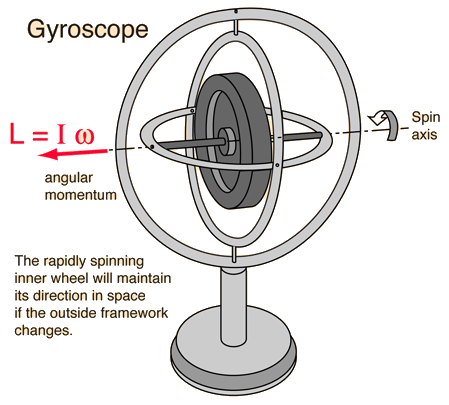
Gyroscope

One typical type of gyroscope is made by suspending a relatively massive rotor inside three rings called gimbals. Mounting each of these rotors on high quality bearing surfaces insures that very little torque can be exerted on the inside rotor.

Further discussion of gyroscopes

Precession of gyroscope

Register to Reply
Guru
Hobbies - HAM Radio - New Member United Kingdom - Big Ben - New Member Fans of Old Computers - Altair 8800 - New Member Canada - Member - New Member

Join Date: Jun 2006
Location: Toronto
Posts: 3968
Good Answers: 120
#42
In reply to #41

Re: Terminal Velocity Vs. Initial Velocity

07/05/2010 3:44 PM

the thought experiment, as all thought experiments do, is abstract them selves from the real world to ignore coriolis etc. and create a special case in isolation

As the mathematician said, when he solved the cow problem....

"consider a spherical cow in a vacuum",

http://en.wikipedia.org/wiki/Spherical_cow

__________________
Per Ardua Ad Astra
Register to Reply
Guru

Join Date: Oct 2008
Posts: 42355
Good Answers: 1693
#43
In reply to #42

Re: Terminal Velocity Vs. Initial Velocity

07/05/2010 3:47 PM

Oh, Sorry.

Register to Reply
Guru
Hobbies - HAM Radio - New Member United Kingdom - Big Ben - New Member Fans of Old Computers - Altair 8800 - New Member Canada - Member - New Member

Join Date: Jun 2006
Location: Toronto
Posts: 3968
Good Answers: 120
#44
In reply to #43

Re: Terminal Velocity Vs. Initial Velocity

07/05/2010 3:59 PM

I recall once a Star Ship was almost destroyed by...quibbles?

__________________
Per Ardua Ad Astra
Register to Reply
Guru

Join Date: Oct 2008
Posts: 42355
Good Answers: 1693
#45
In reply to #44

Re: Terminal Velocity Vs. Initial Velocity

07/05/2010 4:09 PM

Fuzzy things, as I recall.

Register to Reply
Guru

Join Date: Apr 2006
Location: Cincinnati, Ohio, USA
Posts: 662
Good Answers: 49
#40

Re: Terminal Velocity Vs. Initial Velocity

07/05/2010 3:12 PM

POSTS 22 AND 31 COMMENTED ON MY ORIGINAL POST 19 (I tried to respond earlier, but "the system" got stupid and did not read what I had typed, so- here it is again)

It was caused by a late night brain warp- Using FPS as intended, the results are:

Vertical motion starts at 3000 FPS velocity. Gravity exerts a -32 feet per second2 acceleration on the bullet (we will ignore drag for now)

The actual distance traveled will be based on the formula V = G x T where V will equal -3000 FPS to negate the initial upward velocity yielding NET V = 0.

-3000 = (-32 FPS2) x T, or -3000 / -32 FPS2 = 93.75 seconds

Since the initial velocity was 3000 FPS and the final velocity was 0, the average velocity was 1500 FPS ((3000-0) / 2)

1500 FPS x 93.75 seconds = 140,625 feet vertically.

NOW- applying the second related formula V = SqRt (2 x G x distance falling) we get

V = SqRt (2 x -32 FPS x 140625) = SqRt (-9,000,000) = -3000 FPS hitting the ground

BUT- now we take drag into the issue and regardless of how you want to value it, the total vertical distance will NOT be 140,625 feet. Since the falling distance CAN NOT be 140,625, AND because drag will work on the way down as well as on the way up, the final velocity MUST BE less than 3,000 FPS- so less than starting velocity.

Same answer, just more accurate path to it.

__________________
NO MATTER HOW WELL YOU HAVE DONE SO FAR, ALWAYS TRY TO BE BETTER TOMORROW.
Register to Reply
Guru
Engineering Fields - Control Engineering - Time to take control United States - Member - New Member Engineering Fields - Systems Engineering - New Member Engineering Fields - Mechanical Engineering - New Member

Join Date: Apr 2009
Location: Tampa, Florida, USA
Posts: 2129
Good Answers: 87
#47
In reply to #40

Re: Terminal Velocity Vs. Initial Velocity

07/06/2010 3:17 PM

I responded to your earlier post, but hadn't looked far enough along to see this one.

__________________
J B
Register to Reply
Guru

Join Date: Aug 2009
Location: Glen Mills, PA.
Posts: 2385
Good Answers: 114
#60

Re: Terminal Velocity Vs. Initial Velocity

07/10/2010 5:22 PM

A number of people have the correct answer, if in air, there are energy losses and it arrives back more slowly, if there are no losses, as in a vacuum, it passes the muzzle on the downward leg at the muzzle velocity. I'm not sure if it would be affected by a loss of heat during the journey.

A more interesting question for me was:

If you drill a hole through the center of an airless planet (I know you can't do that, but imagine you can). You set up two rifles exactly the same, with bullets, again, exactly the same. You shoot from parallel rifles one side of the planet at parallel targets on the other side, one bullet traveling through the hole in the planet and the other parallel to it, but away from the planet. Which bullet gets to the target first?

__________________
In a time of universal deceit, telling the truth is a revolutionary act. George Orwell
Register to Reply
Register to Reply 61 comments

Good Answers:

These comments received enough positive votes to make them "good answers".

"Almost" Good Answers:

Check out these comments that don't yet have enough votes to be "official" good answers and, if you agree with them, vote them!
Copy to Clipboard

Users who posted comments:

34point5 (4); Andy Germany (1); Anonymous Poster (5); Apothicus (1); aurizon (5); baxterm (2); bob c (2); cabrera0120 (2); DrMoose (1); dvmdsc (1); energygod (4); Jack Marcotte (1); JBTardis (6); kramarat (1); lyn (11); MoronicBumble (2); passingtongreen (1); phph001 (1); ronseto (4); Tornado (3); Usbport (1); wolfcariusm (2)

Previous in Forum: Oil Purificaiton System   Next in Forum: Stainless Steel Trim Rams Pitting

Advertisement