Previous in Forum: What Sensor Should be used to Make an Altimeter?   Next in Forum: Water Treatment Plant
Close
Close
Close
83 comments
Rate Comments: Nested
Guru

Join Date: Jan 2010
Posts: 2446
Good Answers: 60

What is Magnetism?

09/06/2010 4:17 AM

Hi asked this one before.

What is magnetism

http://www.sciencedaily.com/releases/2010/09/100903121418.htm

I know its the magnetic attraction of ferrous metal to a magnet, although non ferrous metal is also attracted to magnectic fields ie as in electricity meters.

and if frozen in liquid nitrogen even some ceramic materials.

so if the magnetic field can attract so many items what exactly is it ?

this question goes there with " what exactly is Gravity" other than the pull or attraction of a lither body to a larger body or mass, But what is the pull ?

Register to Reply
Pathfinder Tags: Gravity magnetism
Interested in this topic? By joining CR4 you can "subscribe" to
this discussion and receive notification when new comments are added.

Good Answers:

These comments received enough positive votes to make them "good answers".

"Almost" Good Answers:

Check out these comments that don't yet have enough votes to be "official" good answers and, if you agree with them, vote them!
Anonymous Poster
#1

Re: What is magnetism

09/06/2010 5:42 AM

Hi asked this one before.
Exactly... so why do so again?

Register to Reply
Guru

Join Date: Jan 2010
Posts: 2446
Good Answers: 60
#4
In reply to #1

Re: What is magnetism

09/06/2010 8:22 AM

Because you lot didnt answer it correctly the last time, Thanks Guest

Register to Reply
Anonymous Poster
#6
In reply to #4

Re: What is magnetism

09/06/2010 9:56 AM

Because you lot didnt answer it correctly the last time.

That implies you know the answer, in which case, stop faffing about and tell us...

Register to Reply Score 1 for Off Topic
Guru

Join Date: Jan 2010
Posts: 2446
Good Answers: 60
#7
In reply to #6

Re: What is magnetism

09/06/2010 10:21 AM

semantics and

no i don't know

why cant you answer the question if you know and stop arguing or better still stop posting

Register to Reply Off Topic (Score 5)
Guru
Engineering Fields - Electromechanical Engineering - Technical Services Manager Canada - Member - Army brat Popular Science - Cosmology - What is Time and what is Energy? Technical Fields - Architecture - Draftsperson Hobbies - RC Aircraft - New Member

Join Date: Sep 2006
Location: Clive, Alberta, Canada
Posts: 5916
Good Answers: 204
#17
In reply to #6

Re: What is magnetism

09/07/2010 12:08 AM

I had to look up faffing... never heard it before... Is that british?

Register to Reply
Power-User

Join Date: Jul 2010
Location: Near ... New Orleans, Louisiana, USA
Posts: 217
Good Answers: 3
#20
In reply to #17

Re: What is magnetism

09/07/2010 11:35 AM

It's the new brown ... been to Wendy's and gotten some faffing biggie fries? hehehe

Register to Reply
Guru
Engineering Fields - Mechanical Engineering - New Member Hobbies - CNC - New Member

Join Date: Aug 2006
Location: Western Australia
Posts: 767
Good Answers: 58
#31
In reply to #17

Re: What is magnetism

09/08/2010 7:57 AM

British indeed. (Though it could be Dutch ).

It's originally British, informal but not rude, and moderately common, especially in the form to faff about. The Daily Telegraph included this on 15 March 2008: "The early boarders certainly bag their seats quickly, but then they immediately relax and happily faff about putting their things in the overhead locker, generally getting in the way of the other passengers."

It can be used as a politer alternative to another four-letter word beginning with f but has no link with it. It starts to appear as a dialect word in Scotland and Northern England at the end of the eighteenth century, as a description of the wind blowing in puffs or small gusts. A North Yorkshire glossary of 1868 described how it was used: "As when a person blows chaff away from corn held in his hands, or the wind when it causes brief puffs of smoke to return down the chimney."

It may have been imitative of the sound of gusty wind, or it may be a variation on maffle, a more widely distributed dialect term in Scotland and England that means to stutter or stammer, or to waste time and procrastinate; this might be from the old Dutch regional word maffelen, meaning to move the jaws. There's also faffle, another dialect word, which also means to stammer or stutter, and which might have influenced the sense.

The word started to move into the wider language in its modern sense around the end of the nineteenth century, though it didn't much appear in print until the 1980s.

__________________
If you can't explain it simply, you don't understand it well enough. (A.E.)
Register to Reply
Guru
Engineering Fields - Electromechanical Engineering - Technical Services Manager Canada - Member - Army brat Popular Science - Cosmology - What is Time and what is Energy? Technical Fields - Architecture - Draftsperson Hobbies - RC Aircraft - New Member

Join Date: Sep 2006
Location: Clive, Alberta, Canada
Posts: 5916
Good Answers: 204
#45
In reply to #31

Re: What is magnetism

09/08/2010 1:02 PM

Awesome, thank you.

Register to Reply
Power-User
United Kingdom - Member - New Member

Join Date: Oct 2010
Location: Torquay England
Posts: 202
Good Answers: 4
#79
In reply to #17

Re: What is magnetism

11/17/2010 4:46 PM

the British don't have a language. They speak ENGLISH. And Faffing is a thing some of us do quite well...

__________________
Torque is not cheap
Register to Reply
Guru

Join Date: Dec 2007
Location: California
Posts: 2363
Good Answers: 63
#80
In reply to #79

Re: What is magnetism

11/18/2010 7:39 PM

A specific dialect of English though, that is greatly different than American English, and fairly distinctive from South African, Australian and New Zealand English.

Register to Reply
Guru
Hobbies - Musician - New Member Australia - Member - Torn and breading Engineering Fields - Nanoengineering - New Member APIX Pilot Plant Design Project - Member - New Member

Join Date: Jun 2006
Location: Magnetic Island, Queensland, Australia
Posts: 3721
Good Answers: 74
#81
In reply to #80

Re: What is magnetism

11/18/2010 7:45 PM

And Queenslandish were we have eggnishners and barbicyou areas.

__________________
The Twain Has Met
Register to Reply Off Topic (Score 5)
Guru
Engineering Fields - Electromechanical Engineering - Technical Services Manager Canada - Member - Army brat Popular Science - Cosmology - What is Time and what is Energy? Technical Fields - Architecture - Draftsperson Hobbies - RC Aircraft - New Member

Join Date: Sep 2006
Location: Clive, Alberta, Canada
Posts: 5916
Good Answers: 204
#82
In reply to #81

Re: What is magnetism

11/18/2010 8:56 PM

sounds outlandish to me!

Register to Reply Off Topic (Score 5)
Guru

Join Date: Jul 2007
Posts: 4448
Good Answers: 143
#2

Re: What is magnetism

09/06/2010 8:10 AM

Magnetism is electricity in a different reference frame.

Did that help?

__________________
"Well, I've wrestled with reality for 35 years, Doctor, and I'm happy to state I finally won out over it." Elwood P. Dowd
Register to Reply
Anonymous Poster
#3

Re: What is magnetism

09/06/2010 8:11 AM

If some one can answer the two questions he will be in line for nobel.

To be precise these are one of the four fundamental forces of the nature (in fact the first one and the last one)

People all over are still trying to understand it. Once they do, you will know. The understanding? doubtful since it will be in a maze of mathematical equations.

Register to Reply
Guru
Hobbies - CNC - New Member Hobbies - DIY Welding - New Member Engineering Fields - Electromechanical Engineering - New Member

Join Date: Aug 2007
Posts: 23647
Good Answers: 420
#11
In reply to #3

Re: What is magnetism

09/06/2010 1:49 PM

If some one can answer the two questions he will be in line for nobel.

try asking Al Gore.

__________________
“ When people get what they want, they are often surprised when they get what they deserve " - James Wood
Register to Reply Off Topic (Score 5)
Guru

Join Date: Nov 2009
Location: Izmir, Turkey
Posts: 2142
Good Answers: 31
#13
In reply to #11

Re: What is magnetism

09/06/2010 1:53 PM

He already got his Nobel prize for knowing nothing!

Register to Reply Off Topic (Score 5)
Guru
Hobbies - CNC - New Member Hobbies - DIY Welding - New Member Engineering Fields - Electromechanical Engineering - New Member

Join Date: Aug 2007
Posts: 23647
Good Answers: 420
#14
In reply to #13

Re: What is magnetism

09/06/2010 2:01 PM

He already got his Nobel prize for knowing nothing!

Nobel Committee: Yes, everythings in order, his cretentials are emmaculate and Al Gore says he is well qualified on the topic of megnetism, lets nominate him....again.

At lease he will make a good spokesman like the topic of GW

__________________
“ When people get what they want, they are often surprised when they get what they deserve " - James Wood
Register to Reply Off Topic (Score 5)
Guru

Join Date: Nov 2009
Location: Izmir, Turkey
Posts: 2142
Good Answers: 31
#15
In reply to #14

Re: What is magnetism

09/06/2010 2:13 PM

For his magnetic personality? Not to mention charisma!

Register to Reply Off Topic (Score 5)
Guru
Hobbies - CNC - New Member Hobbies - DIY Welding - New Member Engineering Fields - Electromechanical Engineering - New Member

Join Date: Aug 2007
Posts: 23647
Good Answers: 420
#16
In reply to #15

Re: What is magnetism

09/06/2010 3:19 PM

For his magnetic personality?

Nobel Commitee: Of course we were talking about his personality.....what else did you think we were talking about......ooohhhhh.

__________________
“ When people get what they want, they are often surprised when they get what they deserve " - James Wood
Register to Reply Off Topic (Score 5)
Guru
Hobbies - HAM Radio - New Member

Join Date: Oct 2006
Location: Vancouver (not BC) Washington (not DC) US of A
Posts: 1261
Good Answers: 12
#65
In reply to #11

Re: What is magnetism

09/12/2010 2:46 AM

Aw C'mon... Al Gore cannot spell orthogonality much less understand it... and magnetic fields and electrical fields are orthogonal to each other.

Register to Reply Off Topic (Score 5)
Guru
Hobbies - CNC - New Member Hobbies - DIY Welding - New Member Engineering Fields - Electromechanical Engineering - New Member

Join Date: Aug 2007
Posts: 23647
Good Answers: 420
#66
In reply to #65

Re: What is magnetism

09/12/2010 7:12 AM

like the irony of the new school named after him......... It was built on a toxic waste site.......kinda matches his persona as well as his personal life, all symbolism and no substance. :))) ......p911

__________________
“ When people get what they want, they are often surprised when they get what they deserve " - James Wood
Register to Reply Off Topic (Score 5)
Guru
Hobbies - CNC - New Member Hobbies - DIY Welding - New Member Engineering Fields - Electromechanical Engineering - New Member

Join Date: Aug 2007
Posts: 23647
Good Answers: 420
#67
In reply to #66

Re: What is magnetism

09/12/2010 7:16 AM

oh, oh, here comes the Al Gore fanatics........A LALALALALALALALALALA * KA BOOM * . ; )

__________________
“ When people get what they want, they are often surprised when they get what they deserve " - James Wood
Register to Reply Off Topic (Score 5)
Guru
Engineering Fields - Optical Engineering - Member Engineering Fields - Engineering Physics - Member Engineering Fields - Systems Engineering - Member

Join Date: Apr 2010
Location: Trantor
Posts: 5363
Good Answers: 647
#5

Re: What is magnetism

09/06/2010 8:56 AM

Your reply to a guest was: Because you lot didn't answer it correctly the last time.

Well, if you know the correct answer, why are you asking (again)?

--

I'm a physicist, but not a QM physicist; here's how I understand it:

Physicists have determined that photons are the exchange particle for electromagnetic fields, i.e., when an electromagnetic event occurs (like the attraction of a piece of iron to a magnet) photons are involved, exchanging the packets of energy that create the force of attraction (or repulsion).

These photons are 'virtual' photons. They are part of the underlying structure of spacetime. The presence of a magnet distorts this local region of spacetime and it does so by creating this field of virtual photons (or, enhancing the probability of photons that posses certain properties of state). When another piece of magnetic material enters the local region it reacts to these virtual photons; also it distorts the local region of spacetime with its own virtual photons. (The intensity of the virtual photons come from the net unbalanced dipole moment of the material.) Due to entropy (or the arrow of time, or Maxwell's Demon's cousin) the materials try to achieve the lowest possible energy state and move within this sea of virtual photons accordingly.

Or if you like: Eventually the virtual photons do the quantum-mechanical equivalent of hooking up and going out for dinner and a movie. Unless they repel, in which case there is a fight in the alley behind the bar.

__________________
Whiskey, women -- and astrophysics. Because sometimes a problem can't be solved with just whiskey and women.
Register to Reply
6
Guru

Join Date: Jul 2008
Posts: 1688
Good Answers: 145
#8

Re: What is Magnetism?

09/06/2010 11:58 AM

Here is my 2 cents worth:

No one really has a full understanding of electric fields, magnetic fields, gravity, time and probably a few others that I forgot.

Some pople are "too cool for school" and never ask.

Many people learn a little in school and then don't ask any more.

Most engineers, scientists and other technical people (formal education or not) ask for a while, work with the forces for years, and then quit asking because they are comfortable working with the forces and they assume that they never will fully understand them.

Some people, typically the PHD++ people, look for the answers all their life. They are on a journey. They know that they will never know all the answers, but they also know that trying to "push the envelope" day after day they not only will learn more for themselves, but they might, if they are lucky, learn something new that they can share with the world.

I guess I accidentally tripped upon the answer to the Guest that was giving Peter a hard time. The ultimate destination of Peter's question is not the answer, it is the journey looking for the answer. The answer is not the answer, the answer is the question.

Worth 2 cents?

__________________
Few things limit our potential as much as knowing answers and setting aside questions.
Register to Reply Good Answer (Score 6)
Guru

Join Date: Jan 2010
Posts: 2446
Good Answers: 60
#10
In reply to #8

Re: What is Magnetism?

09/06/2010 12:45 PM

Like it, Nice one

Register to Reply Off Topic (Score 5)
Guru
Hobbies - CNC - New Member Hobbies - DIY Welding - New Member Engineering Fields - Electromechanical Engineering - New Member

Join Date: Aug 2007
Posts: 23647
Good Answers: 420
#12
In reply to #8

Re: What is Magnetism?

09/06/2010 1:50 PM

Worth 2 cents?

only if you expect change.

__________________
“ When people get what they want, they are often surprised when they get what they deserve " - James Wood
Register to Reply Off Topic (Score 5)
Guru
Engineering Fields - Electromechanical Engineering - Technical Services Manager Canada - Member - Army brat Popular Science - Cosmology - What is Time and what is Energy? Technical Fields - Architecture - Draftsperson Hobbies - RC Aircraft - New Member

Join Date: Sep 2006
Location: Clive, Alberta, Canada
Posts: 5916
Good Answers: 204
#18
In reply to #8

Re: What is Magnetism?

09/07/2010 12:18 AM

A body in motion tends to stay in motion, until acted upon by another body.

Electricity is a field. The electron is the fundamental unit of electrical charge motion

Magnetism is a field. A line of force is the fundamental unit of magnetic field motion

A photon is the particle of exchange that lives at the intersection of electrical and magnetic fields. It must be in motion or it changes into something else.

It stands to reason that both electrical and magnetic fields are 'motion fields'.

A field in motion tends to stay in motion, unless acted upon by another field.

A particle is a field of a different shape.

A field tends to maintain its shape, and to correspond to the shape of least resistance.

magnetism is a motion field of a particular shape

What is moving?

Time.

Register to Reply
Guru
Hobbies - Musician - New Member Greece - Member - New Member

Join Date: Mar 2007
Location: Greece / Athens
Posts: 722
Good Answers: 28
#19
In reply to #18

Re: What is Magnetism?

09/07/2010 7:02 AM

Chrisg288, your post is a total confusion... You mess up things instead of clarifying them...

"... A field in motion tends to stay in motion..." What are you talking about???

"... The electron is the fundamental unit of electrical motion..." Are you serious???

"... A photon is the particle of exchange that lives at the intersection of electrical and magnetic fields. It must be in motion or it changes into something else..." Photons and e/m waves are the two different faces of the reality. Don't put them together. Photons are the quanta of e/m energy and they travell at c otherwise they don't exist (they don't change into sth else, as you said). The transfer of e/m energy can be consider as either e/m waves or a flow of photons (both travelling at c), but not both at the same time.

Anyway, about the initial post, the magnetism is a relativistic (S.R.) phenomenon of electricity, taking place in moving electrons inside the wires.

__________________
George
Register to Reply
Power-User

Join Date: Jul 2010
Location: Near ... New Orleans, Louisiana, USA
Posts: 217
Good Answers: 3
#21
In reply to #19

Re: What is Magnetism?

09/07/2010 11:44 AM

I think that was a BOY GEORGE song. Sing it again Chris!

Register to Reply
Guru
Engineering Fields - Electromechanical Engineering - Technical Services Manager Canada - Member - Army brat Popular Science - Cosmology - What is Time and what is Energy? Technical Fields - Architecture - Draftsperson Hobbies - RC Aircraft - New Member

Join Date: Sep 2006
Location: Clive, Alberta, Canada
Posts: 5916
Good Answers: 204
#25
In reply to #19

Re: What is Magnetism?

09/07/2010 4:06 PM

"What are you talking about???"

Everything is in motion... as I said, it stands to reason the fields are motion as well.

I may have been wearing my tinfoil hat... and it may not be something others have said... but I think it must be true.

as to the electron... the standard statement is that it is the unit of charge. but as all is in motion, I stated it that way... to support my theme.. all is in motion.

you talk about relativism... which to me, translates to 'motion'... so we might be saying the same thing. we can only understand these things when we stop seeing them in static frames of reference. that is an illusion.

Tesla said: "Throughout space there is energy. Is this energy static or kinetic! If static our hopes are in vain; if kinetic — and this we know it is, for certain — then it is a mere question of time when men will succeed in attaching their machinery to the very wheelwork of nature. "

Chris

Register to Reply
Guru

Join Date: Dec 2007
Location: California
Posts: 2363
Good Answers: 63
#63
In reply to #25

Re: What is Magnetism?

09/10/2010 5:39 PM

I think there was some dissimilarity at the whole electron being a unit or electric motion while the magnetic field is the unit of magnetic motion. Problem being that both an electric field and magnetic field are generated by electrons in motion, and if you accelerate (decelerate) the electrons through key energy states you generate electromagnetic energy (photons).

Register to Reply
Guru

Join Date: Nov 2009
Location: Izmir, Turkey
Posts: 2142
Good Answers: 31
#9

Re: What is Magnetism?

09/06/2010 12:04 PM

If all those little photons stuck to making PV electricity instead of doing all sorts of things just think of the power that could be generated.

Down side - the magnet thingies might fall off the fridge!

Register to Reply Off Topic (Score 5)
Power-User

Join Date: Jul 2010
Location: Near ... New Orleans, Louisiana, USA
Posts: 217
Good Answers: 3
#22

Re: What is Magnetism?

09/07/2010 12:08 PM

It's the returning wave of the decaying tangential compressive force of the negative vectors of both sides of gravity (gravity and anti-gravity) with respect to the spin of D-orbit electrons. Anyway ... that's what they told me in kindergarten.

In some dimensions it is directly related to the attractive power of certain powerful animals.

------------------------------------------------------------------------------

I used to be a premonition; but now that I am older, I can't remember the future.

Register to Reply
Guru

Join Date: Nov 2009
Location: Izmir, Turkey
Posts: 2142
Good Answers: 31
#23
In reply to #22

Re: What is Magnetism?

09/07/2010 1:13 PM

Hope you didn't hurt yourself thinking that one up!

Register to Reply
Power-User

Join Date: Jul 2010
Location: Near ... New Orleans, Louisiana, USA
Posts: 217
Good Answers: 3
#26
In reply to #23

Re: What is Magnetism?

09/07/2010 6:18 PM

Due to my experience in sales, it comes naturally. :o)

Register to Reply Off Topic (Score 5)
Guru
Hobbies - CNC - New Member Hobbies - DIY Welding - New Member Engineering Fields - Electromechanical Engineering - New Member

Join Date: Aug 2007
Posts: 23647
Good Answers: 420
#27
In reply to #26

Re: What is Magnetism?

09/07/2010 8:17 PM

Due to my experience in sales, it comes naturally.

what.....horing yourself?......I mean hurting yourself............that was a true, unintentional typo......so I could not help but to just leave it.

__________________
“ When people get what they want, they are often surprised when they get what they deserve " - James Wood
Register to Reply Off Topic (Score 5)
Power-User

Join Date: Jul 2010
Location: Near ... New Orleans, Louisiana, USA
Posts: 217
Good Answers: 3
#32
In reply to #27

Re: What is Magnetism?

09/08/2010 8:15 AM

Sales, BS, yappie, banter, talk wordy to me and Bob's your uncle ... I think they are synonyms So ... no, I did not hurt myself ... It's more like I can't help myself

Register to Reply Off Topic (Score 5)
Guru
Hobbies - CNC - New Member Hobbies - DIY Welding - New Member Engineering Fields - Electromechanical Engineering - New Member

Join Date: Aug 2007
Posts: 23647
Good Answers: 420
#34
In reply to #32

Re: What is Magnetism?

09/08/2010 8:47 AM

Well, your good at it!

__________________
“ When people get what they want, they are often surprised when they get what they deserve " - James Wood
Register to Reply Off Topic (Score 5)
Power-User

Join Date: Jul 2010
Location: Near ... New Orleans, Louisiana, USA
Posts: 217
Good Answers: 3
#48
In reply to #34

Re: What is Magnetism?

09/08/2010 10:20 PM

Won't you feel silly, when you find that I am 99% correct ... I was is sales ... I had to make some of it up!

Register to Reply Off Topic (Score 5)
Guru
Hobbies - DIY Welding - Don't Know What Made The Old Title Attractive... Popular Science - Weaponology - New Member United States - US - Statue of Liberty - 60 Year Member

Join Date: Apr 2009
Location: Yellowstone Valley, in Big Sky Country
Posts: 7425
Good Answers: 295
#24

Re: What is Magnetism?

09/07/2010 3:41 PM

Well, peterg7ltq, another interesting topic.

I have been watching this thread, waiting for some useful advice on my Quixotic project, the "Chick Magnet". For those unaware, I have been trying to convert my 1988 Ford E100 Conversion Van into such a vehicle, with little positive result.

After your thread "What is Gravity", I filled the van with rocks and bricks... did not accomplish much except a blown shock, so the mass was removed. I have installed a rather large electromagnet inside, able to alter the magnetic bipole moment (μ) while in motion. With this, I may be able to better 'aim' the field.

So far, all I have been able to attract are a few metal scraps from along the highways and city streets. That together with all the offgassing from the battery array is making this project, well, less than fun.

I will watch this thread, looking for any more good ideas. Your friend, Doorman.

__________________
Semper Ubi Sub Ubi
Register to Reply
Guru

Join Date: Nov 2009
Location: Izmir, Turkey
Posts: 2142
Good Answers: 31
#28
In reply to #24

Re: What is Magnetism?

09/08/2010 12:34 AM

You are not supposed to drive down the road with the thing turned on!

Wait until you locate the target and then energize the 'chick' magnet. In the event your magnet is too strong there may be some collateral damage to the van as well as the chick - you might want to have a remote control!

Register to Reply Off Topic (Score 5)
Guru
Hobbies - Musician - New Member Greece - Member - New Member

Join Date: Mar 2007
Location: Greece / Athens
Posts: 722
Good Answers: 28
#29

Re: What is Magnetism?

09/08/2010 4:55 AM

Hi Peter... "... What is magnetism..."

As I wrote in my post #19 the magnetism is a relativistic phenomenon:

We have two parallel wires with currents flowing in same directions. Let's suppose that the electrons on both wires are moving with same speeds. Now, let's see what happens to the electrons on one of these wires: From their reference frame, the electrons "see" the electrons on the other wire remaining still while the protons on the other wire moving in the opposite direction. Due to the relativistic effect of Lorentz contraction (contraction of the length of moving objects), the electrons "see" that these moving protons (on the other wire) are closer to each other, hence they "see" a larger density of protons. In other words, they "see" a surplus of protons (with respect to the electrons) on the other wire. So, they "see" the other wire to be positive charged. (Of course, there should be no charge if there were no motion because of the equal numbers of electrons and protons.) Thus, due to this positive charge, the electrons "feel" an attractive electric force towards the other wire (i.e. towards the direction which is perpendicular to their movement).

(Now you can, also, assume what happens in the case of two parallel wires with currents flowing in opposite directions and why the forces will be repulsive.)

Although the speeds of electrons, inside the wire, are quite low (much much lower than c), there is a length contraction (really small but not zero). Due to the large number of electrons and protons the effect becomes significant, giving us what we consider as magnetic forces.

__________________
George
Register to Reply Score 1 for Good Answer
Guru

Join Date: Jan 2010
Posts: 2446
Good Answers: 60
#30
In reply to #29

Re: What is Magnetism?

09/08/2010 5:14 AM

No not electro-magnetism.

Just plain manetism say in a permanent magnet what Gives the permanent magnet the ability to attract ferrous objects with such force ?

I have some rare earth magnets and for their size they are amazingly powerfull Why?

How can a permanet magnet when passing over a piece of non ferrous metal say aluminum pull the aluminum along with it ?

Register to Reply
Guru
Hobbies - CNC - New Member Hobbies - DIY Welding - New Member Engineering Fields - Electromechanical Engineering - New Member

Join Date: Aug 2007
Posts: 23647
Good Answers: 420
#33
In reply to #30

Re: What is Magnetism?

09/08/2010 8:45 AM

How can a permanet magnet when passing over a piece of non ferrous metal say aluminum pull the aluminum along with it ?

is the Aluminium Pure?........Actually I believe everything is magnetic.....Didn't one of the national labs use a large magnetic feild to suspend a live frog.

No not electro-magnetism.

One other thing, I do not believe you can really separate the forces its all tied together.

You know gravity, Magnetism, light, time.......sorry this is a stretch for me.

p911

__________________
“ When people get what they want, they are often surprised when they get what they deserve " - James Wood
Register to Reply
Guru

Join Date: Jan 2010
Posts: 2446
Good Answers: 60
#35
In reply to #33

Re: What is Magnetism?

09/08/2010 8:53 AM

By eliminating electro magnetism it may make it easier to explain.

electro magnetism comes about but the passage of electricity in wires thus artificially creating the magnetic force.

so i suppose the quest is what is naturally occurring magnetism ?

as in permanent magnets

Register to Reply
Guru
Hobbies - CNC - New Member Hobbies - DIY Welding - New Member Engineering Fields - Electromechanical Engineering - New Member

Join Date: Aug 2007
Posts: 23647
Good Answers: 420
#36
In reply to #35

Re: What is Magnetism?

09/08/2010 8:58 AM

You actually have to understand it first, just like cutting perpendicular to the EMF generates electricity.

The answer you seek can not be summed up in a small statement.

p911

__________________
“ When people get what they want, they are often surprised when they get what they deserve " - James Wood
Register to Reply
Guru

Join Date: Jan 2010
Posts: 2446
Good Answers: 60
#38
In reply to #36

Re: What is Magnetism?

09/08/2010 9:18 AM

So whats the long statement then

What is naturally occuring permanet magnetism ?

Register to Reply
Guru
Hobbies - Musician - New Member Australia - Member - Torn and breading Engineering Fields - Nanoengineering - New Member APIX Pilot Plant Design Project - Member - New Member

Join Date: Jun 2006
Location: Magnetic Island, Queensland, Australia
Posts: 3721
Good Answers: 74
#70
In reply to #38

Re: What is Magnetism?

09/13/2010 6:37 PM

Come here for a holiday and you will know as much as I do. A field force could be only in ones head but it still works. How?

__________________
The Twain Has Met
Register to Reply Off Topic (Score 5)
Guru

Join Date: Dec 2007
Location: California
Posts: 2363
Good Answers: 63
#71
In reply to #38

Re: What is Magnetism?

09/13/2010 6:46 PM

how long is permanent?

Register to Reply
Guru
Hobbies - CNC - New Member Hobbies - DIY Welding - New Member Engineering Fields - Electromechanical Engineering - New Member

Join Date: Aug 2007
Posts: 23647
Good Answers: 420
#72
In reply to #71

Re: What is Magnetism?

09/16/2010 6:16 PM

how long is permanent?

they say with hair it should last a couple of months?......so I would say 3 months

__________________
“ When people get what they want, they are often surprised when they get what they deserve " - James Wood
Register to Reply
Guru
Hobbies - Musician - New Member Australia - Member - Torn and breading Engineering Fields - Nanoengineering - New Member APIX Pilot Plant Design Project - Member - New Member

Join Date: Jun 2006
Location: Magnetic Island, Queensland, Australia
Posts: 3721
Good Answers: 74
#73
In reply to #72

Re: What is Magnetism?

09/16/2010 6:35 PM

I'm laughing while dying.

__________________
The Twain Has Met
Register to Reply
Guru
Hobbies - CNC - New Member Hobbies - DIY Welding - New Member Engineering Fields - Electromechanical Engineering - New Member

Join Date: Aug 2007
Posts: 23647
Good Answers: 420
#74
In reply to #73

Re: What is Magnetism?

09/18/2010 10:03 AM

I'm laughing while dying.

well......you not very good at it.

__________________
“ When people get what they want, they are often surprised when they get what they deserve " - James Wood
Register to Reply Off Topic (Score 5)
Guru
Hobbies - Musician - New Member Australia - Member - Torn and breading Engineering Fields - Nanoengineering - New Member APIX Pilot Plant Design Project - Member - New Member

Join Date: Jun 2006
Location: Magnetic Island, Queensland, Australia
Posts: 3721
Good Answers: 74
#75
In reply to #74

Re: What is Magnetism?

09/18/2010 4:51 PM

Yeah I always have problems with the indigo. Not easy to dye and have it stay for keeps.

__________________
The Twain Has Met
Register to Reply Off Topic (Score 5)
Power-User

Join Date: Jul 2010
Location: Near ... New Orleans, Louisiana, USA
Posts: 217
Good Answers: 3
#76
In reply to #71

Re: What is Magnetism?

09/18/2010 11:03 PM

According to the PLAYWITTY dictionary 'permanent' is:

1). any length of time that starts before you can remember, to some time x in the present, when you can't (remember).

__________________________________________________________________________

I used to be a premonition, but now that I am older, I can't remember the future.

Register to Reply Off Topic (Score 6)
Guru
Hobbies - CNC - New Member Hobbies - DIY Welding - New Member Engineering Fields - Electromechanical Engineering - New Member

Join Date: Aug 2007
Posts: 23647
Good Answers: 420
#77
In reply to #76

Re: What is Magnetism?

09/19/2010 10:01 AM

What was the question?......oh I get, that makes it permanent.

__________________
“ When people get what they want, they are often surprised when they get what they deserve " - James Wood
Register to Reply Off Topic (Score 5)
Guru
Hobbies - Musician - New Member Greece - Member - New Member

Join Date: Mar 2007
Location: Greece / Athens
Posts: 722
Good Answers: 28
#39
In reply to #30

Re: What is Magnetism?

09/08/2010 11:26 AM

The same principle is valid, also, on the permanent magnets, as shown in the following picture that I made.

The only difference, in the case of the permanent magnet, is that there is not only one "big current" but an enormous quantity of "tiny currents", each one produced in the atomic level (i.e. electrons whirling around the nucleus). But the main concept remains the same: If there is another permanent magnet (or a coil) close to our permanent magnet, its protons are moving, as seen from the reference frame of each electron on our magnet. The Special Relativity takes place and a tiny force is applied on each electron, giving a significant macroscopic effect due to the enormous quantity of electrons.

(Several materials respond in different ways to an external magnetic field (or they produce magnetic fields of different values) due to their ability to direct all these tiny atomic magnets. I.e. some materials are more "efficient" than others. But, probably, you already know this better than me.)

__________________
George
Register to Reply
Guru

Join Date: Jan 2010
Posts: 2446
Good Answers: 60
#40
In reply to #39

Re: What is Magnetism?

09/08/2010 11:36 AM

No when it comes to atomic theory i am as lost as the rest

another puzzling phenomemy

Is radio waves they sometimes act as waves and sometimes particles or both

but thats for another time

Register to Reply
Guru

Join Date: Jan 2010
Posts: 2446
Good Answers: 60
#41
In reply to #40

Re: What is Magnetism?

09/08/2010 11:52 AM

whilst trying to work out the answer i discovered the below

WoW!!

Magnetoception

From Wikipedia, the free encyclopedia Jump to: navigation, search

Magnetoception (or magnetoreception) is the ability to detect a magnetic field to perceive direction, altitude or location. This sense plays a role in the navigational abilities of several animal species and has been postulated as a method for animals to develop regional maps.

Magnetoception is most commonly observed in birds, where sensing of the Earth's magnetic field is important to the navigational abilities during migration; it has also been observed in many other animals including fruit flies, honeybees, turtles, bacteria, fungi, lobsters, sharks and stingrays.

Contents

[

hide]

Register to Reply
Guru
Hobbies - CNC - New Member Hobbies - DIY Welding - New Member Engineering Fields - Electromechanical Engineering - New Member

Join Date: Aug 2007
Posts: 23647
Good Answers: 420
#43
In reply to #41

Re: What is Magnetism?

09/08/2010 12:49 PM

Try also looking on military sites.

Avenger Class Minesweepers (MCM) use variances of this to detect, or avoid Mines due to the magnetic signatures things give off.

This is not a simple subject you have here Peter.

__________________
“ When people get what they want, they are often surprised when they get what they deserve " - James Wood
Register to Reply
Guru

Join Date: Jan 2010
Posts: 2446
Good Answers: 60
#44
In reply to #43

Re: What is Magnetism?

09/08/2010 12:57 PM

Ah ha if it was simple everyone would know about it. except possibly me.

Because i would be looking at the complected aspect of it all, But i ve always been like that.

we could talk about the world being a grain of sand on the beach or part of a tree, but that subject always made me feel strange even when i was 15 years old

I need to lye down now ( have i spelt lie/lye correctly ) ??

Register to Reply Off Topic (Score 5)
Guru
Engineering Fields - Electromechanical Engineering - Technical Services Manager Canada - Member - Army brat Popular Science - Cosmology - What is Time and what is Energy? Technical Fields - Architecture - Draftsperson Hobbies - RC Aircraft - New Member

Join Date: Sep 2006
Location: Clive, Alberta, Canada
Posts: 5916
Good Answers: 204
#46
In reply to #40

Re: What is Magnetism?

09/08/2010 1:15 PM

you know we originally get our concept of waves from watching the surface of water.

In that, you can see the energy is circular, but is represented by the water in many different ways due to frequency, speed, amplitude, and interference. There is also such a thing in music (and water) called a 'standing wave'. When a water wave arrives at an object (boat, shore, etc.) with sufficient energy, it could be seen to be so large as to be distinct from 'normal water' and have the behaviour of a bullet, but still be able to demonstrate all the characteristics of a wave. If you factor in relativistic effects, then you have some understanding of the duality of energy.

You can also see that the wave energy is developed at the interface between two fluids of different density (water/air), and that friction is a key ingredient.

Quantum theory says that there is a very strong probability that subatomic energy exists in packets. (in motion) and this is where the paradigm or metaphor of water waves begins to separate from subatomic energies.

I get confused in that the theory is there is an electric field, and a quantized wave/particle called the electron. There is also a magnetic field, but what is the quantized wave/particle? (I'm told that lines of force are imaginary)

Chris

Register to Reply
Guru
Hobbies - CNC - New Member Hobbies - DIY Welding - New Member Engineering Fields - Electromechanical Engineering - New Member

Join Date: Aug 2007
Posts: 23647
Good Answers: 420
#47
In reply to #46

Re: What is Magnetism?

09/08/2010 2:08 PM

wow......funny thing about waves you can actual have them cancel themselves out onto themselves.....an example is polarized sunglasses.........and peter wheither you like it or not ....light and magnetism are tied together..........its all radiation, only on a different part of the spectrum. : )

__________________
“ When people get what they want, they are often surprised when they get what they deserve " - James Wood
Register to Reply
Guru

Join Date: Jan 2010
Posts: 2446
Good Answers: 60
#49
In reply to #47

Re: What is Magnetism?

09/09/2010 1:50 AM

wot you mean if i like it or not ?

and peter whether you like it or not ....light and magnetism are tied together..........its all radiation, only on a different part of the spectrum. : )

No they are not.. where on the electro magnetic spectrum is magnetism ??

i don't think magnetism is part of the electromagnetic spectrum its not radiation like light, radio, infra red, Don't take this the wrong way but you need to look it up before commenting on it

earlier on somewhere someone commented about magnetism being related to or similar to photons, he to has misunderstood the question his answer is about the electromagnetic spectrum. Not magnetism

although light.and radio are called electro magnetic they are not related to magnetism as magnetism is not as far as i can find a radiation ??

http://en.wikipedia.org/wiki/Electromagnetic_spectrum

http://www.google.co.uk/search?q=electromagnetic+radiation&sourceid=ie7&rls=com.microsoft:en-gb:IE-SearchBox&ie=&oe=&rlz=1I7GZEU_en&redir_esc=&ei=pm-ITMvfE8yQjAfWyN3mCA

http://mc2.gulf-pixels.com/wp-content/uploads/2009/07/Electromagnetic-Spectrum2.jpg

i was i believe trying to simplify the answer by separating the question anyway who's was talking about light ?

i remember talking about magnetism, and radio waves/particles where did the light bit come from,?


Electromagnetic radiation sounds like dangerous stuff—and, in fact, some of it is. But that the word radiation need not set off sirens in your head. It just describes any way energy is transmitted from one place to another without the need for a physical connection between the two places. We use it as a general term to describe any form of light. It is important that radiation can travel without any physical connection, because space is essentially a vacuum; that is, much of it is empty. If you went on a space walk clicking a pair of castanets, no one, including you, would hear your little concert. Sound is transmitted in waves, but not as radiation. Sound waves require some medium to travel in. So despite what most science fiction movies would lead you to believe, explosions in space are silent. Light (and other forms of electromagnetic radiation) requires no such medium to travel, although many physicists tried in vain to detect a medium, which they called the ether. We'll talk more about this fact in a moment.
The electromagnetic part of the phrase denotes the fact that the energy is conveyed in the form of fluctuating electric and magnetic fields. These fields require no medium to support or sustain them.

Now the above statement in bold is wrong the part about magnetic fields is,

You cannot detect magneticly any magnetic field coming from a light source, or radio ariel

try it hold a compass or other even more sensitive intrusment near a beam of light or near a radio ariel and see if you can measure the so called magnetic field. you cant there isnt one.

the explanation of magnetic waves is inccorect there are waves but not magnetic they are light or electric but not magnetic, look at the lines formed with iron filings around a magnet they are lines not waves

CR4 Admin: Modified Post

Copyright Violation: Reduced copied text according to copyright law. Please see Section 13 of the CR4 FAQ about posting copyrighted material.

Register to Reply
Guru

Join Date: Jan 2010
Posts: 2446
Good Answers: 60
#50
In reply to #49

Re: What is Magnetism?

09/09/2010 2:39 AM

http://www.bautforum.com/showthread.php/106034-magnetic-field-as-part-of-light-beam

its not just me thinking of heavy questions just found the above

his question is

Thread: magnetic field as part of light beam

  1. 17-July-2010 03:57 PM #1 melech
  2. Junior Member Join Date Mar 2010 Posts 21

    magnetic field as part of light beam

    Does the magnetic field portion of a beam of light have the same properties as the magnetic field surrounding a magnet? For example, will it attract a piece of iron? If so, why is this not apparent to an observer e.g., holding a flashlight near a piece of iron?
  3. and at least on of the answer was
  4. Join Date Dec 2006 Posts 361 Originally Posted by korjik Yes, it is just like the magnetic field surrounding a magnet. The difference is that the intensity of the field in a beam is really really small compared to a magnet, and the field oscillates trillions (or more) of times per second.I think it is a bit misleading to say that the beam, between a source and sink has a magnetic field and an electric field - we derive those notions in terms of measurements at the source and sink (or sinks) and at lower EM frequencies (as opposed to light) we can, as you imply, measure these components at a sink. Without multiple macroscopic sinks (such as transmission through a dielectric), there does not appear to be any such properties as an electric and magnetic field in vacuum between the source and sink. For example, as far as I understand, no measured interference ever occurs between two EM waves crossing in vacuum.

CR4 Admin: Modified Post

Copyright Violation: Reduced copied text according to copyright law. Please see Section 13 of the CR4 FAQ about posting copyrighted material.

Register to Reply
Guru
Hobbies - CNC - New Member Hobbies - DIY Welding - New Member Engineering Fields - Electromechanical Engineering - New Member

Join Date: Aug 2007
Posts: 23647
Good Answers: 420
#51
In reply to #49

Re: What is Magnetism?

09/09/2010 10:10 AM

as you hear a shoe drop peter,,,with my admission of lack of knowledge on the subject, it will take some time to digest this.......and a good chance of maybe to learn or at least understand something.

will get back to you

p911

__________________
“ When people get what they want, they are often surprised when they get what they deserve " - James Wood
Register to Reply
Guru

Join Date: Jan 2010
Posts: 2446
Good Answers: 60
#52
In reply to #51

Re: What is Magnetism?

09/09/2010 10:19 AM

Me too i have to read that lot but at least its all in one place now.

Its a very complex subject with some statements made by people in the past refering to things that now seem unrelated errrrr wot??? no nor me.

Back to studying

Register to Reply Off Topic (Score 5)
Guru

Join Date: Jan 2010
Posts: 2446
Good Answers: 60
#53
In reply to #52

Re: What is Magnetism?

09/09/2010 1:06 PM

Ah good old sub atomic particles.

http://www.youtube.com/watch?v=HYwn0c-euYE

Register to Reply
Guru

Join Date: Jan 2010
Posts: 2446
Good Answers: 60
#54
In reply to #53

Re: What is Magnetism?

09/09/2010 1:42 PM

Wave theory

In the 1660s, Robert Hooke published a wave theory of light. Christiaan Huygens worked out his own wave theory of light in 1678, and published it in his Treatise on light in 1690. He proposed that light was emitted in all directions as a series of waves in a medium called the Luminiferous ether. As waves are not affected by gravity, it was assumed that they slowed down upon entering a denser medium.

Thomas Young's sketch of the two-slit experiment showing the diffraction of light. Young's experiments supported the theory that light consists of waves.

The wave theory predicted that light waves could interfere with each other like sound waves (as noted around 1800 by Thomas Young), and that light could be polarized, if it were a transverse wave. Young showed by means of a diffraction experiment that light behaved as waves. He also proposed that different colors were caused by different wavelengths of light, and explained color vision in terms of three-colored receptors in the eye.

Another supporter of the wave theory was Leonhard Euler. He argued in Nova theoria lucis et colorum (1746) that diffraction could more easily be explained by a wave theory.

Later, Augustin-Jean Fresnel independently worked out his own wave theory of light, and presented it to the Académie des Sciences in 1817. Simeon Denis Poisson added to Fresnel's mathematical work to produce a convincing argument in favour of the wave theory, helping to overturn Newton's corpuscular theory. By the year 1821, Fresnel was able to show via mathematical methods that polarization could be explained only by the wave theory of light and only if light was entirely transverse, with no longitudinal vibration whatsoever.

The weakness of the wave theory was that light waves, like sound waves, would need a medium for transmission. A hypothetical substance called the luminiferous aether was proposed, but its existence was cast into strong doubt in the late nineteenth century by the Michelson-Morley experiment.

Newton's corpuscular theory implied that light would travel faster in a denser medium, while the wave theory of Huygens and others implied the opposite. At that time, the speed of light could not be measured accurately enough to decide which theory was correct. The first to make a sufficiently accurate measurement was Léon Foucault, in 1850.[17] His result supported the wave theory, and the classical particle theory was finally abandoned.

[edit] Electromagnetic theory A linearly polarized light wave frozen in time and showing the two oscillating components of light; an electric field and a magnetic field perpendicular to each other and to the direction of motion (a transverse wave).

In 1845, Michael Faraday discovered that the plane of polarization of linearly polarized light is rotated when the light rays travel along the magnetic field direction in the presence of a transparent dielectric, an effect now known as Faraday rotation.[18] This was the first evidence that light was related to electromagnetism. In 1846 he speculated that light might be some form of disturbance propagating along magnetic field lines.[19] Faraday proposed in 1847 that light was a high-frequency electromagnetic vibration, which could propagate even in the absence of a medium such as the ether.

Faraday's work inspired James Clerk Maxwell to study electromagnetic radiation and light. Maxwell discovered that self-propagating electromagnetic waves would travel through space at a constant speed, which happened to be equal to the previously measured speed of light. From this, Maxwell concluded that light was a form of electromagnetic radiation: he first stated this result in 1862 in On Physical Lines of Force. In 1873, he published A Treatise on Electricity and Magnetism, which contained a full mathematical description of the behaviour of electric and magnetic fields, still known as Maxwell's equations. Soon after, Heinrich Hertz confirmed Maxwell's theory experimentally by generating and detecting radio waves in the laboratory, and demonstrating that these waves behaved exactly like visible light, exhibiting properties such as reflection, refraction, diffraction, and interference. Maxwell's theory and Hertz's experiments led directly to the development of modern radio, radar, television, electromagnetic imaging, and wireless communications.

[edit] The special theory of relativity

The wave theory was wildly successful in explaining nearly all optical and electromagnetic phenomena, and was a great triumph of nineteenth century physics. By the late nineteenth century, however, a handful of experimental anomalies remained that could not be explained by or were in direct conflict with the wave theory. One of these anomalies involved a controversy over the speed of light. The constant speed of light predicted by Maxwell's equations and confirmed by the Michelson-Morley experiment contradicted the mechanical laws of motion that had been unchallenged since the time of Galileo, which stated that all speeds were relative to the speed of the observer. In 1905, Albert Einstein resolved this paradox by revising the Galilean model of space and time to account for the constancy of the speed of light. Einstein formulated his ideas in his special theory of relativity, which advanced humankind's understanding of space and time. Einstein also demonstrated a previously unknown fundamental equivalence between energy and mass with his famous equation

where E is energy, m is, depending on the context, the rest mass or the relativistic mass, and c is the speed of light in a vacuum.

[edit] Particle theory revisited

Another experimental anomaly was the photoelectric effect, by which light striking a metal surface ejected electrons from the surface, causing an electric current to flow across an applied voltage. Experimental measurements demonstrated that the energy of individual ejected electrons was proportional to the frequency, rather than the intensity, of the light. Furthermore, below a certain minimum frequency, which depended on the particular metal, no current would flow regardless of the intensity. These observations appeared to contradict the wave theory, and for years physicists tried in vain to find an explanation. In 1905, Einstein solved this puzzle as well, this time by resurrecting the particle theory of light to explain the observed effect. Because of the preponderance of evidence in favor of the wave theory, however, Einstein's ideas were met initially by great skepticism among established physicists. But eventually Einstein's explanation of the photoelectric effect would triumph, and it ultimately formed the basis for wave–particle duality and much of quantum mechanics.

[edit] Quantum theory

A third anomaly that arose in the late 19th century involved a contradiction between the wave theory of light and measurements of the electromagnetic spectrum emitted by thermal radiators, or so-called black bodies. Physicists struggled with this problem, which later became known as the ultraviolet catastrophe, unsuccessfully for many years. In 1900, Max Planck developed a new theory of black-body radiation that explained the observed spectrum. Planck's theory was based on the idea that black bodies emit light (and other electromagnetic radiation) only as discrete bundles or packets of energy. These packets were called quanta, and the particle of light was given the name photon, to correspond with other particles being described around this time, such as the electron and proton. A photon has an energy, E, proportional to its frequency, f, by

where h is Planck's constant, λ is the wavelength and c is the speed of light. Likewise, the momentum p of a photon is also proportional to its frequency and inversely proportional to its wavelength:

As it originally stood, this theory did not explain the simultaneous wave- and particle-like natures of light, though Planck would later work on theories that did. In 1918, Planck received the Nobel Prize in Physics for his part in the founding of quantum theory.

[edit] Wave–particle duality

The modern theory that explains the nature of light includes the notion of wave–particle duality, described by Albert Einstein in the early 1900s, based on his study of the photoelectric effect and Planck's results. Einstein asserted that the energy of a photon is proportional to its frequency. More generally, the theory states that everything has both a particle nature and a wave nature, and various experiments can be done to bring out one or the other. The particle nature is more easily discerned if an object has a large mass, and it was not until a bold proposition by Louis de Broglie in 1924 that the scientific community realized that electrons also exhibited wave–particle duality. The wave nature of electrons was experimentally demonstrated by Davisson and Germer in 1927. Einstein received the Nobel Prize in 1921 for his work with the wave–particle duality on photons (especially explaining the photoelectric effect thereby), and de Broglie followed in 1929 for his extension to other particles.

[edit] Quantum electrodynamics

The quantum mechanical theory of light and electromagnetic radiation continued to evolve through the 1920s and 1930s, and culminated with the development during the 1940s of the theory of quantum electrodynamics, or QED. This so-called quantum field theory is among the most comprehensive and experimentally successful theories ever formulated to explain a set of natural phenomena. QED was developed primarily by physicists Richard Feynman, Freeman Dyson, Julian Schwinger, and Shin-Ichiro Tomonaga. Feynman, Schwinger, and Tomonaga shared the 1965 Nobel Prize in Physics for their contributions.

[edit] Spirituality

Further information: Light and darkness An intricate display for the feast of St. Thomas at Kallara Pazhayapalli in Kottayam, Kerala, India dramatically illustrates the importance of light in religion.

The sensory perception of light plays a central role in spirituality (vision, enlightenment, darshan, Tabor Light). The presence of light as opposed to its absence (darkness) is a common metaphor of good and evil, knowledge and ignorance, and similar concepts. God's thought system is understood to be light and a higher vibrational frequency. Therefore light is understanding which can be achieved through knowledge, right-mindedness and forgiveness. Whereas darkness is ignorance which is a form of judgement (wrong-mindedness) and as such is resistance to light. These ideas are prevalent in both Eastern and Western spirituality.

[edit] See also

Register to Reply
Guru
Hobbies - CNC - New Member Hobbies - DIY Welding - New Member Engineering Fields - Electromechanical Engineering - New Member

Join Date: Aug 2007
Posts: 23647
Good Answers: 420
#55
In reply to #54

Re: What is Magnetism?

09/09/2010 1:57 PM

You give me this feeling like I'm a little dutch boy.........and the only thing I have to plug the leak is my itty bitty fingers

__________________
“ When people get what they want, they are often surprised when they get what they deserve " - James Wood
Register to Reply Off Topic (Score 5)
Guru

Join Date: Jan 2010
Posts: 2446
Good Answers: 60
#56
In reply to #55

Re: What is Magnetism?

09/09/2010 2:21 PM

Sorry i am going to deep for me as well.

I am just waiting for my head to explode.

Register to Reply Off Topic (Score 5)
Guru
Engineering Fields - Electromechanical Engineering - Technical Services Manager Canada - Member - Army brat Popular Science - Cosmology - What is Time and what is Energy? Technical Fields - Architecture - Draftsperson Hobbies - RC Aircraft - New Member

Join Date: Sep 2006
Location: Clive, Alberta, Canada
Posts: 5916
Good Answers: 204
#57
In reply to #56

Re: What is Magnetism?

09/09/2010 3:01 PM

its tooo much... can't take it any more... boom.

Register to Reply Off Topic (Score 5)
Guru

Join Date: Jan 2010
Posts: 2446
Good Answers: 60
#58
In reply to #57

Re: What is Magnetism?

09/09/2010 3:04 PM

I am going to Mcdonalds now for a rest c u ltr

Register to Reply Off Topic (Score 5)
Guru
Hobbies - CNC - New Member Hobbies - DIY Welding - New Member Engineering Fields - Electromechanical Engineering - New Member

Join Date: Aug 2007
Posts: 23647
Good Answers: 420
#42
In reply to #39

Re: What is Magnetism?

09/08/2010 12:46 PM

What he said.......due to my knowledge of this subject

__________________
“ When people get what they want, they are often surprised when they get what they deserve " - James Wood
Register to Reply
Guru

Join Date: Jan 2010
Posts: 2446
Good Answers: 60
#37

Re: What is Magnetism?

09/08/2010 8:59 AM

An amendment to the question.

Eliminate electro magnetism it may make it easier to explain.

Electro magnetism comes about by the passage of electricity in wires thus artificially creating the magnetic force.

So i suppose the question should be what is naturally occurring magnetism ?

And what is the magnetism in permanents magnets that gives the material the ability to attract ferrous metals and to some degree non ferrous materials

As in permanent magnets

Register to Reply
Guru
United States - Member - New Member Engineering Fields - Mechanical Engineering - New Member Engineering Fields - Petroleum Engineering - New Member Hobbies - Target Shooting - New Member

Join Date: Jan 2008
Location: Spring, Texas
Posts: 3403
Good Answers: 150
#59

Re: What is Magnetism?

09/10/2010 9:35 AM

Peter, at it's most fundamental level nobody really and truly knows. We know it's effects and understand what it does, but we don't understand exactly what it IS.

There is no answer to your question at this time.

__________________
Who is John Galt?
Register to Reply
Guru

Join Date: Jan 2010
Posts: 2446
Good Answers: 60
#60

Re: What is Magnetism?

09/10/2010 3:07 PM

http://www.explainthatstuff.com/magnetism.html

CR4 Admin: The direct copy and paste of this article from its original website was removed by request of the author - it is copyright infringement. Please view the link above to read the article.

Register to Reply
Guru
Hobbies - CNC - New Member Hobbies - DIY Welding - New Member Engineering Fields - Electromechanical Engineering - New Member

Join Date: Aug 2007
Posts: 23647
Good Answers: 420
#61
In reply to #60

Re: What is Magnetism?

09/10/2010 3:41 PM

I had a couple of physics courses in college, we covered stuff like this.

I would come home, I would help on the farm. we were combining corn and had a breakdown which we drove the combine into the shop. we were working on it and dropped a small wrench behind the grain bin on the combine....out of reach...brother was swearing like a bandit........which what made matters worse....or made it as bad as it was, we also had a neighbor telling him how he should be doing it.

I picked up a crow bar....about 40-50 pounds and dropped it (with force) perpendicular to the cement with a large ping, I grabbed it lightly before it fell and kinda balanced it until the vibration stops.

Well the noise itself shut-up my brother and more so the neighbor, and definitely got their attention. I went up on the combine and stuck crowbar behind the grain bin and heard a very faint "ping" I pulled it out and there..... bearly hanging the end of the crowbar was the small wrench in question. "and also a small bolt" he dropped 15 minute prior.

neighbor just about s#it in his pants.....and asked "How'd you do that." I looked at my brother and said..."We're farmers, we're supposed to know that".

The look of satisfaction on my brothers face, by putting a gag on the neighbor with this....parlor trick...made his day.

This happened over 20-25 years ago.......and he brought it up about 2 Easter's ago when I was visiting.

p911

__________________
“ When people get what they want, they are often surprised when they get what they deserve " - James Wood
Register to Reply Score 1 for Good Answer
Power-User

Join Date: Jul 2010
Location: Near ... New Orleans, Louisiana, USA
Posts: 217
Good Answers: 3
#68
In reply to #61

Re: What is Magnetism?

09/13/2010 7:37 AM

I told you it has to do with d-orbit electrons. :o) Be patient ... I'm not quite ready to give away my extraterrestrial identity just yet ... after all I only made it through 5th grade ... there.

Register to Reply
Guru

Join Date: Jan 2010
Posts: 2446
Good Answers: 60
#78
In reply to #60

Re: What is Magnetism?

09/21/2010 7:26 PM
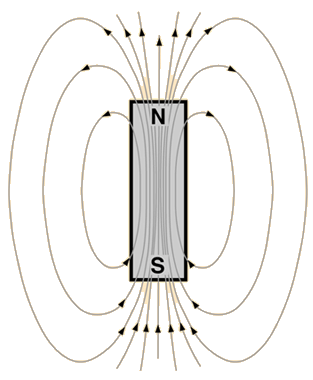
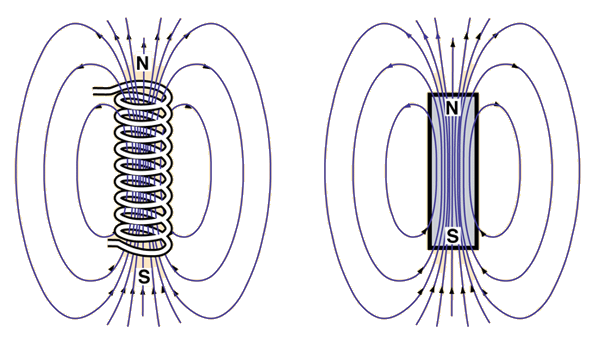
Bar Magnet

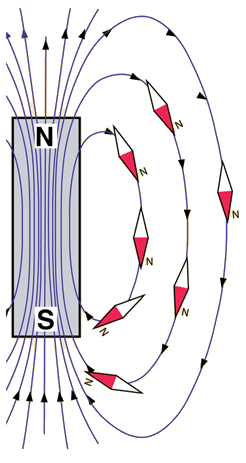
The lines of magnetic field from a bar magnet form closed lines. By convention, the field direction is taken to be outward from the North pole and in to the South pole of the magnet. Permanent magnets can be made from ferromagnetic materials.

The magnetic field lines of a bar magnet can be traced out with the use of a compass. The needle of a compass is itself a permanent magnet and the north indicator of the compass is a magnetic north pole. The north pole of a magnet will tend to line up with the magnetic field, so a suspended compas needle will rotate until it lines up with the magnetic field. Unlike magnetic poles attract, so the north indicator of the compass will point toward the south pole of a magnet. In response to the

Earth's magnetic field, the compass will point toward the geographic North Pole of the Earth because it is in fact a magnetic south pole. The magnetic field lines of the Earth enter the Earth near the geographic North Pole.

Comparison of magnetic and electric fields

Compare to solenoid magnetic field

Index
Magnetic field concepts

HyperPhysics***** Electricity and Magnetism

R Nave

Go Back
Electric and Magnetic Sources
The

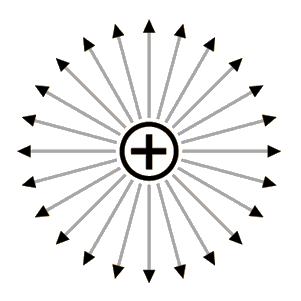
electric field of a point charge is radially outward from a positive charge.

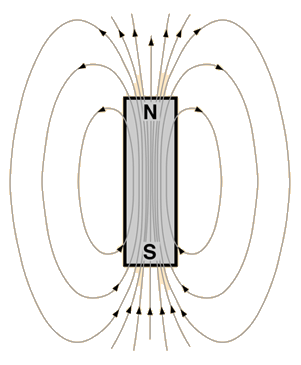
The magnetic field of a

bar magnet.

Electric sources are inherently "monopole" or point charge sources.

Magnetic sources are inherently dipole sources - you can't isolate North or South "monopoles".

Index
Magnetic force
Magnetic field concepts

HyperPhysics***** Electricity and Magnetism

R Nave

Go Back
Bar Magnet and Solenoid

The magnetic field produced by electric current in a solenoid coil is similar to that of a bar magnet.

Add iron core to solenoid

Index
Magnetic field concepts

HyperPhysics***** Electricity and Magnetism

R Nave

Go Back
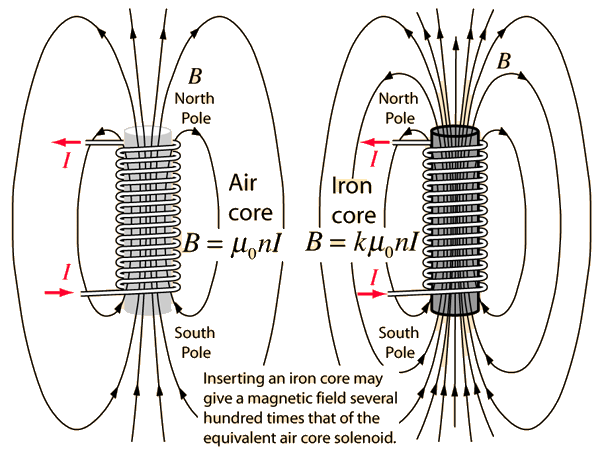
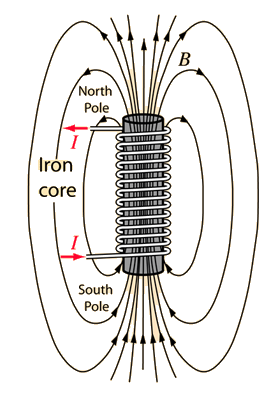
Iron Core Solenoid

An iron core has the effect of multiplying greatly the magnetic field of a solenoid compared to the air core solenoid on the left.

Properties of iron core solenoid

Index
Magnetic field concepts

HyperPhysics***** Electricity and Magnetism

R Nave

Go Back
Electromagnet

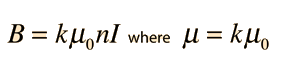
Electromagnets are usually in the form of iron core solenoids. The ferromagnetic property of the iron core causes the internal magnetic domains of the iron to line up with the smaller driving magnetic field produced by the current in the solenoid. The effect is the multiplication of the magnetic field by factors of tens to even thousands. The solenoid field relationship is

and k is the relative permeability of the iron, shows the magnifying effect of the iron core.

Index
Magnetic field concepts

HyperPhysics***** Electricity and Magnetism

R Nave

Go Back

http://science.nasa.gov/science-news/science-at-nasa/2010/21sep_zigzag/

Sept. 21, 2010: Solar storms don't always travel in a straight line. But once they start heading in our direction, they can accelerate rapidly, gathering steam for a harder hit on Earth's magnetic field.

So say researchers who have been using data from NASA's twin STEREO spacecraft to unravel the 3D structure of solar storms. Their findings are presented in today's issue of Nature Communications.

A coronal mass ejection (CME) observed by STEREO on Dec. 12, 2008. [larger image]

"This really surprised us," says co-author Peter Gallagher of Trinity College in Dublin, Ireland. "Solar coronal mass ejections (CMEs) can start out going one way—and then turn in a different direction."

The result was so strange, at first they thought they'd done something wrong. After double- and triple-checking their work on dozens of eruptions, however, the team knew they were onto something.

"Our 3D visualizations clearly show that solar storms can be deflected from high solar latitudes and end up hitting planets they might otherwise have missed," says lead author Jason Byrne, a graduate student at the Trinity Center for High Performance Computing.

A 3D model of an actual CME based on multiscale processing of STEREO data. [9MB movie]

The key to their analysis was an innovative computing technique called "multiscale image processing." Gallagher explains:

"'Multiscale processing' means taking an image and sorting the things in it according to size. Suppose you're interested in race cars. If you have a photo that contains a bowl of fruit, a person, and a dragster, you could use multiscale processing to single out the race car and study its characteristics."

In medical research, multiscale processing has been used to identify individual nuclei in crowded pictures of cells. In astronomy, it comes in handy for picking galaxies out of a busy star field. Gallagher and colleagues are the first to refine and use it in the realm of solar physics.
"We applied the multiscale technique to coronagraph data from NASA's twin STEREO spacecraft," Gallagher continues. "Our computer was able to look at starry images cluttered with streamers and bright knots of solar wind and zero in on the CMEs."

STEREO-A and STEREO–B are widely separated and can see CMEs from different points of view. This allowed the team to create fully-stereoscopic models of the storm clouds and track them as they billowed away from the sun.

One of the first things they noticed was how CMEs trying to go "up"—out of the plane of the solar system and away from the planets—are turned back down again. Gallagher confesses that they had to "crack the books" and spend some time at the white board to fully understand the phenomenon. In the end, the explanation was simple:

The magnetic field of a bar magnet.

The sun's global magnetic field, which is shaped like a bar magnet, guides the wayward CMEs back toward the sun's equator. When the clouds reach low latitudes, they get caught up in the solar wind and head out toward the planets—"like a cork bobbing along a river," says Gallagher.

Once a CME is embedded in the solar wind, it can experience significant acceleration. "This is a result of aerodynamic drag," says Byrne. "If the wind is blowing fast enough, it drags the CME along with it—something we actually observed in the STEREO data."

Past studies from other missions had revealed tantalizing hints of this CME-redirection and acceleration process, but STEREO is the first to see it unfold from nearly beginning to end.

"The ability to reconstruct the path of a solar storm through space could be of great benefit to forecasters of space weather at Earth," notes Alex Young, STEREO Senior Scientist at the Goddard Space Flight Center. "Knowing when a CME will arrive is crucial for predicting the onset of geomagnetic storms."

"Furthermore," he says, "the image processing techniques developed by the Trinity team in collaboration with NASA Goddard can be used in applications ranging from surveillance to medical diagnostics."

To learn more about zig-zagging CMEs and the advanced computing techniques used to track them, read "Propagation of an Earth-directed coronal mass ejection in three dimensions" by Byrne et al in the Sept. 21, 2010, issue of Nature Communications.

Register to Reply
Guru

Join Date: Dec 2007
Location: California
Posts: 2363
Good Answers: 63
#62

Re: What is Magnetism?

09/10/2010 5:30 PM

One thing to bear in mind magnetic fields are more like electric fields (except of course orthognal to the electric fields). Magnetic fields unlike gravity can also repel objects depending on polar orientations.

Register to Reply
Guru

Join Date: Dec 2008
Location: Cd. Juarez, Chihuahua, Mexico.
Posts: 1023
Good Answers: 69
#64

Re: What is Magnetism?

09/11/2010 3:14 PM

Hello Peter:

Eventhough no definitive explanation has been given to the source of naturally occurring magnetism, one of the latest theories states that is is the motion of the charges that constitutes (or builds) electrons what causes it; independent of electron rotation. But then I have to ask: What causes the existence of such charges ?, and what are they made of ?

Electric currents thru a conductor, create magnetic fields around the same. You can build an electromagnet delivering X Gauss; but there will be energy consumption, thus dissipation of heat from the core and windings, we all know that; and this is sometimes used as an attempt to explain natuarlly occurring magnetism, but then, why there is no heat being released by a natural magnet of the same "pull"?.

For me magnetism an electromagnetism are two different causes producing apparently the same effect. I think that at least two "kinds" of magnetism exist.

Have you ever though about what defines the structure of our universe? I doubt it is only the gravity and centrifugal forces, as we were taught.

Just think about this: Since there is a given gravitational attraction between two planets, each on its orbit (say, located at oposed sides of the sun, which is in the middle); how much this force will be increased when they eventually meet, one in front of the other (with the sun "behind" them) ?... Exactly ! Then tell me why they don't collide?.

I see most of the celestial bodies with a magnetosphere, as magnetic nucleus shielded by a magnetic "bubble" wich prevents interference of other major bodies, all spinning in an endless vortex of energy (I certainly think the outer space is not empty).

This energy for me has to do with some form of magnetism, and I envision a universal three-dimensional magnetic web wich defines the structure of the universe (who knows, this could be for example the surface of a spoon with wich a small child is eating at a different level of existence ).

If you manage to somehow "tune" those vectors and skate over them, give me a haul, I'd like to see the milky way from the outside.

Yahlasit

__________________
No hay conocimiento ni herramienta que sustituya al sentido comun.
Register to Reply
Guru

Join Date: Dec 2007
Location: California
Posts: 2363
Good Answers: 63
#69
In reply to #64

Re: What is Magnetism?

09/13/2010 5:32 PM

? Huh?

Register to Reply
Guru
United States - Member - Hobbies - Fishing - New Member Hobbies - Target Shooting - New Member Hobbies - RC Aircraft - New Member Engineering Fields - Aerospace Engineering - New Member

Join Date: May 2009
Location: Saint Helens, Oregon
Posts: 2216
Good Answers: 70
#83

Re: What is Magnetism?

01/08/2012 10:58 PM

I just ran across this in Discover Magazine and maybe Richard Feynman can better explain magnetism, "When asked to explain magnetism, "he urged his BBC interviewer to take it ......."

__________________
Confucius once said, “ Ability will never catch up with the demand for it".
Register to Reply
Register to Reply 83 comments

Good Answers:

These comments received enough positive votes to make them "good answers".

"Almost" Good Answers:

Check out these comments that don't yet have enough votes to be "official" good answers and, if you agree with them, vote them!
Copy to Clipboard

Users who posted comments:

Anonymous Poster (3); BruceFlorida (1); chrisg288 (7); dj95401 (1); Doorman (1); G.K. (3); ky (4); merc600sec (1); one2playwitt (8); peterg7lyq (19); phoenix911 (19); RCE (5); Rorschach (1); russ123 (5); Sciesis2 (1); The Prof (1); TVP45 (1); Usbport (1); Yahlasit (1)

Previous in Forum: What Sensor Should be used to Make an Altimeter?   Next in Forum: Water Treatment Plant

Advertisement