|
Golf is a game of grown men (and women!) hitting little
balls big distances. A lot of people
drink, curse and throw their clubs and this is called golf, too.
Perhaps you're like your humble author and try as you might
you can never get that perfect golf drive down every time. (Full disclosure: I can only play golf for about 2-3 months a
year.) I'd say out of 10 drives maybe half of them are straight, and out of
those 5 I'm only happy with 3 of those. It can be frustrating spending
all that money and time to achieve 30% satisfaction in a hobby. Forget my short game because we're not
touching that-at least today.
But have you considered what causes your balls' trajectory to curve or slice in
mid-flight? If you play and said, "Yes," you probably blamed something out of
your control (clubs, course, etc.). If you said, "No," then how does all that
cash feel, Tiger?
Why so glum, millionaire chum? Oh, right... via Dailymail UK
Let's examine golf balls.
The first golf balls were wooden but the featherie ball
would be the golf standard for over 200 years. Created by placing boiled
feathers in a painted hide pouch, a compact ball would result as the feathers
cooled and expanded. The featherie had superior trajectory but was expensive
and prone to rot. In 1848, Dr. Robert Adams Patterson made a golf ball from the
sap of gutta-percha trees. This ball was easy to produce, felt like rubber, and
was perfectly round. Players discovered that nicks and scratches on the ball's
surface actually improved the ball's flight, and evenly impressed dimples were
soon added to the ball to create a layer of turbulence. Fifty years after the 'guttie,' a bored
friend of a BF Goodrich employee wound a rubber thread into a ball. When Coburn
Haskell bounced the ball, he found it bouncy and durable. With the application
of a cover, it would be the golf ball that would dominate 20th
Century golf. Modern golf balls have multi-layered construction with a surlyn
or urethane shell, additional layers of high density rubber and metal, and a
low-density rubber core.
The trajectory of the golf ball is directly related to the
dimple design found on the ball cover.
Let's recall the impulse lesson from Fight
Night Physics that determines the momentum transferred from one object to
another.
"Step right up, folks. See if you can out drive the amazing golf ball, uh…wacker guy!" -Happy Gilmore
For today we're going to examine the impulse transferred
from the club face to the golf ball. Each club has a unique club face, designed
to provide different arcs to a struck golf ball. Ideally, the club face should
strike the ball perpendicularly providing backspin to the ball, and providing
lift due to the Magnus effect. The
dimples increase friction and traction through the air.
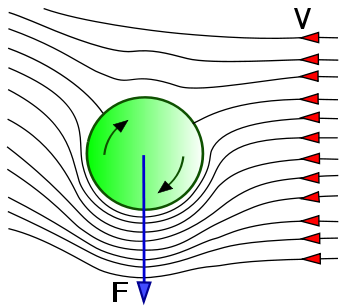
Magnus effect, in action! via Schema-root
When the golf ball is struck less or more than
perpendicularly, sidespin is created and increases the hook/slice on the ball,
resulting in the golfer wasting his or her companion's time while searching for
the ball. (More disclosure:
I can't help you with hooks and slices but this man can). Highly layered (three,
four, five) golf balls are designed for better players because higher density
layers dramatize the ball's spin.
Let's assume that this is one of my good holes. I crush the
ball straight off the tee and it lands 250 yards in front of me (Full
disclosure: this is fantasy). Is it as simple as a square club face? Not quite.
The dimples have a distinct effect on the aerodynamics of the ball.
Stay
with me here. The dimples on the golf ball help create
turbulent air flow around the ball at high speeds (like after the ball is
driven) and produces a farther traveled golf ball. Without dimples, the ball
is subject to laminar flow where the fluid (in our instance air) boundary is
split at the front of the ball. This results in a large area of low pressure
behind the ball and increased drag. Since the dimples on the golf ball redirect
the air flow and create a layer of turbulence, the separation of the fluid
boundary is later along the golf ball's body, significantly reducing drag. In short, dimples should be admired on golf
balls too, not just the cutie who drives the refreshment cart.
There are no conclusions as to a perfect number of dimples.
Many companies have their own preferences and marketing strategies, but as long
as the ball meets USGA and St. Andrew's standards, the ball is usable. An example of golf balls not sanctioned for
tournament play are those made by Polara, which have equators or axes that
straighten themselves during flight due to manipulated ball dimples.
What say you duffers alike? What type ball do you pull out of your bag? And where does it end up?
Resources
Wikipedia - Golf Ball History
Kubik - Silly Laws
Science Buddies - A cure for hooks and slices
| 


 Re: Turbulent: A Golf Game


