Challenge Questions Blog

Challenge Questions

Stop in and exercise your brain. Talk about this month's Challenge from Specs & Techs or similar puzzles.

So do you have a Challenge Question that could stump the community? Then submit the question with the "correct" answer and we'll post it. If it's really good, we may even roll it up to Specs & Techs. You'll be famous!

Answers to Challenge Questions appear by the last Tuesday of the month.

Previous in Blog: Stumped by the Screen: Newsletter Challenge (December 2017)   Next in Blog: Electric Bill Enigma: Newsletter Challenge (February 2018)
Close
Close
Close
Page 2 of 2: « First < Prev 1 2 Last »
Rate Comments: Nested

Fuddled Frequencies: Newsletter Challenge (January 2018)

Posted December 31, 2017 5:01 PM
Pathfinder Tags: challenge question frequency

This month's Challenge Question: Specs & Techs from GlobalSpec:

Suppose your preferred AM radio station is located at 800 kHz on your radio dial, and you have a very special, perfect radio receiver that can only tune exactly at 800 kHz, excluding all other frequencies. Would you hear the music more clearly using such a radio receiver, or there is no difference between it and a standard receiver? Can this be true if you have an FM receiver with the same characteristics?

And the answer is:

If the radio receiver is limited to exactly one frequency it cannot receive modulated waves, and without modulation no information can be transmitted – only hum. This is true for FM radios as well.

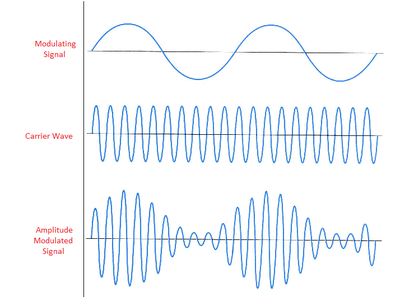
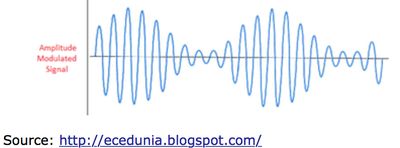
In order for a radio transmission to carry information (music in this case), the main signal (music) has to be modulated so it can make “different expressions.” AM waves are modulated by “adding” a high frequency (the carrier; this is the frequency at which you should tune your receiver) to the original signal (modulating signal). The result is a signal with highs and lows is shown in the figure.

The amplitude-modulated signal contains more than one frequency and the radio receiver must be able to receive all frequencies, including the frequency of the original signal.

Reply

Interested in this topic? By joining CR4 you can "subscribe" to
this discussion and receive notification when new comments are added.

Good Answers:

These comments received enough positive votes to make them "good answers".

"Almost" Good Answers:

Check out these comments that don't yet have enough votes to be "official" good answers and, if you agree with them, vote them!
Guru

Join Date: May 2006
Location: Placerville, CA (38° 45N, 120° 47'W)
Posts: 6215
Good Answers: 248
#155
In reply to #154
Find in discussion

Re: Fuddled Frequencies: Newsletter Challenge (January 2018)

01/19/2018 1:38 PM

I keep thinking about this myself...

What you are describing is simply an extension of what I said in post #122, and Rixter answered in #123.

Thinking about the properties of high Q resonant circuits allowed me to understand the limitations of such circuits to respond to rapid changes in amplitude, and thus reconcile my thoughts with those of the people who rely on the mathematics of adding and multiplying sine waves to reach their conclusions.

BUT! The original post did indeed say "...perfect radio receiver that can only tune exactly at 800 kHz". If it is a "perfect" receiver, then it should not have the limitations of resonant circuits, and should be able to receive and resolve any 800kHz signal having an amplitude between some lower and upper limits.

Such a receiver could, for example, measure the average voltage of each positive half-cycle (an envelope detector), or invert the negative halves and measure every half-cycle for maximum response (an improved envelope detector). If, as you indicated, the transmitter made all amplitude changes exactly at the zero crossover points, then there would be no frequencies other than 800kHz in the transmitted signal, and there would be no sidebands.

The OP said nothing about the transmitter, but if we can have a perfect receiver, then we should also be able to have a perfect transmitter, capable of doing the above. If, as amichelen says in post #134, "This is a theoretical question and a non-existing receiver." then we may as well have a theoretical, non-existing transmitter as well.

The only problem I see with this is the manner in which the receiver would reject other frequencies, but since it is a perfect receiver, that's not my problem.

I see no reason why such an AM transmitter could not be built, and then with that perfect receiver, it should easily be able to detect all the audio frequencies encoded into that 800kHz signal.

__________________
Teaching is a great experience, but there is no better teacher than experience.
Reply Score 1 for Good Answer
Guru
Safety - Hazmat - New Member United States - US - Statue of Liberty - New Member Engineering Fields - Chemical Engineering - Old Hand

Join Date: Mar 2011
Location: Lubbock, Texas
Posts: 14331
Good Answers: 162
#157
In reply to #155

Re: Fuddled Frequencies: Newsletter Challenge (January 2018)

01/19/2018 4:35 PM

The real issue is that real AM transmission relies on various techniques to remove most of the carrier wave from the broadcast, as it is not required for de-convolution on the receiving end. It puts a very efficient amount of the power (usually) into usually the plus side band, in order for "customers" to get a clear, unheeded audio program.

Think about how GPS works, and all the complexities of the maths involved to correct for bending of signal by the ionosphere and what not. It is not a trivial game being played at by surveyors any more.

Not only that, Military ground fixes nor aerial fixes require transmitting anything these days. The satellites take care of it all, and the first atomic super accurate clocks were not launched into space until only a couple of decades ago. This did allow for a test of Special and General Relativity, where clock errors due to speed were predicted, a few microseconds per day, if I recall correctly.

__________________
If it ain't broke, don't fix it. Just build a better one.
Reply
Guru

Join Date: Apr 2010
Location: About 4000 miles from the center of the earth (+/-100 mi)
Posts: 9913
Good Answers: 1141
#158
In reply to #155

Re: Fuddled Frequencies: Newsletter Challenge (January 2018)

01/19/2018 9:34 PM

You're still trying to cheat the math.

Sorry, changing the amplitude of the modulating signal (i.e. the audio) at zero crossings of the carrier achieves nothing. The reason is that the frequency spectrum doesn't represent a single cycle of the carrier, it represents the signal for its entire duration. (The time-based signal goes into the Fourier Transform and the frequency spectrum come out.)

Some information on Fourier Spectrum Analysis can be found here

Reply
Guru

Join Date: Apr 2010
Location: About 4000 miles from the center of the earth (+/-100 mi)
Posts: 9913
Good Answers: 1141
#159
In reply to #155

Re: Fuddled Frequencies: Newsletter Challenge (January 2018)

01/19/2018 9:47 PM

If, as you indicated, the transmitter made all amplitude changes exactly at the zero crossover points, then there would be no frequencies other than 800kHz in the transmitted signal, and there would be no sidebands.

You're still trying to cheat the math.

Sorry, changing the amplitude of the modulating signal (i.e. the audio) at zero crossings of the carrier achieves nothing. The reason is that the frequency spectrum doesn't represent a single cycle of the carrier, it represents the signal for its entire duration. (The time-based signal goes into the Fourier Transform and the frequency spectrum come out.)

Some information on Fourier Spectrum Analysis can be found here

Reply
Guru

Join Date: Aug 2005
Location: Hemel Hempstead, UK
Posts: 5826
Good Answers: 322
#160
In reply to #159

Re: Fuddled Frequencies: Newsletter Challenge (January 2018)

01/20/2018 8:52 AM

"The reason is that the frequency spectrum doesn't represent a single cycle of the carrier, it represents the signal for its entire duration."

That is exactly my point.

That is why trying to answer this question using the frequency domain is completely pointless.

You have to look at in (the incredibly easy to understand) time domain.

__________________
If you spend all your time looking for people and things to complain about: trust me, you will find plenty to complain about.
Reply
Guru
Safety - Hazmat - New Member United States - US - Statue of Liberty - New Member Engineering Fields - Chemical Engineering - Old Hand

Join Date: Mar 2011
Location: Lubbock, Texas
Posts: 14331
Good Answers: 162
#167
In reply to #160

Re: Fuddled Frequencies: Newsletter Challenge (January 2018)

01/22/2018 11:23 AM

The frequency domain is the only way to know what takes place in the time domain, since we can see the entire frequency domain (provided with a suitable sampling subset of the data), and supposing that we have t=0 phase detector for the carrier, no information content at all is lost in the transform at some level of sampling.

We never will have sufficient time (in this life or the next) to completely visit and see the entire time domain of the signal in question. I therefore call B.S. on your previous answer.

__________________
If it ain't broke, don't fix it. Just build a better one.
Reply
Guru

Join Date: May 2006
Location: Placerville, CA (38° 45N, 120° 47'W)
Posts: 6215
Good Answers: 248
#161
In reply to #159

Re: Fuddled Frequencies: Newsletter Challenge (January 2018)

01/20/2018 11:17 AM

I've been aware of the basic concepts of the Fourier Transform for well over 50 years, but have never done any math regarding it. Thanks for the link. I did spend some time there...

"...it represents the signal for its entire duration." The entire duration of what? Surely we don't have to wait 'till the end of a program/transmission to obtain a Fourier Transform!

I'm quite well aware that any complex wave can be constructed by adding sufficient sine waves of appropriate frequencies, amplitudes, and phase relationships (cosine waves are just phase-shifted sine waves). But here we are not dealing with complex waves; we are dealing with pure sine waves having a constant frequency of 800kHz, an unchanging phase, and only changing the amplitude.

So the Fourier Transform should be a single line @ 800kHz, whose length changes with the amplitude of the signal. Where is the flaw in that?

Mathematics is a wonderful tool for understanding many things, but those things exist with or without the math, and math is not the only way to understand most things. I'm not trying to cheat math or anything else. I'm simply trying to understand how things work, and use that understanding to predict how those things would work under different circumstances. I've been doing that for roughly 70 years...

__________________
Teaching is a great experience, but there is no better teacher than experience.
Reply
Guru

Join Date: Apr 2010
Location: About 4000 miles from the center of the earth (+/-100 mi)
Posts: 9913
Good Answers: 1141
#162
In reply to #161

Re: Fuddled Frequencies: Newsletter Challenge (January 2018)
01/20/2018 2:20 PM

Some problems are easily solved in the time domain and some in the frequency domain. For example, the only way to see what gets through a filter is to work in the frequency domain. The frequency spectrum of a signal is just a plot of what frequencies are present. The frequency plot of a filter just indicates what frequencies will pass.

The frequency spectrum of what passes through the filter is just the product of the frequency spectrum of the signal times the frequency response of the filter. If you want to do this in the time domain, you have to compute the convolution of the signal and the impulse response of the filter, a considerably more difficult operation.

When we talk about a zero bandwidth signal, we are talking about an extreme limit that cannot be reached. A zero bandwidth in the frequency domain corresponds to an unvarying sinusoid in the time domain that stretches from minus infinity to plus infinity, also an extreme limit that is impossible to achieve.

In the real world, these extreme limits don't exist, they are abstract, but we use these terms in place of very large durations of signals or very small bandwidth passband of the receiver, just as limits in calculus are computed as some variable becomes infinite or zero.

Time duration (delta t) and frequency precision (delta f) are inversely proportional. An 800 KHz signal lasting 1 second would have a spectral line width of about 1 Hz. If the signal lasts for 10 seconds, the bandwidth would be about 0.1Hz, and so on.

If you amplitude modulate this carrier signal with a frequency of, say, 10 Hz, you would have three lines in the spectrum, the original carrier and lines on both sides at +/- 10 Hz from the carrier frequency. The finite extent of the signal, turning it on and off, is really modulation, multiplying the signal amplitude by 0, then 1, and then 0. This is what causes the frequency line width that is inversely proportional to duration.

Frequency plot of carrier of length T. As T becomes longer, 1/T becomes smaller.

Reply Score 1 for Good Answer
Guru

Join Date: May 2006
Location: Placerville, CA (38° 45N, 120° 47'W)
Posts: 6215
Good Answers: 248
#164
In reply to #162

Re: Fuddled Frequencies: Newsletter Challenge (January 2018)

01/20/2018 3:16 PM

Thank you for your time!

Apparently, you see my not using the math as a restriction in my understanding, and I see your depending entirely on the math as a restriction on your understanding.

At this point, my next step would be to build the best approximation I could of the specified receiver, and see what happens, but I already have too many real unfinished projects. so I think it's time for me to stop this and go back to my real projects.

__________________
Teaching is a great experience, but there is no better teacher than experience.
Reply
Guru

Join Date: Aug 2005
Location: Hemel Hempstead, UK
Posts: 5826
Good Answers: 322
#166
In reply to #162

Re: Fuddled Frequencies: Newsletter Challenge (January 2018)

01/22/2018 5:18 AM

GA: but like dkwarner I believe that you are only describing the limitations of the technique.

__________________
If you spend all your time looking for people and things to complain about: trust me, you will find plenty to complain about.
Reply
Guru

Join Date: Aug 2005
Location: Hemel Hempstead, UK
Posts: 5826
Good Answers: 322
#165
In reply to #161

Re: Fuddled Frequencies: Newsletter Challenge (January 2018)

01/22/2018 5:09 AM

"Mathematics is a wonderful tool for understanding many things, but those things exist with or without the math."

Exactly: GA.

__________________
If you spend all your time looking for people and things to complain about: trust me, you will find plenty to complain about.
Reply
Guru
Safety - Hazmat - New Member United States - US - Statue of Liberty - New Member Engineering Fields - Chemical Engineering - Old Hand

Join Date: Mar 2011
Location: Lubbock, Texas
Posts: 14331
Good Answers: 162
#168
In reply to #161

Re: Fuddled Frequencies: Newsletter Challenge (January 2018)

01/22/2018 11:28 AM

Any FT of time-dependent data, regardless of the source can only reach an upper frequency limit of half the sampling frequency. The lower limit of frequency in the FT depends on t=0 amplitude (phase information), and the duration of the sampling time envelope. period.

This means that to sample and have information content about a 1 Hz signal applied to an 800.000 KHz carrier, one would have to same for at least a few seconds. Accuracy of the transformed amplitude gains with every second of sampling.

First there is the Nyquist issue, then essentially, there is the inverse Nyquist issue.

Thus, the best FT will be able to be faster than the carrier wave by quite a bit, and also last longer than multiple periods of the cutoff frequency.

That is finally, my last word on this beaten to death topic.

__________________
If it ain't broke, don't fix it. Just build a better one.
Reply
Guru

Join Date: May 2006
Location: Placerville, CA (38° 45N, 120° 47'W)
Posts: 6215
Good Answers: 248
#170
In reply to #168

Re: Fuddled Frequencies: Newsletter Challenge (January 2018)

01/22/2018 12:22 PM

"...one would have to same for at least a few seconds."

I presume you meant ...sample for...

"Accuracy of the transformed amplitude gains with every second of sampling."

This may be true for a carrier modulated by a constant pure sine wave, but it can't be true for a carrier modulated by music or speech, because that amplitude is constantly changing.

I readily admit that I had to look up the Nyquist issue, and didn't bother to look up the inverse.

__________________
Teaching is a great experience, but there is no better teacher than experience.
Reply
Guru
Safety - Hazmat - New Member United States - US - Statue of Liberty - New Member Engineering Fields - Chemical Engineering - Old Hand

Join Date: Mar 2011
Location: Lubbock, Texas
Posts: 14331
Good Answers: 162
#169
In reply to #161

Re: Fuddled Frequencies: Newsletter Challenge (January 2018)

01/22/2018 11:35 AM

Let me really blow your mind. As you may be aware, the refractive index is the speed of light in a medium. In this case, the medium is "air". Some considerable distance is expected between transmitter and receiver, although not entirely necessarily the case. It is "normally" the case.

Reflections of the signal may take place, as well as refraction at thermal layering boundaries, or boundaries of conductors, etc. Having wavelets traveling through air with different speed limits will result in phase shifts. You will never have an 800.000 kHz signal arrive intact with pure frequency and phase, even if unmodulated. End of story. End transmission.

Thus in actual fact, phase shifts of the carrier wave can and do take place all the time, and have a lot to do with radio interference. Deconvolve the encumbrances between source and detector, and you will be a millionaire? I don't know, but it might have serious applications in the real world.

__________________
If it ain't broke, don't fix it. Just build a better one.
Reply
Guru

Join Date: May 2006
Location: Placerville, CA (38° 45N, 120° 47'W)
Posts: 6215
Good Answers: 248
#171
In reply to #169

Re: Fuddled Frequencies: Newsletter Challenge (January 2018)

01/22/2018 12:39 PM

As I said to Rixter, Thanks for your time!

Rather than blow my mind, this time you provided some information that I fully understand, and hadn't thought of. In addition to reflection and refraction, you could also include diffraction, although that's probably pretty insignificant at a frequency as low as 800kHz.

I heard back in the early '60s that people in Bishop, CA (on the East side of the Sierras) could receive channel 6 TV signals from San Luis Obispo, CA (on the West side of both the Sierras and the coast range), due to the diffraction caused by the sharp peaks of the Sierras.

__________________
Teaching is a great experience, but there is no better teacher than experience.
Reply
Guru
Safety - Hazmat - New Member United States - US - Statue of Liberty - New Member Engineering Fields - Chemical Engineering - Old Hand

Join Date: Mar 2011
Location: Lubbock, Texas
Posts: 14331
Good Answers: 162
#172
In reply to #171

Re: Fuddled Frequencies: Newsletter Challenge (January 2018)

01/22/2018 1:27 PM

Very interesting!

Yes, to measure the contributions of very low frequencies, one has to sample for nearly the duration of the device emitting the spectrum, in certain cases. This is compounded by the phenomenon called the "low-frequency catastrophe", where the amplitude of noise bears an x-1 relationship (inverse) to the frequency x. The lower you go, the higher the noise gets, until you no longer can fish the signal out of the noise.

__________________
If it ain't broke, don't fix it. Just build a better one.
Reply
Guru

Join Date: Aug 2005
Location: Hemel Hempstead, UK
Posts: 5826
Good Answers: 322
#173
In reply to #169

Re: Fuddled Frequencies: Newsletter Challenge (January 2018)

01/23/2018 2:09 PM

This is no time to pick and choose which parts of this theoretical system are perfect and which are not.

For the last 150 posts or so the argument has centred around whether or not a perfect 800KHz filter will pass a signal from a perfect 800KHz carrier modulated by some audio frequency signal in such a way that the audio can be retrieved.

Correct me if I'm wrong, but I think you believe that the filter has to have a bandwidth at least as wide as the audio signal.

Whereas I believe that a filter with a much smaller bandwidth would work OK.

__________________
If you spend all your time looking for people and things to complain about: trust me, you will find plenty to complain about.
Reply
Guru
Safety - Hazmat - New Member United States - US - Statue of Liberty - New Member Engineering Fields - Chemical Engineering - Old Hand

Join Date: Mar 2011
Location: Lubbock, Texas
Posts: 14331
Good Answers: 162
#174
In reply to #173

Re: Fuddled Frequencies: Newsletter Challenge (January 2018)

01/23/2018 4:56 PM

Hell, build one, and see who buys it, heck build both ends of the thing.

__________________
If it ain't broke, don't fix it. Just build a better one.
Reply
Guru

Join Date: May 2006
Location: Placerville, CA (38° 45N, 120° 47'W)
Posts: 6215
Good Answers: 248
#176
In reply to #174

Re: Fuddled Frequencies: Newsletter Challenge (January 2018)

01/23/2018 5:15 PM

I'd love to, but the result would still be a low frequency AM receiver, with the accompanying weaknesses, so no one would buy it. Thus not worth the trouble...

__________________
Teaching is a great experience, but there is no better teacher than experience.
Reply
Guru

Join Date: May 2006
Location: Placerville, CA (38° 45N, 120° 47'W)
Posts: 6215
Good Answers: 248
#175
In reply to #173

Re: Fuddled Frequencies: Newsletter Challenge (January 2018)

01/23/2018 5:11 PM

I agree, AS LONG AS we use the broadest possible definition of the term "filter". In that sense, a "filter" would be any device or set of devices that can extract (at least most of) the modulation information from the modulated carrier.

I do understand why that filter can NOT be a standard resonant circuit, because a resonant circuit having the high Q required to obtain the narrow bandwidth will continue to oscillate after the exciting signal is reduced or gone.

I think I also understand why that filter cannot be a sampling circuit that depends on a Fourier Transform to detect the signal.

BUT, that does not (in my estimation) prohibit the existence of some other form of "filter", perhaps as yet unknown.

I still maintain that any signal that has a positive-going zero crossing once and only once every 800,000th of a second is basically an 800kHz signal. A device that detects those zero crossings could easily reject any signals not meeting that criteria, thus accepting ONLY 800kHz signals, of whatever waveshape (that does not result in additional zero crossings). A device that sums the energy of the incoming (accepted) signal once every 800,000th of a second (or 1,600,000th of a second) would generate the output. Isn't that essentially what a diode and RC circuit do?

__________________
Teaching is a great experience, but there is no better teacher than experience.
Reply
Guru
Safety - Hazmat - New Member United States - US - Statue of Liberty - New Member Engineering Fields - Chemical Engineering - Old Hand

Join Date: Mar 2011
Location: Lubbock, Texas
Posts: 14331
Good Answers: 162
#142
In reply to #139
Find in discussion

Re: Fuddled Frequencies: Newsletter Challenge (January 2018)

01/17/2018 9:32 AM

Really? There is no convincing a fence post. I would sooner argue with a fence post, at least the fence post will at some point surrender and relent.

Carrier ain't **it! Got it?

__________________
If it ain't broke, don't fix it. Just build a better one.
Reply
Guru

Join Date: May 2006
Location: Placerville, CA (38° 45N, 120° 47'W)
Posts: 6215
Good Answers: 248
#98
In reply to #86
Find in discussion

Re: Fuddled Frequencies: Newsletter Challenge (January 2018)

01/12/2018 12:30 AM

In the above post. the words

"or, from the same post:" were supposed to be followed by the Graphic Rixter provided showing the carrier and its sidebands in the frequency domain. I use a pasted graphic instead of a link.

Let's try this:

__________________
Teaching is a great experience, but there is no better teacher than experience.
Reply
Guru
Safety - Hazmat - New Member United States - US - Statue of Liberty - New Member Engineering Fields - Chemical Engineering - Old Hand

Join Date: Mar 2011
Location: Lubbock, Texas
Posts: 14331
Good Answers: 162
#54
In reply to #51
Find in discussion

Re: Fuddled Frequencies: Newsletter Challenge (January 2018)

01/08/2018 9:54 AM

Wow! I can say no more. You are being really opaque on this one.

__________________
If it ain't broke, don't fix it. Just build a better one.
Reply
Guru

Join Date: Aug 2005
Location: Hemel Hempstead, UK
Posts: 5826
Good Answers: 322
#69
In reply to #54

Re: Fuddled Frequencies: Newsletter Challenge (January 2018)
01/10/2018 7:41 AM

I'm not trying to be opaque: I'm trying to be really transparent. You said " a pure sine wave", and I said "at what amplitude?"

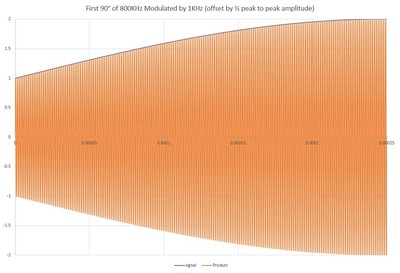
This is the first 90° of the 800KHz carrier being modulated by a 1KHz signal offset by half the peak to peak amplitude.

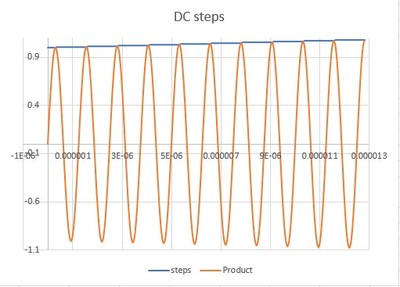
If you looked at the signals with a scope, and, captured 10 cycles of the carrier on the input to the filter around the 30° point; this is what you'd see.

What do you think you'd see on the output of the filter?

__________________
If you spend all your time looking for people and things to complain about: trust me, you will find plenty to complain about.
Reply Score 1 for Good Answer
Power-User

Join Date: Mar 2005
Posts: 214
Good Answers: 3
#83
In reply to #69

Re: Fuddled Frequencies: Newsletter Challenge (January 2018)

01/10/2018 4:34 PM

Randall, You can assume an amplitude that makes the received signal to be able to be heard by the listener. In reality, the amplitude is not of utmost importance. Choose any value, and the answer will be the same.

I do not understand what you want to convey with the figures you include in your post.

Reply
Guru

Join Date: Aug 2005
Location: Hemel Hempstead, UK
Posts: 5826
Good Answers: 322
#94
In reply to #83

Re: Fuddled Frequencies: Newsletter Challenge (January 2018)

01/11/2018 4:17 PM

" In reality, the amplitude is not of utmost importance."

In an AMPLITUDE MODULATED signal I think it's very important.

The figures in the post show the signal in blue and the modulated carrier in orange.

I simply created an 800KHz carrier then multiplied it by a 1KHz signal (offset by ½). That is what amplitude modulation is.

I have only shown the first half rising edge of the signal (0 to 90°).

The snap shot shows a few cycles of the carrier around the 30° point of the signal.

__________________
If you spend all your time looking for people and things to complain about: trust me, you will find plenty to complain about.
Reply
Guru

Join Date: Aug 2005
Location: Hemel Hempstead, UK
Posts: 5826
Good Answers: 322
#101
In reply to #83

Re: Fuddled Frequencies: Newsletter Challenge (January 2018)

01/12/2018 5:56 AM

" In reality, the amplitude is not of utmost importance."

That is true for Frequency Modulation, and, is the great strength of FM over AM. As I pointed out in post 30 the weakness of AM is that if anything interferes with the power of the AM radio signal then the received speech/music is also affected.

__________________
If you spend all your time looking for people and things to complain about: trust me, you will find plenty to complain about.
Reply
Power-User

Join Date: Mar 2005
Posts: 214
Good Answers: 3
#61
In reply to #44
Find in discussion

Re: Fuddled Frequencies: Newsletter Challenge (January 2018)
01/09/2018 4:42 PM

I totally agree!

Reply
Guru
Safety - Hazmat - New Member United States - US - Statue of Liberty - New Member Engineering Fields - Chemical Engineering - Old Hand

Join Date: Mar 2011
Location: Lubbock, Texas
Posts: 14331
Good Answers: 162
#46
In reply to #42
Find in discussion

Re: Fuddled Frequencies: Newsletter Challenge (January 2018)

01/04/2018 9:42 AM

You mean your pony's saddlebags aren't full of crap?

You sound confused here, JP. You disagree with waveform guys, but then you talk about side-band noise, now which is it?

Anyway, I have not done the math since I was in Physics Electronics 502.

Once you begin with e, and start applying signal to add as a multiplier, see what results.

I think that in every case, there is a band of frequencies produced.

__________________
If it ain't broke, don't fix it. Just build a better one.
Reply
Guru

Join Date: Apr 2015
Location: NYC until mid 2015, currently NC
Posts: 756
Good Answers: 8
#35

Re: Fuddled Frequencies: Newsletter Challenge (January 2018)
01/02/2018 9:48 PM

Since reception is limited to EXACTLY 800,000 Hz, all you would hear is any signal received at that value.

Signals broadcast at 799,999 or 800,001 Hz would not be heard, so the best you MIGHT hear is a series of hums and silence.

The question does not mention the accuracy of the broadcast.

__________________
Good judgment comes from experience, and a lotta that comes from bad judgment.
Reply
Guru
Popular Science - Cosmology - Let's keep knowledge expanding Engineering Fields - Retired Engineers / Mentors - Hobbies - HAM Radio - New Member

Join Date: Dec 2006
Location: North America, Earth
Posts: 4528
Good Answers: 106
#36
In reply to #35

Re: Fuddled Frequencies: Newsletter Challenge (January 2018)

01/02/2018 10:59 PM

The OP did not say that. The receiver is TUNED exactly at 800 kHz. A perfect receiver has the bandwidth to receive perfect music.

__________________
“I would rather have questions that can't be answered than answers that can't be questioned.” - Richard Feynman
Reply Score 1 for Good Answer
Guru

Join Date: Dec 2010
Posts: 1895
Good Answers: 44
#56
In reply to #36

Re: Fuddled Frequencies: Newsletter Challenge (January 2018)

01/08/2018 12:01 PM

I think this question was too obvious for a group of engineers who seem to want to nuke the question rather than give the OP a clear answer.

In my daily job, I operate hundreds of single station AM receivers. We use Reduced Carrier Double Sideband AM, and PLQM receivers. Other methods include suppressed carrier and FM multiplexed RC DSB PLQM.

Generally, each RF detector has a bandwidth of 2 kHz where the LSB demod intelligence is what is filtered and used.

There seem to be a few assumptions about whether the station is over the air, wired, or even which country.

My quick and easy answer to the OP would be...yeah, it's better.

Reply Score 1 for Good Answer
Guru
Safety - Hazmat - New Member United States - US - Statue of Liberty - New Member Engineering Fields - Chemical Engineering - Old Hand

Join Date: Mar 2011
Location: Lubbock, Texas
Posts: 14331
Good Answers: 162
#57
In reply to #56

Re: Fuddled Frequencies: Newsletter Challenge (January 2018)

01/08/2018 1:52 PM

I don't see that as working at all. Maybe the hangup is perceived Q and actual Q of the filter circuit for the receiver, and the way the question was worded, nothing gets through but carrier = = zero information content, period. End of story.

Practically, there is probably no such device, and an AM receiver with best Q might still have 2 kHz side-band. Thus, most of a signal (audio) will get through in the real world.

__________________
If it ain't broke, don't fix it. Just build a better one.
Reply
Guru

Join Date: Dec 2010
Posts: 1895
Good Answers: 44
#58
In reply to #57

Re: Fuddled Frequencies: Newsletter Challenge (January 2018)

01/09/2018 12:56 PM

I don't understand how this trend got started. The OP was "...that can only tune exactly ", not "nothing get through but carrier".

The OP was for a single station receiver. It never mentioned anything about filtering sidebands and only tuning the carrier.

It's a dedicated AM receiver...not a tuner.

It's done all of the time in industry, so the OP is actually pointless...it's been done, we do this, it will be done.

Done.

Reply
Guru
Safety - Hazmat - New Member United States - US - Statue of Liberty - New Member Engineering Fields - Chemical Engineering - Old Hand

Join Date: Mar 2011
Location: Lubbock, Texas
Posts: 14331
Good Answers: 162
#59
In reply to #58

Re: Fuddled Frequencies: Newsletter Challenge (January 2018)

01/09/2018 1:11 PM

"you have a very special, perfect radio receiver that can only tune exactly at 800 kHz, excluding all other frequencies".

What part of exclusive is giving you a problem. OP did not state single station receiver. As you have eloquently stated that is done all the time.

You and I both know that for any information to be conveyed, the product of carrier and modulation is taken, and that produces side-bands. The side-bands will not be picked up by the "perfect" 800 kHz receiver that only receives mono-frequency radio waves.

Done.

__________________
If it ain't broke, don't fix it. Just build a better one.
Reply
Guru

Join Date: Dec 2010
Posts: 1895
Good Answers: 44
#73
In reply to #59

Re: Fuddled Frequencies: Newsletter Challenge (January 2018)

01/10/2018 2:16 PM

Fücking Christ…I see why I stayed away from this convoluted forum for so long.

It’s a simple fücking question with a simple answer.

People on this forum are so obtuse. Of course the OP didn’t want some engineer to design an AM radio that wouldn’t demodulate information, but that’s EXACTLY what the “engineers” here are doing. What the hell would the purpose of designing a radio receiver be if you didn’t have a product?

It’s not supposed to be about witty debate showing who can come up with the stupidest and most convoluted Rube Goldberg-inspired answer in an attempt to confuse people, but you wouldn’t know it by following this shït show.

So goddämned stupid.

Reply Off Topic (Score 5)
Guru
Safety - Hazmat - New Member United States - US - Statue of Liberty - New Member Engineering Fields - Chemical Engineering - Old Hand

Join Date: Mar 2011
Location: Lubbock, Texas
Posts: 14331
Good Answers: 162
#80
In reply to #73

Re: Fuddled Frequencies: Newsletter Challenge (January 2018)

01/10/2018 3:43 PM

Lordie Pete!

I agree, nobody (in their right mind) would ever build such a receiver anyway. I also agree that purpose built, single tuners are made.

Let us re-define the "perfect" received from monochromatic receiver, to an AM receiver with really nice side-bands ±20 kHz with carrier suppression for all those audiophiles out there with "bat ears". The problem with this new "perfect" receiver is that it cross-talks with the next frequency allotment on the + side and on the - side of the carrier, so it is also about worthless.

The real perfect AM receiver is one that follows the FCC rules of the road (air).

You get what you get, and you don't get to whine. The rule is ±10 kHz, that is as good as AM ever gets (unless you are in your own little world with very high local AM XMTR, and no other AM freq is found in your bandwidth, you can do whatever the heck you please, as long as FCC doesn't sniff you out.)

This is one of those deals where (1) it is nothing, and (2) it is everything.

__________________
If it ain't broke, don't fix it. Just build a better one.
Reply Off Topic (Score 5)
Power-User

Join Date: Mar 2005
Posts: 214
Good Answers: 3
#63
In reply to #58

Re: Fuddled Frequencies: Newsletter Challenge (January 2018)

01/09/2018 4:50 PM

Done? What do you mean?

Reply
Guru
United Kingdom - Member - Indeterminate Engineering Fields - Control Engineering - New Member

Join Date: Jan 2007
Location: In the bothy, 7 chains down the line from Dodman's Lane level crossing, in the nation formerly known as Great Britain. Kettle's on.
Posts: 32175
Good Answers: 839
#64
In reply to #58

Re: Fuddled Frequencies: Newsletter Challenge (January 2018)

01/10/2018 2:51 AM

<...It's a dedicated AM receiver...not a tuner...> Nonsense. Modulating the carrier signal widens the signal in the frequency domain. A hypothetical receiver set to receive only the carrier frequency with no bandwidth would not receive the modulating information.

__________________
"Did you get my e-mail?" - "The biggest problem in communication is the illusion that it has taken place" - George Bernard Shaw, 1856
Reply
Guru

Join Date: Jun 2013
Location: Central Canada
Posts: 677
Good Answers: 28
#65
In reply to #64

Re: Fuddled Frequencies: Newsletter Challenge (January 2018)

01/10/2018 3:40 AM

PW, what are you saying ? You seem to be saying that the carrier and the modulated carrier are not the same signal. Is it not true that the modulation affects the entire BW of the carrier ? Is it not true that every frequency within the window of the carrier BW is modulated ? How then can a single frequency which happens to be the single centre frequency be treated any differently than the entire channel ? The centre frequency is by definition "a" frequency, and thus is neither 799999 nor 800001. This is a BW of 1 hz, but still constitutes a carrier in a perfect scenario. Lets be clear here that the OP is specifying something hypothetical, in that a perfect receiver does not exist, but answer the question hypothetically as well, without muddying the issue with real world truths ? The OP posted that he has a perfect receiver operating in an imperfect environment. Can we not answer his question from the hypothetical point of view of the receiver? ? How does perfection deal with an imperfect input ? I suggest that the perfect receiver deals with only that portion of the signal that falls across it's narrow window, and do our analysis based only on that single point in the spectrum. What information MUST be present at every point in the transmitted BW, including the centre frequency ? IMHO, most of the answers here have clouded the issue by not dealing with the question AS POSTED. Taken literally, the question is very different from the question considered using conventional imperfect parameters.

__________________
Smart as a post and twice as fast.
Reply
Guru
United Kingdom - Member - Indeterminate Engineering Fields - Control Engineering - New Member

Join Date: Jan 2007
Location: In the bothy, 7 chains down the line from Dodman's Lane level crossing, in the nation formerly known as Great Britain. Kettle's on.
Posts: 32175
Good Answers: 839
#66
In reply to #65

Re: Fuddled Frequencies: Newsletter Challenge (January 2018)

01/10/2018 3:57 AM

<...you...>

It is not a personal statement; there are no opinions here.

https://en.wikipedia.org/wiki/Sideband

__________________
"Did you get my e-mail?" - "The biggest problem in communication is the illusion that it has taken place" - George Bernard Shaw, 1856
Reply
Guru

Join Date: Jun 2013
Location: Central Canada
Posts: 677
Good Answers: 28
#67
In reply to #66

Re: Fuddled Frequencies: Newsletter Challenge (January 2018)

01/10/2018 4:29 AM

A deft sidestep, to be sure. If ..you.. did not ..say.. it then who posted that comment ?

Another way to look at it, is that every answer posted here is an opinion.

Aside from that exercise in semantics,

Consider this :

There are an infinite number of frequencies within the range of 800000hz. They are 800000.001 800000.002 and so on, one may break those down to whatever precision one wishes.

Do not all of these tiny variations in the frequency of 800000 constitute a BW of one hz ?

Now apply the modulation to that BW and try to imagine what the perfect receiver experiences.

__________________
Smart as a post and twice as fast.
Reply
Power-User

Join Date: Mar 2005
Posts: 214
Good Answers: 3
#71
In reply to #65

Re: Fuddled Frequencies: Newsletter Challenge (January 2018)

01/10/2018 8:43 AM

This is a very good point! The answer to the question should be entirely based on the question, even if this is an idealized situation. Just answer the idealized question with an idealized answer.

Reply
Power-User

Join Date: Mar 2005
Posts: 214
Good Answers: 3
#70
In reply to #64

Re: Fuddled Frequencies: Newsletter Challenge (January 2018)

01/10/2018 8:39 AM

I agree!

Reply
Power-User

Join Date: Mar 2005
Posts: 214
Good Answers: 3
#62
In reply to #56

Re: Fuddled Frequencies: Newsletter Challenge (January 2018)

01/09/2018 4:48 PM

Better? For what?

Reply
Guru

Join Date: Jun 2013
Location: Central Canada
Posts: 677
Good Answers: 28
#68
In reply to #35

Re: Fuddled Frequencies: Newsletter Challenge (January 2018)

01/10/2018 5:08 AM

Are there not infinite frequencies between 799999 and 800001?

How about 800000.0001 to 800000.9999 and all those in between ?

Is this not a 1 hz BW ? The real world does not contain perfect individually defined frequencies. To specify a perfect frequency with no BW would be to specify no signal to be received and thus not a receiver.

A centre frequency of 800000 with 1 hz BW would extend from 799999.5 to 800000.5 approximately. OP stated "exactly 800khz". Since we are measuring in hz, can there be an intermediate frequency and still be classified as 800000 ?

The real transmitter then transmits, contained in the typical 800khz Broadcast bandwidth, this tiny subset of frequencies, and they must be modulated equally to all others within the larger BW. Modulation is imposed on all frequencies within the BW; including the centre frequency.

__________________
Smart as a post and twice as fast.
Reply
Guru

Join Date: Mar 2007
Location: by the beach in Florida
Posts: 33392
Good Answers: 1817
#43

Re: Fuddled Frequencies: Newsletter Challenge (January 2018)

01/03/2018 2:41 PM

AM radio station's have a 10 khz bandwidth, the carrier frequency is in the center and is the identifying nomenclature, the upper side band carries the modulation code of the sound and must be demodulated by the receiver to reproduce the sound...so the question is if this theoretical receiver was built for radio reception of only one station at 800khz, then it would need a 10khz receiver band to demodulate the signal or it wouldn't work at all.... it would be an antenna....

https://fas.org/man/dod-101/navy/docs/es310/AM.htm

__________________
All living things seek to control their own destiny....this is the purpose of life
Reply Score 1 for Good Answer
Guru
Popular Science - Cosmology - Let's keep knowledge expanding Engineering Fields - Retired Engineers / Mentors - Hobbies - HAM Radio - New Member

Join Date: Dec 2006
Location: North America, Earth
Posts: 4528
Good Answers: 106
#75

Re: Fuddled Frequencies: Newsletter Challenge (January 2018)

01/10/2018 2:17 PM

It's been way more than a week. The OP has fled. He read all the responses and decided he would be lynched if he posted his answer.

__________________
“I would rather have questions that can't be answered than answers that can't be questioned.” - Richard Feynman
Reply Score 1 for Good Answer
Power-User

Join Date: Mar 2005
Posts: 214
Good Answers: 3
#76
In reply to #75

Re: Fuddled Frequencies: Newsletter Challenge (January 2018)

01/10/2018 2:28 PM

Don't worry... the answer will be posted ... soon ...

Reply
Guru

Join Date: Aug 2005
Location: Hemel Hempstead, UK
Posts: 5826
Good Answers: 322
#78
In reply to #76

Re: Fuddled Frequencies: Newsletter Challenge (January 2018)

01/10/2018 3:15 PM

Hold off on the reply while we're still debating it.

You keep agreeing with all the guys who think they can get at the answer through the frequency domain.

But you haven't replied to my post 69 in particular and several others where I've tried to point out that although the frequency domain is a really useful tool it doesn't represent the whole truth. It's easy to represent a piece of music in the time domain so that in theory it can be reproduced exactly. Try doing the same thing in the frequency domain.

__________________
If you spend all your time looking for people and things to complain about: trust me, you will find plenty to complain about.
Reply
Guru
Safety - Hazmat - New Member United States - US - Statue of Liberty - New Member Engineering Fields - Chemical Engineering - Old Hand

Join Date: Mar 2011
Location: Lubbock, Texas
Posts: 14331
Good Answers: 162
#82
In reply to #78

Re: Fuddled Frequencies: Newsletter Challenge (January 2018)

01/10/2018 4:00 PM

We don't like in the freq domain (oh hell, well some of us do).

In your previous example along this vein, I showed you clearly there was no nugget to be found. If you XMT for 100 cycles of carrier at 800 kHz, the time span is what?

125 μs (reads as microseconds). An audio frequency of 20 kHz (not within allotment on FCC AM XMTR) completes 2.5 cycles. That might be just enough to encode the 20 kHz, and be detected, but no one on the other end will hear it because auditory time constant is about 170 ms (milliseconds). Lower audio frequencies will not likely have sufficient encoding time, so the information content is lost.

Your argument seems to be postulated on the idea that the carrier intensity is going up and down in response to something. I think the answer is that the carrier transfer function through the XMTR and Receiver is not unity. The carrier transfer function through XMTR (unless suppressed) is near unity (especially when there is silence on the information to be transmitted). On the receiver end, if it really is an AM receiver, which is supposed to be, the detector output time constant filters out the carrier power, so that transfer function is zero, or at least near zero. 1 x 0 = 0.

If there are no side bands, then there is no band (the band does not play on).

__________________
If it ain't broke, don't fix it. Just build a better one.
Reply
Guru

Join Date: Aug 2005
Location: Hemel Hempstead, UK
Posts: 5826
Good Answers: 322
#93
In reply to #82

Re: Fuddled Frequencies: Newsletter Challenge (January 2018)

01/11/2018 4:06 PM

"Your argument seems to be postulated on the idea that the carrier intensity peak to peak level is going up and down in response to something."

Um yes: that's what amplitude modulation is, there's a clue in the name. The carrier is simply multiplied by the signal.

The receiver filters everything picked up by the aerial to retrieve the modulated carrier then rectifies it to recreate the signal.

In the pictures in post 69 the blue trace is the signal: a 1KHz sine wave with a peak to peak amplitude of 2; it is offset by 1 volt to keep it positive all the time. It is multiplied by an 800KHz carrier which is also 2 volts peak to peak; the resulting radio signal is the orange trace.

Of course the aerial would receive loads of "noise", but to keep things simple lets assume that there is no interference so the signal at the input to the filter is exactly the same as the signal created by the modulator.

All zero crossing points in the snapshot around the 30° point are at exactly the same point in time as the zero crossing points of the original 800KHz signal.

If you put that signal through an 800KHz filter: what do you think you would see on the other side?

__________________
If you spend all your time looking for people and things to complain about: trust me, you will find plenty to complain about.
Reply
Guru
Safety - Hazmat - New Member United States - US - Statue of Liberty - New Member Engineering Fields - Chemical Engineering - Old Hand

Join Date: Mar 2011
Location: Lubbock, Texas
Posts: 14331
Good Answers: 162
#95
In reply to #93

Re: Fuddled Frequencies: Newsletter Challenge (January 2018)

01/11/2018 4:18 PM

800kHz

BTW if no one noticed, the answer was posted, and Hannes notified.

__________________
If it ain't broke, don't fix it. Just build a better one.
Reply
Guru

Join Date: Aug 2005
Location: Hemel Hempstead, UK
Posts: 5826
Good Answers: 322
#96
In reply to #95

Re: Fuddled Frequencies: Newsletter Challenge (January 2018)

01/11/2018 4:28 PM

800KHz

At what amplitude?

__________________
If you spend all your time looking for people and things to complain about: trust me, you will find plenty to complain about.
Reply
Guru

Join Date: Aug 2005
Location: Hemel Hempstead, UK
Posts: 5826
Good Answers: 322
#119
In reply to #96

Re: Fuddled Frequencies: Newsletter Challenge (January 2018)

01/15/2018 6:01 AM

Come on James and Amichelen, You've got to play:

You've bought a perfect 800KHz filter on Ebay; forget the radio part just get the mixer part of the transmitter; multiply the 800KHz 2V peak to peak sine wave (conveniently output by the magic filter) by a 2V 1KHz sine wave offset by 1V:-

.........In this picture the original signal tracks the top of the envelope but is obscured by the AM signal.

Connect the output of the mixer to the input of the filter, and, connect a scope to the input and output of the filter. Trigger the scope on channel one on the input to the filter at 1½V on a time base which allows you to see approximately this on the input to the filter:-

What does the probe on the output of the filter capture?

How about if the 1KHz sine transitions smoothly to a DC 2V signal at the peak.

So that you see this on the input to the filter:-

Note I've only shown the vertical axis from 1.98V to 2V

What do you see on the output of the filter?

You could try that same experiment in your head the other way round i.e. a 2V DC signal which smoothly transitions to a 1KHz sine wave.

__________________
If you spend all your time looking for people and things to complain about: trust me, you will find plenty to complain about.
Reply Score 1 for Good Answer
Guru

Join Date: Aug 2005
Location: Hemel Hempstead, UK
Posts: 5826
Good Answers: 322
#120
In reply to #119

Re: Fuddled Frequencies: Newsletter Challenge (January 2018)

01/15/2018 10:47 AM

How about if the Signal is a series of DC steps:-

How about if those steps were half the length, there are two obvious ways to do that: each step spans either a complete positive carrier section or negative carrier section, OR, each step spans a either complete positive going slope or a complete negative going slope.

Can you guess what my next question is going to be?

__________________
If you spend all your time looking for people and things to complain about: trust me, you will find plenty to complain about.
Reply
Guru

Join Date: Aug 2005
Location: Hemel Hempstead, UK
Posts: 5826
Good Answers: 322
#99
In reply to #95

Re: Fuddled Frequencies: Newsletter Challenge (January 2018)

01/12/2018 5:34 AM

"the radio receiver must be able to receive all frequencies, including the frequency of the original signal."

Somehow I lost my belief in anything the original person who wrote this said when I read that.

__________________
If you spend all your time looking for people and things to complain about: trust me, you will find plenty to complain about.
Reply
Power-User

Join Date: Mar 2005
Posts: 214
Good Answers: 3
#114
In reply to #99

Re: Fuddled Frequencies: Newsletter Challenge (January 2018)

01/12/2018 3:06 PM

Read the answer. It says that "the radio receiver must be able to receive all frequencies, including the frequency of the original signal." However, "our" receiver (theoretical, non-existent) only receive one frequency (800 kHz); this is the reason this theoretical receiver will not be able to reproduce the music.

SImple!

Reply
Guru

Join Date: May 2006
Location: Placerville, CA (38° 45N, 120° 47'W)
Posts: 6215
Good Answers: 248
#115
In reply to #114

Re: Fuddled Frequencies: Newsletter Challenge (January 2018)

01/12/2018 9:41 PM

There is no such thing as a radio receiver that is able to receive all frequencies! No matter how simple or how sophisticated the radio, every radio ever made has both a lower and an upper limit of frequencies it can receive.

If a transmitter is able to vary the amplitude of its single carrier frequency, that variation in amplitude can be detected by an appropriate receiver, without need to even be aware of any sidebands.

Just because something is included in the answer provided by the OP, does NOT necessarily mean that something is correct! Over many years, I have seen quite a few cases where on a test, the answer provided by the person who wrote the question was just plain wrong! I should have made a collection of such questions and "answers", but I didn't.

__________________
Teaching is a great experience, but there is no better teacher than experience.
Reply
Power-User
Hobbies - Musician - New Member Technical Fields - Technical Writing - New Member

Join Date: Nov 2012
Posts: 431
Good Answers: 6
#81

Re: Fuddled Frequencies: Newsletter Challenge (January 2018)

01/10/2018 3:48 PM

I updated the question with the author's answer.

__________________
Nobody realizes that some people expend tremendous energy merely to be normal. -Camus
Reply
Guru

Join Date: Oct 2009
Posts: 1460
Good Answers: 30
#102
In reply to #81

Re: Fuddled Frequencies: Newsletter Challenge (January 2018)

01/12/2018 9:12 AM

And in my ignorance I disagree with the posted answer. The fact that the transmitter necessarily broadcasts sidebands in addition to the carrier frequency does not mean that the receiver needs to process both the carrier signal and also the sidebands. Indeed the opposite is true. There are advantages to sideband reception on its own, but reception can also be achieved with an envelope detector, which, I believe, does not make use of the sidebands at all. No problem with receiving musical information, even if diode non-linearity has an influence on the quality of reception involved.

Incidentally I would also disagree further with the OP response. I believe that the carrier wave is modulated by the information frequency, not the other way about. This is certainly true of FM and other fancy modulations.

Reply
Power-User

Join Date: Mar 2005
Posts: 214
Good Answers: 3
#103
In reply to #102

Re: Fuddled Frequencies: Newsletter Challenge (January 2018)

01/12/2018 10:17 AM

You have to consider the question. This is a theoretical problem where it is stated that the receiver receives ONLY the carrier frequency of 800 kHz.

The receiver does not receive any other frequency, including the sidebands.

Reply
Guru

Join Date: Oct 2009
Posts: 1460
Good Answers: 30
#106
In reply to #103

Re: Fuddled Frequencies: Newsletter Challenge (January 2018)

01/12/2018 12:24 PM

I have considered the question. My thesis is that the receiver can demodulate the centre frequency with an envelope detector, gaining the full information without any need for the sidebands. Why does an envelope detector need sidebands?

Reply
Power-User

Join Date: Mar 2005
Posts: 214
Good Answers: 3
#107
In reply to #106

Re: Fuddled Frequencies: Newsletter Challenge (January 2018)

01/12/2018 12:33 PM

You have to remember that this (non-existent) receiver can ONLY receive the carrier (800 kHz) and nothing else. So you will never be able to detect the envelope (which is the music you want to hear) out of a pure sine wave (the carrier. See the second wave in the figure I posted earlier).

Reply
Guru

Join Date: May 2006
Location: Placerville, CA (38° 45N, 120° 47'W)
Posts: 6215
Good Answers: 248
#109
In reply to #107

Re: Fuddled Frequencies: Newsletter Challenge (January 2018)

01/12/2018 1:19 PM

The modulated carrier is NOT a pure sine wave! It is a sine wave with varying amplitude, and that varying amplitude can be used to produce a varying voltage; the output signal of music, speech or whatever.

I'm getting the impression that we have two camps here: the theoretical and the practical. I'm definitely in the practical camp. I would never hire an engineer from one of the theoretical schools; if they've never actually built a few physical devices, I don't want them.

Those crystal radios I built nearly 70 years ago knew nothing about sidebands, but they worked!

__________________
Teaching is a great experience, but there is no better teacher than experience.
Reply Score 1 for Good Answer
Guru

Join Date: Oct 2009
Posts: 1460
Good Answers: 30
#116
In reply to #107

Re: Fuddled Frequencies: Newsletter Challenge (January 2018)

01/13/2018 10:00 AM

Just rewrite that to "this (non-existent) receiver can ONLY receive the carrier frequency (800 kHz) but can nevertheless record its amplitude"

Reply
Guru

Join Date: May 2006
Location: Placerville, CA (38° 45N, 120° 47'W)
Posts: 6215
Good Answers: 248
#104
In reply to #102

Re: Fuddled Frequencies: Newsletter Challenge (January 2018)

01/12/2018 12:11 PM

GA. I too am highly dissatisfied with the OP's answer. In addition to your points, the "answer" refers to a figure. Perhaps the OP made the same mistake I did on one of my posts on this thread: I pasted an image instead of providing a link to it. In years past, a pasted image did not appear in the CR4 editor window, so I knew it was necessary to provide the link. This time, the image did appear in the editor, so I assumed the CR4 editor had been improved to accept pasted images. I believe the image did appear in the preview window, but it did not appear in the thread.

Also, the "answer"'s last statement is at least incomplete, if not plain wrong. I suspect that the OP intended to say that the receiver must receive all frequencies within the sidebands; if the receiver received all frequencies, it would not be able to separate one station from another, and any reception would be totally unintelligible.

I still believe that an extreme Q receiver that had a 1Hz or narrower bandwidth could indeed receive the signal, distorted to some extent.

__________________
Teaching is a great experience, but there is no better teacher than experience.
Reply
Power-User

Join Date: Mar 2005
Posts: 214
Good Answers: 3
#105
In reply to #104

Re: Fuddled Frequencies: Newsletter Challenge (January 2018)

01/12/2018 12:22 PM

This is the original questions and the answer:

Question

Suppose your preferred music AM radio station is located at 800 kHz on your radio dial, and you have a very special, perfect radio receiver that can tune only exactly at 800 kHz, excluding all other frequencies. Would you hear the music more clearly using such a radio receiver, or there is no difference as n a standard receiver? Can this be true if you have an FM receiver with the same characteristics?

Answer

If the radio receiver is limited to exactly one frequency, it cannot receive modulated waves, and without modulation no information can be transmitted, so no music. This radio could only humm with one unchanging sound. This is true also for FM radios.

In order for a radio transmission to carry information (music in this case) the main signal (music) has to be modulated so it can make “different expressions”. AM waves are modulated by “adding” a high frequency (the carrier. This is the frequency you should tune your receiver) to the original signal (modulating signal). The result is a signal with high and lows as is shown in the figure.

Source: http://ecedunia.blogspot.com/

The amplitude-modulated signal contains more than one frequency and the radio receiver must be able to receive all frequencies, including the frequency of the original signal

Reply
Guru

Join Date: May 2006
Location: Placerville, CA (38° 45N, 120° 47'W)
Posts: 6215
Good Answers: 248
#108
In reply to #105

Re: Fuddled Frequencies: Newsletter Challenge (January 2018)

01/12/2018 12:56 PM

Thanks for the figure. It is what I expected.

I still see (NO MATH needed) the zero crossings occurring at the exact same times in both the unmodulated and the modulated waveforms, meaning that the period of both waves is constant at 1/800,000 of a second.

The only math required is the simple f=1/T; a single constant period means a single constant frequency of 800kHz.

I do understand that, if you look at a time frame shorter than one full period, different slopes correspond to different frequencies, but to me, that is a mathematical contrivance; a less-than complete understanding of the situation.

I know virtually nothing about software-defined radios, beyond the fact that they do exist and can be incredibly tiny, but it would be very interesting if someone could create such a radio with a 1HZ bandwidth and tune it to an actual AM radio signal.

__________________
Teaching is a great experience, but there is no better teacher than experience.
Reply Score 1 for Good Answer
Guru
Safety - Hazmat - New Member United States - US - Statue of Liberty - New Member Engineering Fields - Chemical Engineering - Old Hand

Join Date: Mar 2011
Location: Lubbock, Texas
Posts: 14331
Good Answers: 162
#130
In reply to #108

Re: Fuddled Frequencies: Newsletter Challenge (January 2018)

01/16/2018 10:21 AM

Do the math. Last time I am going to say it.

Acsin(ωct+δc)= carrier (where 800.000 kHz is the only frequency present from a high Q crystal oscillator).

Bmsin(ωmt+δm) = music broadcast (information as a single note, single frequency)

The AM signal in time domain:

Bmsin(ωmt+δm) ⋅ Acsin(ωct+δc), where we have multiplied carrier amplitude by the music. Now for simplicity, assume B=A (100% modulation). Let m= instantaneous phase of the music, and c = instantaneous phase of the carrier.

useful trigonometric identities.

sin(m)sin(c) = cos(m)cos(c)-cos(m+c)

Note that now there is a term containing m+c phase.

That is all I have to say on the matter.

__________________
If it ain't broke, don't fix it. Just build a better one.
Reply
Guru

Join Date: May 2006
Location: Placerville, CA (38° 45N, 120° 47'W)
Posts: 6215
Good Answers: 248
#131
In reply to #130

Re: Fuddled Frequencies: Newsletter Challenge (January 2018)

01/16/2018 12:06 PM

Thanks James. 50 or so years ago, I could have done that math, but I'm not sure I would have understood it. I'm a visually oriented person; if I can't associate some form of illustration with the math, then I don't really understand the math. Unfortunately, I didn't realize that fact while I was in college, but it was a very serious limitation!

I still use trig almost daily while designing machine parts, but that always involves arcs and triangles that I can draw and visualize. In fact, I've spent much of the past week going back and forth between my CAD program and Excel, verifying the veracity of both the drawings and the spreadsheet to six figures of precision, so I can design a toothed roller for producing a particular kind of honeycomb in whatever size is needed. With that process, I found errors both in the drawings and in the spreadsheet. Once the two agree within the slightly different rounding processes to six figures, I'm confident that I've got it right.

Thus, in this drawing copied from amichelen:

As long as the upward zero crossings occur exactly 1/800,000 of a second apart, then I call it an 800kHz signal, regardless of the deviations from the mathematical definition of an 800kHz pure sine wave shape of any single amplitude.

As I indicated in an earlier post, my revelation in all this is the understanding that a really high-Q resonant circuit will continue to oscillate for a significant time after removal of the stimulating signal, so it can't quickly respond to a sudden lowering of the intensity of the stimulating signal. And of course to obtain zero bandwidth of the resonant circuit would require infinite Q, which means that the resonant circuit would continue oscillating forever, whether the stimulating signal changes or not, and indeed could not respond to a lowering of the amplitude of the stimulating signal.

Now in a real circuit, there are always losses, so the Q can't be infinite, and the oscillations will be reduced after the signal amplitude is reduced, with the rate of reduction being determined by the amount of those losses, which include the energy required to detect the amplitude of those oscillations.

__________________
Teaching is a great experience, but there is no better teacher than experience.
Reply
Guru
Safety - Hazmat - New Member United States - US - Statue of Liberty - New Member Engineering Fields - Chemical Engineering - Old Hand

Join Date: Mar 2011
Location: Lubbock, Texas
Posts: 14331
Good Answers: 162
#133
In reply to #131

Re: Fuddled Frequencies: Newsletter Challenge (January 2018)

01/16/2018 1:42 PM

I can call a donkey a mule, but it still might be a donkey.

__________________
If it ain't broke, don't fix it. Just build a better one.
Reply
Guru
Safety - Hazmat - New Member United States - US - Statue of Liberty - New Member Engineering Fields - Chemical Engineering - Old Hand

Join Date: Mar 2011
Location: Lubbock, Texas
Posts: 14331
Good Answers: 162
#112
In reply to #105

Re: Fuddled Frequencies: Newsletter Challenge (January 2018)

01/12/2018 1:25 PM

Now you have to explain that hum. If it is a perfect receiver, then the S/N ratio is probably higher that a cat's rear end. No hum for signal with a S/N greater than 20.

That is not dB, that is 20.

I hear the sound of silence all around this so-called receiver.

__________________
If it ain't broke, don't fix it. Just build a better one.
Reply
Power-User

Join Date: Mar 2005
Posts: 214
Good Answers: 3
#117
In reply to #104

Re: Fuddled Frequencies: Newsletter Challenge (January 2018)

01/13/2018 3:37 PM

See post #105 to see the figure.

Reply
Guru

Join Date: May 2006
Location: Placerville, CA (38° 45N, 120° 47'W)
Posts: 6215
Good Answers: 248
#118
In reply to #117

Re: Fuddled Frequencies: Newsletter Challenge (January 2018)

01/13/2018 6:15 PM

I thanked you for that figure in post #108, and actually was referring to it (the modulated carrier waveform) when I said that the zero crossings still occurred twice every 1/800,000 of a second, indicating a base frequency of 800kHz.

__________________
Teaching is a great experience, but there is no better teacher than experience.
Reply
Guru
Safety - Hazmat - New Member United States - US - Statue of Liberty - New Member Engineering Fields - Chemical Engineering - Old Hand

Join Date: Mar 2011
Location: Lubbock, Texas
Posts: 14331
Good Answers: 162
#111
In reply to #102

Re: Fuddled Frequencies: Newsletter Challenge (January 2018)

01/12/2018 1:22 PM

Totally befuddled once again, no concept of reality. Sorry, but you and other in the same vein are lost, and may not again touch the elephant!

Where did you learn this crap? Go back and RTFM!

__________________
If it ain't broke, don't fix it. Just build a better one.
Reply
Reply to Blog Entry Page 2 of 2: « First < Prev 1 2 Last »

Good Answers:

These comments received enough positive votes to make them "good answers".

"Almost" Good Answers:

Check out these comments that don't yet have enough votes to be "official" good answers and, if you agree with them, vote them!
Copy to Clipboard

Users who posted comments:

70AARCuda (1); amichelen (28); Casper71 (1); cuba_pete (3); dkwarner (28); Hannes (1); James Stewart (38); Jpfalt (2); LongintheTooth (12); phph001 (11); PWSlack (6); Randall (23); Rixter (13); SolarEagle (2); StandardsGuy (3); Stephen Archer (1); Tom_Consulting (1); tonyhemet (2)

Previous in Blog: Stumped by the Screen: Newsletter Challenge (December 2017)   Next in Blog: Electric Bill Enigma: Newsletter Challenge (February 2018)

Advertisement
