Challenge Questions Blog

Challenge Questions

Stop in and exercise your brain. Talk about this month's Challenge from Specs & Techs or similar puzzles.

So do you have a Challenge Question that could stump the community? Then submit the question with the "correct" answer and we'll post it. If it's really good, we may even roll it up to Specs & Techs. You'll be famous!

Answers to Challenge Questions appear by the last Tuesday of the month.

Previous in Blog: Pyramids: Newsletter Challenge (08/21/07)   Next in Blog: Wedding Predictions: Newsletter Challenge (09/04/07)
Close
Close
Close
Page 2 of 2: « First < Prev 1 2 Last »
Rate Comments: Nested

Electric Field: Newsletter Challenge (08/28/07)

Posted August 26, 2007 5:01 PM

Tom and John are standing in a large chamber; they are about 150 meters apart. Tom is measuring a weak electric field, but John is not detecting any field at all. Tom notices that if he walks towards the center of the chamber the electric field increases rather quickly, inversely proportional to cube of the distance. When John walks toward the same point, he still measures no electric field. Why is Tom measuring an electric field but John isn't?

(Update: Sept 4, 8:26 AM) And the Answer is...

Tom and John are both measuring a dipole. John is approaching from direction that is perpendicular to the dipole moment and so the fields of the two charges cancel out. Tom is approaching from a direction that is not perpendicular to the dipole moment. The electric field of a dipole is proportional to the inverse of the distance cubed.

Reply

Interested in this topic? By joining CR4 you can "subscribe" to
this discussion and receive notification when new comments are added.

Good Answers:

These comments received enough positive votes to make them "good answers".

"Almost" Good Answers:

Check out these comments that don't yet have enough votes to be "official" good answers and, if you agree with them, vote them!
Guru
Hobbies - HAM Radio - New Member Engineering Fields - Mechanical Engineering - New Member United States - Member - New Member

Join Date: Jun 2007
Location: Kiefer OK
Posts: 1325
Good Answers: 22
#79

Re: Electric Field: Newsletter Challenge (08/28/07)

08/30/2007 2:27 AM

This might not be an electrical or electromagnetic problem, but a math problem.

Here are some numbers I plugged into Algosim, a math program:

1/753 = 2.37037037037 × 10⁻⁶

1/503 = 8 × 10⁻⁶

1/253 = 6.4 × 10⁻⁵

1/203 = 0.000125

1/103 = 0.001

1/53 = 0.008

1/43 = 0.015625

1/33 = 0.037037037037

1/23 = 0.125

1/13 = 1

1/.93 = 1.37174211248

1/.83 = 1.953125

1/.73 = 2.91545189504

1/.63 = 4.62962962963

1/.53 = 8

1/.43 = 15.625

Notice how rapidly the results increase as Tom gets less than 1 meter from the field source. The reason Tom measures the field so strongly is that he is very close to the source. John is approximately 150 meters away from the source and the field is so weak at that distance, it doesn't register on John's meter because it doesn't reach the sensitivity level of the meter. The type of source has nothing to do with why Tom measures it and John doesn't. Tom was close enough to get a reading when John was 150 meters away.

Of course the author of the question couldn't tell us that Tom was closer to the source, or else he would have given away the answer. Most of us assumed the source was in the center of the chamber, and both men were equidistant from it.

However, I still need to review electromagentic theory.

__________________
I wonder..... Would Schrödinger's cat play with a ball of string theory?
Reply
Guru

Join Date: Apr 2007
Posts: 3531
Good Answers: 59
#80
In reply to #79

Re: Electric Field: Newsletter Challenge (08/28/07)

08/30/2007 4:36 AM

Wouldn't that would have been a very poor trick question? The strong implication is that the distance is measured from the centre of the room; more significantly, perhaps: grammatically, "the same point" that both men can approach should be the origin of the 1/distance3 law.

Reply
Guru
Hobbies - HAM Radio - New Member Engineering Fields - Mechanical Engineering - New Member United States - Member - New Member

Join Date: Jun 2007
Location: Kiefer OK
Posts: 1325
Good Answers: 22
#89
In reply to #80

Re: Electric Field: Newsletter Challenge (08/28/07)

08/30/2007 3:59 PM

Fyz,
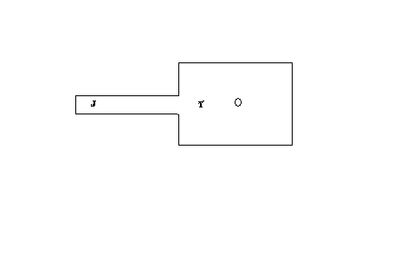
Nothing in the wording of the problem implies that the electric field is in the center of the chamber, but nothing stops us from inferring that it is. All we are told is that Tom nears the center of the field as he walks closer to the center of the chamber.
In a similar vein, we are not told that the chamber is 150 meters long. The queston only states that John is 150 meters away from Tom, and that is the only dimension given.

But, let's assume the field is at the center of the chamber and the chamber is over 300 meters long. Then we could have an arrangement like this:

__________________
I wonder..... Would Schrödinger's cat play with a ball of string theory?
Reply
Guru

Join Date: Apr 2007
Posts: 3531
Good Answers: 59
#90
In reply to #89

Re: Electric Field: Newsletter Challenge (08/28/07)

08/30/2007 4:17 PM

Hi Doug

I think there is a strong implication that the reference point for the inverse cube law is near the centre of the chamber, which in turn implies that this is the source for the field. Obviously, your drawing is a conceivable interpretation. However, that would be entirely uninteresting, and completely inappropriate for a technical forum. If it turns out to be the 'solution', you won't have to tolerate my ramblings on this site in the future. (So how much does that make it worth worth offering the editorial staff to post that answer?)

Fyz

Reply
Guru
Hobbies - HAM Radio - New Member Engineering Fields - Mechanical Engineering - New Member United States - Member - New Member

Join Date: Jun 2007
Location: Kiefer OK
Posts: 1325
Good Answers: 22
#91
In reply to #90

Re: Electric Field: Newsletter Challenge (08/28/07)

08/30/2007 7:32 PM

Well, other possibilities do exist.

The electric field could be located one fourth the way into the chamber from the entrance at one end. Tom enters at that end and John comes in through the door at the opposite end. Of course, Tom is moving towards the center of the chamber. As he does, he detects the EF and notices the strange inverse cube changes in the field strength. At the time Tom detects the EF, John is 150 meters away.

But then nothing in the wording of the problem indicates that the two men are in opposite halves of the chamber. Imagine an arrangement like the one in my diagram, except the two men are near one of the side walls, with John in a corner and Tom at the middle of the wall. Both walk towards the center, and Tom detects the EF while John is still too far away to pick up anything.

Despite what some have said, the EF could have an electromagnetic origin, such as RF. RF field strength meters are essetially EF detectors.

Very few RF radiators follow the inverse cube rule. I can think of only two that might fit the parameters of the problem.

First would be a yagi with an extreme number of directors that produce a very narrow beamwidth and very high gain. I imagine an oversized reflector might help, too.

The other possibilty is a 'slinky' dipole. As the name implies, it uses two or more of the coiled toys as radiating elements. You tune it by adjusting the length, and/or tapping with leads and gator clips between the elements and the feedline. Because the elements are essentially loading coils, you could have enough gain to resemble or apporximate the inverxe cube rule, but I don't know for certain.
Radio waves radiate perpendicular to the elements and not to the ends. Someone standing inline with the dipole elements would not detect a signal unless very close. A similar effect occurs with loops, such as the one I've used for hidden transmitter hunting.

However, having made the case for RF, I must destroy it. Unless the transmitters and antennas are operating in the gigahertz or microwave ranges, the antennas are likely to be large enough to be seen and our EF seekers would not need meters to locate the field source. They would need the meters only to measure its strength.

Please don't stop rambling, Fyz. Some, okay most, are over my head, but I do learn things from them sometimes.

__________________
I wonder..... Would Schrödinger's cat play with a ball of string theory?
Reply
Power-User

Join Date: Aug 2007
Location: Knoxville Tenn, Lake Helen, FL
Posts: 191
#92
In reply to #91

Re: Electric Field: Newsletter Challenge (08/28/07)

08/30/2007 9:35 PM

In radar theory there is such a thing a the "pattern" kinda looks like a palmetto leaf, with one strong main beam and numerous sidelobes. There are ways to electronically "cancel' out the sidelobes in such a way as to make the main be the only one really "visible". This makes it alot harder to jam. (sidelobe jamming is common).

What if this could be done with electric fields? .. In that situation Tom could be walking in the beam or a sidelobe (if not canceled) and john walking not in the beam area? Or john could be walking inbetween sidelobes/ just wondering if it could be applied to electric fields as well?

__________________
Peace begets Synergy which begets Progress!
Reply
Guru

Join Date: Apr 2007
Posts: 3531
Good Answers: 59
#97
In reply to #92

Re: Electric Field: Newsletter Challenge (08/28/07)

08/31/2007 7:19 AM

Radiated waves do have electric fields, of course, but these are inverse linear along any radial line towards the source. The problem would be for Tom to see the inverse cube law without being confined to a very artificial path.

Fyz

Reply
Guru

Join Date: Apr 2007
Posts: 3531
Good Answers: 59
#96
In reply to #91

Re: Electric Field: Newsletter Challenge (08/28/07)

08/31/2007 7:16 AM

Hi Doug

RF origins -indeed, I don't see a problem - I already mentioned a sensible frequency limit for this. Dipole antennas have inverse cube field-strength laws in their near field - i.e. within about lambda/4 of the antenna. Outside about lambda, the power is closely inverse square along any radial line towards the antenna, which means the field is merely inverse linear. To see inverse cube in the far-field, Tom would have to walk along a tightly-defined curved path that runs into the region of a field zero; and John would need to be in a field zero, for whatever reason. Again, Tom's path is so artificial as not to be worthwhile considering.

What is needed to make this a sensible challenge is a real-world situation where Tom and John are moving more-or-less freely within wide regions (so Tom can establish the inverse cube law) and that are similar distances from the source of the signal. As I implied in my previous reply to you, I really don't find it interesting to keep looking for "outs" that make the technical aspect* of the question trivial.
*The technical aspect would be to have two significant regions of an open chamber, similar distances from an apparent source, in which the field was inverse cube and near-zero respectively. The closest we have come is the cut-off region open at one end, as illustrated with horizontal conductors by myself (the ceiling), and between walls (which would either need to be covered, or quite high relative to the width of the passage) by Rick Lee; neither is entirely satisfactory in terms of being "open", but they do at least represent realistic situations that illustrate a physical principle - and one that may not be familiar to all participants.

Fyz

Reply
Guru

Join Date: Jul 2006
Location: Silicon Valley
Posts: 5356
Good Answers: 50
#93
In reply to #90

Re: Electric Field: Newsletter Challenge (08/28/07)

08/30/2007 11:58 PM

If you are measuring the differential of a field, doesn't that change with the cube (and not square of the distance)? If true, dose that tell us anything about the field? Any answers?

__________________
"Perplexity is the beginning of dementia" - Professor Coriolus
Reply
Guru

Join Date: Apr 2007
Posts: 3531
Good Answers: 59
#98
In reply to #93

Re: Electric Field: Newsletter Challenge (08/28/07)

08/31/2007 7:37 AM

I think you are looking for "outs" - that provide an inverse square law of field; and I agree that the wording is just sufficiently ambiguous to allow this.

But in this case the "out" does not seem to make any difference in terms of answering the question, because neither monopole (inverse square) nor dipole (inverse cube) static (or near-field) electric fields have intrinsic regions of zero; and radiated fields are always inverse linear, except where disturbed in some way, and inverse cube would require a very artificial sort of disturbance, and so be uninteresting.

Fyz

Reply
Guru
Hobbies - HAM Radio - New Member Popular Science - Weaponology - New Member United States - Member - New Member Engineering Fields - Mechanical Engineering - New Member

Join Date: Jan 2006
Location: Saint Louis, Missouri USA
Posts: 1929
Good Answers: 9
#84
In reply to #79

Re: Electric Field: Newsletter Challenge (08/28/07)

08/30/2007 8:57 AM

However, I still need to review electromagentic theory.

Hey, 3Doug! While you are reviewing electromagentic theory, check out electrovioletic, electroindigoic, electrocrimsonic, electrotealic, electroamberic, electromauvic, and electrocyanic theories as well!

ROFL

__________________
"What, me worry?" Alfred E. Neuman
Reply
Guru
Hobbies - HAM Radio - New Member Engineering Fields - Mechanical Engineering - New Member United States - Member - New Member

Join Date: Jun 2007
Location: Kiefer OK
Posts: 1325
Good Answers: 22
#88
In reply to #84

Re: Electric Field: Newsletter Challenge (08/28/07)

08/30/2007 3:26 PM

Did you check the time stamp on that post? I got started on that thought and didn't want to quit until I had finished the post. No wonder my dyslexic figners acted up!

Who formulated those theories? Roy G. Biv?

__________________
I wonder..... Would Schrödinger's cat play with a ball of string theory?
Reply Off Topic (Score 5)
Power-User

Join Date: Apr 2007
Location: Pittsburgh
Posts: 208
Good Answers: 1
#86
In reply to #79

Re: Electric Field: Newsletter Challenge (08/28/07)

08/30/2007 9:33 AM

If you know the configuration of the room and the electrodes, you can model the fields by setting up a 2 or 3 dimensional array, depending on the symetry.

First constrain the array to simulate the electrodes. Then use an averaging formula to compute the average of the charge of each point based on the surounding points and run this throught a bunch of iterations and you get a real good feel for how the geometries affect the fields. The program is really simple to set up and write but of course the puzzler did not give use the necessary information for this.

The room's layout and the positions of the individuals can have an enormous impact on the field strength. Being in a corner or nave can almost completely nullify the field.

Reply
Anonymous Poster
#95

Re: Electric Field: Newsletter Challenge (08/28/07)

08/31/2007 6:43 AM

Tom is outside of a charged Faraday cage.

John is inside the charged Faraday cage.

One of the Faraday cage walls is at the center of the chamber and the cage contents all the half chamber where John is. (No electric field inside)

Reply
Participant

Join Date: Sep 2007
Posts: 3
#115

Re: Electric Field: Newsletter Challenge (08/28/07)

09/04/2007 3:26 AM

A solution to the problem could be a 2D quadrupole made by 4 long strait and parallel electrical wires. This quadrupole can be transversal, longitudinal or any combination of the two. The only condition is that the electrical charges, defined by the geometry of the wires and their potentials, have to have an axial symmetry. The potential has the same symmetry and the electrical field is null on this axis. So Tom is moving along this axis. John is moving in a plane orthogonal to the wires, say in their median plane. If the wires are long enough, in this plane, the problem becomes a 2D one. In this case, the electrical potential of a single wire is in – ln(r), were r is the distance to the wire. If the distance d between the wires is small compared to r, so if John is at a great distance of the wires, the reason for the great room, the electrical field is in r-3. Tom must not be too big to allow for d to be small (he is between the wires). I hope for him that the potentials of the wires (+ and -) are not too high. As the orientation of the wires does not matter, to avoid using ropes or ladders for Tom or John, the wires can be horizontal, with for example the axis of symmetry on the floor. Tom is crawling on it, pushing his electrometer in front of him (that reminds him his military service). John is walking towards the wires in their median plane. I would prefer to be Tom.

WM

Reply
Participant

Join Date: Sep 2007
Posts: 3
#120
In reply to #115

Re: Electric Field: Newsletter Challenge (08/28/07)

09/05/2007 3:17 AM

In this answer, I mixed up Tom and John. They have to be inverted.

WM

Reply
Guru

Join Date: Jul 2007
Posts: 4448
Good Answers: 143
#116

Re: Electric Field: Newsletter Challenge (08/28/07)

09/04/2007 11:46 AM

I still don't get John's zero measurement. Where does it cancel?

Tom

__________________
"Well, I've wrestled with reality for 35 years, Doctor, and I'm happy to state I finally won out over it." Elwood P. Dowd
Reply
Guru

Join Date: Apr 2007
Posts: 3531
Good Answers: 59
#117

Re: Electric Field: Newsletter Challenge (08/28/07)

09/04/2007 4:29 PM

What a complete disappointment. So far as I can tell, "And the Answer is..." is simply wrong.

For the inverse cube law to apply, the measurements must be made in the near field of the dipole (the region of 'electrostatics'). In this region, there is no position where the electric field is zero - unless some other field cancels it locally.
[The electrostatic field of an electrostatic dipole has the same form as the magnetic field of a magnetic dipole. Many of you may remember tracing this at school, either using iron filings or a magnetic compass; you will have found that the field is rotationally symmetric about the axis of the dipole, and has no regions where the field is zero.]

Radiating (far-field) dipoles do have zeros - but in this region the field varies as the simple inverse of the distance from the dipole (giving inverse square of power).

With deepest sympathy

Fyz

Reply
Power-User

Join Date: Apr 2007
Posts: 178
Good Answers: 3
#118
In reply to #117

Re: Electric Field: Newsletter Challenge (08/28/07)

09/04/2007 6:27 PM

What a complete disappointment. So far as I can tell, "And the Answer is..." is simply wrong.

I agree totally. This person doesn't seem to appear to have read the in-depth discussion and/or doesn't understand the question he/she asked. Or my textbooks must be from a different generation. Since I am 80 years old, I have been out of school for a loooong time.

Snakers

Reply
Participant

Join Date: Sep 2007
Posts: 3
#119
In reply to #117

Re: Electric Field: Newsletter Challenge (08/28/07)

09/05/2007 3:13 AM

I also totaly agree; the answer is completely wrong. The author mix up two physical quantities: electrical potential (V) and electrical field (V/m). The electrical field is the gradient of the electrical potential. In the "And the Answer is ...", John is measuring an electrical potential and Tom, an electrical field.

Reply
Anonymous Poster
#121

Re: Electric Field: Newsletter Challenge (08/28/07)

09/05/2007 4:43 AM

Don't waste on these basic fundas of Physics

Reply Off Topic (Score 5)
Reply to Blog Entry Page 2 of 2: « First < Prev 1 2 Last »

Good Answers:

These comments received enough positive votes to make them "good answers".

"Almost" Good Answers:

Check out these comments that don't yet have enough votes to be "official" good answers and, if you agree with them, vote them!
Copy to Clipboard

Users who posted comments:

3Doug (6); alzie (2); AmpTech (1); Anonymous Poster (17); cuznmonkey (6); dkwarner (1); English Rose (4); Faustfix (3); Goober (1); keko (2); ModelMaker (2); Mogg (1); NeilJ (3); ozzb (1); Physicist? (23); RickLee (7); SKULLCRUSHER (2); Snakers (3); STL Engineer (17); thrudd (1); TRIPLEBATTERYLIFE (2); TVP45 (2); user-deleted-1105 (1); vermin (9); Vulcan (1); WaveMaker (3)

Previous in Blog: Pyramids: Newsletter Challenge (08/21/07)   Next in Blog: Wedding Predictions: Newsletter Challenge (09/04/07)

Advertisement