Challenge Questions Blog

Challenge Questions

Stop in and exercise your brain. Talk about this month's Challenge from Specs & Techs or similar puzzles.

So do you have a Challenge Question that could stump the community? Then submit the question with the "correct" answer and we'll post it. If it's really good, we may even roll it up to Specs & Techs. You'll be famous!

Answers to Challenge Questions appear by the last Tuesday of the month.

Previous in Blog: Explosion: CR4 Challenge (03/10/09)   Next in Blog: Speeding Ticket: CR4 Challenge (03/24/09)
Close
Close
Close
Page 2 of 2: « First < Prev 1 2 Last »
Rating: Comments: Nested

Capacitor Charge: CR4 Challenge (03/17/09)

Posted March 17, 2009 8:48 AM

This week's Challenge Question:

Put two charged (one positive and the other negative)conducting plates facing each other at a distance of 10 cm. Assume the charge in each plate is 1 Coulomb and each plate has dimensions of 5 cm by 5 cm. If you discharge this capacitor certain amount of energy is released (the spark).

If, before discharging the plates, you pull them apart to reach 15 more centimeters, the energy released when discharged will be smaller or bigger than in the first case? Explain.

And the Answer is....

The energy stored in the electric field of a capacitor is given by

The voltage V is proportional to the charge Q, and is given by

The capacitance, C, is given by

A is the area of the plates and d the distance of separation between the plates.

From the above equation we see that by increasing the distance between the plates the capacitance decreases. The voltage, however, increases according to the voltage equation, above. Now, let's re-write the first equation by using the fact that C = Q/V,

It is clear then - given that V has increased and Q is a constant - that the energy will be bigger.

Reply

Interested in this topic? By joining CR4 you can "subscribe" to
this discussion and receive notification when new comments are added.

Good Answers:

These comments received enough positive votes to make them "good answers".

"Almost" Good Answers:

Check out these comments that don't yet have enough votes to be "official" good answers and, if you agree with them, vote them!
Guru

Join Date: Apr 2007
Posts: 3531
Good Answers: 59
#108
In reply to #97
Find in discussion

Re: Capacitor Charge: CR4 Challenge (03/17/09)

03/23/2009 6:58 AM

That would be an excellent test if
a) you could find a Voltmeter with infinite AC impedance; and
b) the wiring capacitance was small enough.

I'd like to suggest another slightly-feasible thought experiment: suppose you have two very similar capacitors, equivalent to the capacitor in its original configuration. Each of them is charged to 1 Coulomb (he-he?), and a potential between the plates of a growllion* Volts. If you connect the negative plate of one of them to the positive plate of the other, the potential between the other two plates will now be two growllion Volts. If you now move the capacitors so that the two connected plates are everywhere adjacent, what is the Voltage between the outer plates?
Now create the identical situation by starting with one capacitor and pulling the plates apart to twice their original separation. Then place a pair of connected plates midway between the two plates.

*growllion = invented non-metric unit

Reply
Guru

Join Date: Jan 2009
Posts: 1011
Good Answers: 25
#113
In reply to #108

Re: Capacitor Charge: CR4 Challenge (03/17/09)
03/23/2009 2:14 PM

I love your Growllion non metric unit. Have you patented it yet.

I was thinkling about doing it in DC.

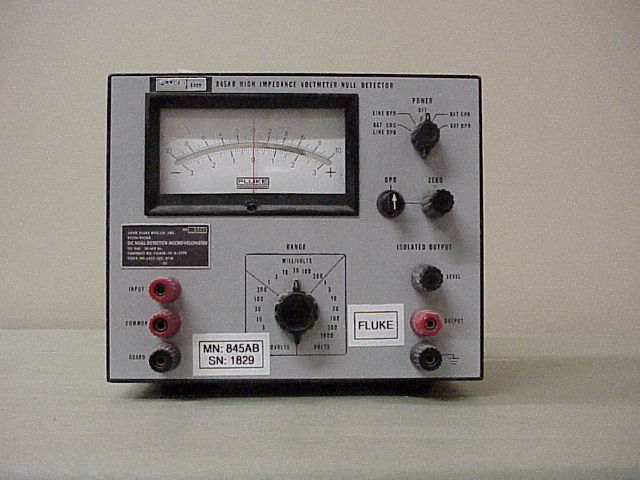
I have such a DC Meter, a Fluke 895A.

It can go up to 1100 Volts from its internal supply to provide an extermely high input resistance at null.

It's meter would deflect indicating the change and direction you move the plates back and forth and you can follow the null for each tiny increment of movement.

Or:

Used with a separate voltage reference.

The Fluke 845AB Null Detector is an all solid-state null detector designed for extremely high input.

Offers 19 ranges from 1 µV to 1000 VDC.
Accuracy of ±2%.
Input isolation is greater than 10E+12 ohms.
Input may be floated to 1100 V above ground and overload protected to 1100 V on all ranges.
Recorder output isolated from input.

The Fluke 845AB Null Detector is an all solid-state null detector designed for extremely high input impedance, sensitivity, and isolation.

Jon

Reply
Guru

Join Date: Apr 2007
Posts: 3531
Good Answers: 59
#114
In reply to #113

Re: Capacitor Charge: CR4 Challenge (03/17/09)

03/23/2009 2:49 PM

You should be able to see trends with that. Personally, I think it would be better to adjust the experiment a little to minimise extraneous trends - and also keep the Voltages down. I'd make the plates about 30-cm x30-cm, and use a separation that varies from about 2-cm to 5-cm.

Reply
Guru

Join Date: Jan 2009
Posts: 1011
Good Answers: 25
#117
In reply to #114

Re: Capacitor Charge: CR4 Challenge (03/17/09)

03/23/2009 3:08 PM

Agree. That would diminish a lot of the outside influences.

Reply
Guru

Join Date: Apr 2007
Posts: 3531
Good Answers: 59
#120
In reply to #117

Re: Capacitor Charge: CR4 Challenge (03/17/09)

03/23/2009 4:34 PM

N.B. I don't have access to the specification for the Fluke meter - do you know the input capacitance? (Even my modified capacitor only varies from about 40-pF down to 16-pF)

Reply
Anonymous Poster
#121
In reply to #120

Re: Capacitor Charge: CR4 Challenge (03/17/09)

03/23/2009 5:26 PM

Just what I posted with the pictures.

I may have the 895a manual buried in my storage.

Reply
Guru

Join Date: Apr 2007
Posts: 3531
Good Answers: 59
#123
In reply to #121

Re: Capacitor Charge: CR4 Challenge (03/17/09)

03/23/2009 6:13 PM

I found the 845AB on the web.
The resistance between the measurement pins is only 100 MegOhm (0.3-Volt range and above). That will give you a time-constant of only about 2-ms - so unless you have a high-speed control loop (i.e. the reference tracks rapidly) it won't do the job you require.

For convenience you would need an electrometer with a measurement impedance of >1010 Ohm - not just isolation of the measurement pair from ground. (The supports for the plates will also need to be very clean, and the humidity low...)

Reply
Guru
Canada - Member - Toronto, Ontario (South Parkdale On The Lakeshore) Engineering Fields - Marine Engineering - Great Lakes School Of Marine Technology (Owen Sound and Port Colbourne) Technical Fields - Architecture - Private Practice 1976-1990 Technical Fields - Education - Toronto Teachers' College 1971 Technical Fields - Marketing/Advertising - Founding Member Hobbies - Hunting - Founding Member Hobbies - Target Shooting - Founding Member

Join Date: Mar 2006
Location: Toronto Ontario Canada
Posts: 1265
Good Answers: 14
#124
In reply to #97
Find in discussion

Re: Capacitor Charge: CR4 Challenge (03/17/09)

03/24/2009 10:27 PM

Hi, kudukdweller9!

Just don't let old roadapple near that squirrel of yours!

Mark

Reply Off Topic (Score 5)
Power-User

Join Date: Feb 2008
Posts: 124
Good Answers: 24
#90
In reply to #72
Find in discussion

Re: Capacitor Charge: CR4 Challenge (03/17/09)

03/20/2009 11:02 PM

Yes moving the plates closer to 1cm from 10cm results in less voltage between them (once again assuming that the voltage source is first disconnected). The energy discharged will then be smaller than when they were at 10cm.

Reply
Guru

Join Date: Jan 2009
Posts: 1011
Good Answers: 25
#91
In reply to #90

Re: Capacitor Charge: CR4 Challenge (03/17/09)

03/21/2009 1:33 AM

Do you think the current provided to the discharge would also be increased by moving the plates from 10 to 1 cm?

Reply
Guru
United Kingdom - Member - Not a New Member Hobbies - Musician - New Member Hobbies - Fishing - New Member

Join Date: May 2006
Location: Reading, Berkshire, UK. Going under cover.
Posts: 9684
Good Answers: 468
#92
In reply to #91

Re: Capacitor Charge: CR4 Challenge (03/17/09)

03/21/2009 6:33 AM

I can't say what would happen to the current using a spark discharge, but if the plates were discharged through a resistor, Ohm's Law tells us the current would be less. It would, however, take longer to discharge1, as there's the same amount of charge (in Coulombs) in each case.

1 Since, with a non-zero resistance, the discharge is exponential, I'd better add "to the same fraction of the original charge", to avoid complicating things with talk about "longer infinities".

__________________
"Love justice, you who rule the world" - Dante Alighieri
Reply
Power-User

Join Date: Feb 2008
Posts: 124
Good Answers: 24
#93
In reply to #91

Re: Capacitor Charge: CR4 Challenge (03/17/09)

03/21/2009 6:37 AM

The current would depend on the resistance of the medium through which the discharge occurred. Assuming that it was some sort of shorting bar with the same resistance in both cases then the current would reduce in an approximately exponential way in both cases. With a separation of 10cm the current would start off higher (since the initial voltage is higher) but would fall faster over time than with 1cm separation and would not last as long. This is because the sum of the instantaneous current over the period of the discharge equals the total charge which is the same in both cases. Even though the sum of the instantaneous current over the period of the discharge is the same in both cases the sum of the instantaneous power (instantaneous volts X instantaneous current) is higher for the case where the plates are at 10cm separation than at 1cm separation.

Reply
Guru

Join Date: Jan 2009
Posts: 1011
Good Answers: 25
#94

Re: Capacitor Charge: CR4 Challenge (03/17/09)

03/22/2009 4:28 AM

THE ENERGY RELEASED WOULD BE CONTINGENT ON THE CAPACITIVE REACTANCE WHICH IS CONTINGENT ON THE VALUE OF CAPACITANCE WHICH IS CONTINGENT ON THE AREA OF AND THE DISTANCE BETWEEN THE PLATES. THE PLATES IN THIS CASE RECIEVING A 1 COULOMB CHARGE AND THEN BEING MOVED ANOTHER 15 CM APART DECREASING THE CAPACITANCE AND INCREASING THE CAPACITIVE REACTANCE.

THE CHARGE ON THE PLATES HAS TO WORK THROUGH THIS INCREASED CAPACTIVE REACTANCE DURING THE EXTREMELY RAPID DISCHARGE.

FOR EXAMPLE:
A CAPACITANCE OF 5.0E-06 F FORCED TO DISCHARGE AT A RATE OF 1.59E-07 SECONDS PRODUCES A CAPACITIVE REACTANCE OF 0.03185 OHMS.

A CAPACITANCE OF 5.0E-12 F, CAUSED BY INCREASED DISTANCE BETWEEN THE PLATES, FORCED TO DISCHARGE AT A RATE OF 1.59E-07 SECONDS PRODUCES A CAPACITIVE REACTANCE OF 31,847 OHMS.

REACTANCE PLAY AN IMPORTANT PART IN THE CHARACTERISTICS OF ENERGY EXPENDED DURING DISCHARGE.

Reply
Guru

Join Date: Mar 2007
Location: Etherville
Posts: 12362
Good Answers: 115
#95
In reply to #94

Re: Capacitor Charge: CR4 Challenge (03/17/09)

03/22/2009 4:45 AM

DEAR KUDUKDWELLER9, WOULD YOU BE SO KIND AS TO PRESS THE KEY THAT SAYS "Caps LocK". OTHERWISE IT MAKE IT LOOK LIKE YOU ARE SHOUTING, AND IT'S ALSO HARDER TO READ YOUR POST. YOU CAN GET CAPITAL LETTERS, AS AND WHEN REQUIRED, BY HOLDING DOWN THE SHIFT KEY. IT IS CUSTOMARY TO USE CAPITALS AT THE START OF SENTENCES, AND WHEN USING PROPER NOUNS ETC. DO NOT WORRY ABOUT THIS SLIGHT MISTAKE - MY GRAMMAR IS TERRIBLE SO IM IN NO POSITION TO JUDGE - BUT IT WILL HELP IF YOU FOLLOW THE USUAL CONVENTIONS. HOPE YOU DONT MIND MY OFFERING A HELPFUL TIP, IT IS MEANT IN A FRIENDLY WAY

Many thanks

In eager anticipation,

kris

__________________
For sale - Signature space. Apply on self addressed postcard..
Reply Off Topic (Score 5)
Power-User

Join Date: Feb 2008
Posts: 124
Good Answers: 24
#102
In reply to #94

Re: Capacitor Charge: CR4 Challenge (03/17/09)

03/22/2009 8:50 PM

Capacitive reactance applies to AC currents only and varies from infinity at 0 Hz and appproaches zero as the frequency approaches infinity. It has nothing to do with the energy of the discharge of a capacitor. Just look up the definition of capacitive reactance on the web if you don't believe me.

Reply
Guru
Popular Science - Weaponology - New Member Netherlands - Member - New Member Fans of Old Computers - Commodore 64 - New Member

Join Date: Sep 2007
Location: Japan
Posts: 2703
Good Answers: 38
#103
In reply to #102

Re: Capacitor Charge: CR4 Challenge (03/17/09)

03/22/2009 9:12 PM

As long as we do not know the discharge method then i am not sure how much energy is transmitted, i only know that the voltage is larger, if just 2 wires from the plates are connected to each other the spark will happen at different distances between the wires, depending on the starting condition so the energy spark would be the same.

__________________
From the Movie "The Big Lebowski" Don't pee on the carpet man!
Reply
Guru

Join Date: Apr 2007
Posts: 3531
Good Answers: 59
#109
In reply to #103

Re: Capacitor Charge: CR4 Challenge (03/17/09)

03/23/2009 7:16 AM

I think it is reasonable to assume the discharge methods in the two cases are in some sense equivalent.
That could for example be bringing the discharge terminals to the separation at which a spark first occurs, bringing them to the same separation, or moving them until they touch.

In the first case, the spark will quench when the potential falls approximately to a fixed proportion of the original; this corresponds to a fixed proportion of the charge*, and therefore a fixed proportion of the stored energy will be dissipated in the spark.
In the second case, the final Voltage will be the same for both discharges, so a larger proportion of the energy will be dissipated when the capacitor spacing is larger.
In the third case, all the stored energy* is dissipated.

As the stored energy is Q2/(2.C), and the capacitance reduces as the spacing increases, we can see that the stored energy increases - so for all three cases the discharge increases with increasing plate separation.
I would be interested if you could produce a reasonable scenario for which the energies were the same (I suggest you assume that the capacitance changes by a factor of 1.6)

*In both these cases the charge conducted via the spark is unchanged, but the energy is increased.

Reply
Guru

Join Date: Jan 2009
Posts: 1011
Good Answers: 25
#104
In reply to #102

Re: Capacitor Charge: CR4 Challenge (03/17/09)

03/22/2009 11:06 PM

0 Hz is DC.

Capacitive reactance exists when there is a transfer of charge from one plate to the other.

Charging or discharging a capacitor is an ac event as far as the capacitor cares. If you go instantly from +1 Volt to +10 Volts and discharge instantly from +10 Volts to +1 Volt a million times per second it is ac, except that there is no reverse charging, and that satisfies the description of capacitive reactance. It is called undulating dc to avoid confusion. There will be alternating current in the conductor between the plates even though they never completely reverse charge.

In this case there is a high energy as lots of electrons zip through the conductor during the discharge.

Even a single discharge at the same instantaneous rate satisfies the description of capacitive reactance.

With ac if you look at the zero crossing you see maximum charging current at a low voltage. If you look at the peak you will see the maximum dc voltage and little to no current as the cap becomes fully charged. This is also true of a charging cycle using a single dc pulse.

Reducing capacitance by putting more space between the plates and keeping the same electron imbalance decreases its ability to offer as great a discharge due to the decreased attractive force between the plates that generate the flow.

The current produced by a high voltage capacitor of a certain capacitance can be used to instantaneously vaporize a tiny wire because it delivers a very high current for a very short time. That's pretty energetic.

A capacitor with an inversely proportional voltage and capacitance, may just heat it up without burning it. Not so energetic.

They both hold the same coulomb charge but because of their different capacitive reactance they give up their charges differently.

Jon

Reply
Member

Join Date: Feb 2009
Posts: 9
#100

Re: Capacitor Charge: CR4 Challenge (03/17/09)

03/22/2009 7:30 PM

energy will be less because of dielectric (opposing electric field) it takes more charge on the plates to jump the greater distance (smaller capacitance).

Reply
Guru

Join Date: Jan 2009
Posts: 1011
Good Answers: 25
#101
In reply to #100

Re: Capacitor Charge: CR4 Challenge (03/17/09)

03/22/2009 8:33 PM

What dielectric?

True, it takes more charge/voltage on the plates for the bigger jump but no more charge was applied.

The charge on the plates was the same as the original charge before the distance was increased.

Are we looking for a spark distance or how strong of a spark?

"the energy released when discharged will be smaller or bigger than in the first case?"

How do we interpret that?

How do we measure that?

Lets go down to the lab and set up some equipment.

Jon

Reply
Guru

Join Date: Jan 2009
Posts: 1011
Good Answers: 25
#105

Re: Capacitor Charge: CR4 Challenge (03/17/09)

03/23/2009 2:04 AM

Ok, no more fooling around.

Since one plate has a deficiency of electrons and the other plate an excess, a force of attraction exists between them. For the original spacing the charges were in equilibrium. Moving the plates farther apart, as the spacing increases, the force of attraction decreases pulling fewer electrons from within the material of the negative plate to its surface creating an over-abundance of electrons inside the plate.

To compensate, the voltage source would have to move electrons around the circuit, leaving the positive plate with less deficiency and the negative plate with even less excess. But with no battery to compensate, the charge on the plates would decrease and so would the capacitance.

Without the voltage source, it leaves the plates uncompensated so part of the coulomb of charge is lost by migrating back into the material.

The energy released would be smaller.

Jon

Reply
Power-User

Join Date: Feb 2008
Posts: 124
Good Answers: 24
#107
In reply to #105

Re: Capacitor Charge: CR4 Challenge (03/17/09)

03/23/2009 5:16 AM

Hi K9, surely you are still fooling around when you say that Without the voltage source, it leaves the plates uncompensated so part of the coulomb of charge is lost by migrating back into the material. By what mechanism does part of the charge on an isolated plate suddenly disappear? Take the negative plate for example, it has more electrons then protons, it is not negative in one part and positive in other parts so that the result is neutral. While those excess electrons can migrate to different parts of the plate they can't just disapear. When the attractive force due to the greater separation of the plates decreases the electrons which were piled up on that face of the plate just migrate around the plate until their repulsion balances the remaining attraction of the other plate but the plate still has the same charge.

Reply
Guru

Join Date: Apr 2007
Posts: 3531
Good Answers: 59
#110
In reply to #107

Re: Capacitor Charge: CR4 Challenge (03/17/09)

03/23/2009 7:18 AM

Kudos

Fyz

Reply
Guru

Join Date: Jan 2009
Posts: 1011
Good Answers: 25
#111
In reply to #107

Re: Capacitor Charge: CR4 Challenge (03/17/09)

03/23/2009 9:11 AM

Some of the electrons are made unavailable by migrating into the atoms beneath the surface of the plate due to the diminished attraction that was keeping them at the surface.

They are not lost so bringing the plates closer they pop their little heads out again.

That is why the distance between the plates causes a change in capacitance.

This may be where the question of "How many angels can dance on the head of a pin." came from.

Reply
Guru

Join Date: Apr 2007
Posts: 3531
Good Answers: 59
#112
In reply to #111

Re: Capacitor Charge: CR4 Challenge (03/17/09)

03/23/2009 11:15 AM

Buried electrons would not be screened unless there was excess and positive charge to move into the way to screen them. As the net charge does not change, that cannot happen. So, buried or not, they would still retain their full power.

It's the same principle as that it requires the whole mass of the Earth (rather than the bit of groundon which you stand) to provide the gravity that attracts you downwards.

Reply
Guru

Join Date: Jan 2009
Posts: 1011
Good Answers: 25
#115
In reply to #112

Re: Capacitor Charge: CR4 Challenge (03/17/09)

03/23/2009 2:50 PM

How do you equate quantum stuff with electrostatics?

Doesn't a capacitor work the same out in the vacuum of space far from the affects of gravity?

What of the negatively charged (reverse biased) base of the NPN Bipolar Transistor?

Or the IGFET that is not conducting because it can only see the repelling charge of its Gate? (The gate is capacitively isolated from the other elements in the IGFET.)

Or in Thermionic Emission where the grid, being more negative than the heated plate, tells the electrons that are boiling off to stay at home and do dishes or develope a space charge because the influence of positive plate is hidden to them by a nearby negatively charged screen.

Decreased attraction between capacitor plates has this affect too. So some of the electrons that had been gathered at the surface by the initial charge and attractive scent of the nearby positive plate can drop back into the material and be masked from the attractive force of the opposite subatomic gender by the nucleus of their new-found friend.

Yes the little buggers are still there and can pop out when the plates are returned to there initial position.

Jon

Reply
Guru

Join Date: Apr 2007
Posts: 3531
Good Answers: 59
#118
In reply to #115

Re: Capacitor Charge: CR4 Challenge (03/17/09)

03/23/2009 4:28 PM

Transistors (NPN bipolars, IGFEts etc) and thermionic devices are analysed under conditions where there is a circuit that can remove or apply charges from the channel, base or, for that matter grid (after all, this is the situation in which they are of use). This capacitor is a much simpler case than any of those devices, and trying to handle them simultaneously is only liable to confuse communications.

Charges cannot "hide" except by virtue of allowing opposing charges that are attracted to come to the appropriate places to neutralise them*. The way they come to the appropriate places would be by conduction - but we have isolated the plates so there is no opportunity for external charges to arrive and "hide" (usually termed "neutralise") the original charges.

*That is the basis of Gauss's law of electrostatics, which states that "the total electric flux through a closed surface is proportional to the total electric charge enclosed within the surface".

Reply
Guru

Join Date: Jan 2009
Posts: 1011
Good Answers: 25
#116
In reply to #112

Re: Capacitor Charge: CR4 Challenge (03/17/09)

03/23/2009 3:00 PM

Oh, and a positive charge is due to an absence of electrons. like darknes is the absence of light, cold is the absence of heat.

The atomic structures whose electrons have been ripped away now sit around and repel each other and those at the surface are attracted by the cute little angels dancing seductively across the gap.

Reply
Guru

Join Date: Apr 2007
Posts: 3531
Good Answers: 59
#119
In reply to #116

Re: Capacitor Charge: CR4 Challenge (03/17/09)

03/23/2009 4:30 PM

Wilful misinterpretation will doubtless make you new friends.

Reply
Anonymous Poster
#122
In reply to #119

Re: Capacitor Charge: CR4 Challenge (03/17/09)

03/23/2009 5:28 PM

It could happen.

Reply
Reply to Blog Entry Page 2 of 2: « First < Prev 1 2 Last »

Good Answers:

These comments received enough positive votes to make them "good answers".

"Almost" Good Answers:

Check out these comments that don't yet have enough votes to be "official" good answers and, if you agree with them, vote them!
Copy to Clipboard

Users who posted comments:

Anonymous Poster (14); BobD (10); Cyberfool (3); DRFREON (1); Electroman (3); Epke (2); FKIA (1); Haajee (1); hardik makwana (1); icjr (1); ion mihaiu (1); jim35848 (1); JohnDG (7); Kris (3); kudukdweller9 (28); MarkTheHandyman (12); Physicist? (29); rakesh_semwal (11); Skipperknc (1)

Previous in Blog: Explosion: CR4 Challenge (03/10/09)   Next in Blog: Speeding Ticket: CR4 Challenge (03/24/09)

Advertisement
