|
A ritual seemingly for uncreative male lovers (I consider giving chocolate a relationship death stroke), a heart-shaped assortment really gets across that message of "I love that you love chocolate and I remembered."

"It is the east, and Juliet is the sun." via Wikimedia
So where did this tradition come from? And, are there any truths to the rumors of chocolate as an aphrodisiac? We'll answer this and more in the inaugural post of Courtship Chemistry!
Simply, love is a feeling of affection and attachment towards another human. The Ancient Greeks had four different words for love, each representing a different type of affection and attachment. Today we're relegated to one word, but it seems to work just fine.
Biologically, love is explained by three stages according to anthropologist Helen Fisher: lust, attraction and attachment. Lust is the desire to mate and propagate a species, a primal need. Attraction is the systematic determination of what people desire in a partner, often focusing on traits to complement their own. Attachment is the sharing and caring with a partner over a period of time.
Psychologically, love falls into Maslow's hierarchy of needs, where physiological needs and a sense of safety are treasured before the sense of belonging offered by love. By achieving this third step in the hierarchy, the two proceeding steps should become easier to sustain since another individual is considerate of mutual needs. Interestingly, the need for love and belonging can supersede the previous steps in the hierarchy once it is achieved, as evidenced by when people remain with abusive partners.
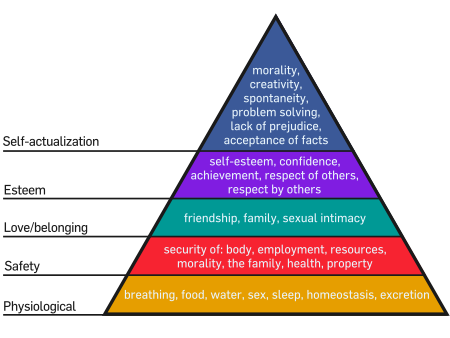
via Wikimedia
What is Valentine's Day? Where did it come from?
While it is colloquially Valentine's Day, it is more accurately Saint Valentine's Day, which celebrates the lives of two Christian martyrs: Valentine of Roma and Valentine of Terni. Both of these individuals were killed in Third Century Rome and were persecuted for their religious beliefs.
Here is where history becomes a bit more muddled however, as broken records keep the two Valentines indistinct. Roman Emperor Claudius II passed a law prohibiting marriage for young men, thereby eliminating a main distraction for his soldiers. One of these Valentines continued to perform marriages despite this new edict. This Valentine was jailed and scheduled to be executed. Whilst awaiting the sentence, Valentine met a young blind woman that he returned sight to with his affection. His last correspondence with his beloved was a note signed "From your Valentine." February 14 was the day of his interment, which coincided with a traditional Roman festival of fertility. Rome later became a Christian empire and it was then safe to celebrate Valentine's death and commitment to love.
I should note this is hearsay, and excluding two Valentines and a Roman festival of fertility, these rumors are impossible to verify.
Cupid's work goes unrewarded... via MWLN
Why is it customary to give chocolate on Valentine's Day?
While cacao was used by indigenous South Americans as early as 1400 BC, it was primarily drunk and fermented into alcohol. The Mayan and Aztec civilizations incorporated chocolate into their diets regularly and the Aztecs even sacrificed chocolate to their goddess of fertility, Xochiquetzal. (Are you beginning to see a connection here?)
Thanks, but no thanks. via Bailey's Chocolate Bar
When Spain began to colonize the Americas, they imported cacao by the ship-full. It remained a decadent, valuable and luscious commodity, so it made sense to gift it to women of romantic interest.
That standardized, glossy heart-shaped box was first produced by the Ganong Company in New Brunswick in 1932, though it was originally released as a Christmas gift. When consumers began requesting the product during Valentine's Day, Gonong changed their production schedule. The chocolate gift sets became especially popular after World War II during the 'baby boomer' years.
The tradition [in my opinion, regrettably] continues today.
So, probably the real reason my reader that you've stuck around this long...
Is chocolate an aphrodisiac?
There seems to be a lot of debate in the scientific field as to how much of an arousing effect chocolate can have. There is no debate however, of pleasure inducing chemicals being found within chocolate.
Phenyl ethylamine (PEA) is an occurring chemical in chocolate and is also found in methamphetamine. PEA is made naturally in the brain and is released when people fall in love or have an orgasm. Furthermore, tryptophan (yes, that sleepy chemical) is also organically present in chocolate. Tryptophan is an essential building block for serotonin, another chemical directly linked to sexual arousal. Finally, anandamide binds with cannabinoid receptors, creating euphoria and a sense of well-being.
I don't know if you've followed this, but chocolate seems like a legitimate drug. However, scientists conclude that there are such insignificant amounts of these chemical in chocolate, that a person is unlikely to feel any physiological effects. These chemicals, especially when combined with the sugar rush, caffeine and theobromine also present in chocolate, typically results in a physiological high, but with no sexual potency.
A May 2006 study by Italian scientists concludes similarly, stating there is no direct correlation between eating chocolate and sexual activity.

NOT an aphrodisiac. via Metro Kids
So guys, there you have it. Save the money on the chocolate and put some real thought into a meaningful Valentine's Day gift. I think that will be a better aphrodisiac.
Resources
NYT - The Claim: Chocolate is an aphrodisiac
eHarmony - Fact or Myth: Chocolate is an Aphrodisiac
Wikipedia - Valentine's Day; Chocolate Holidays
Shippenburg University - Abraham Maslow
| 

 2
2


 Re: As Comes Valentine's Day, There Goes Chocolate


Good Answers:
"Almost" Good Answers: